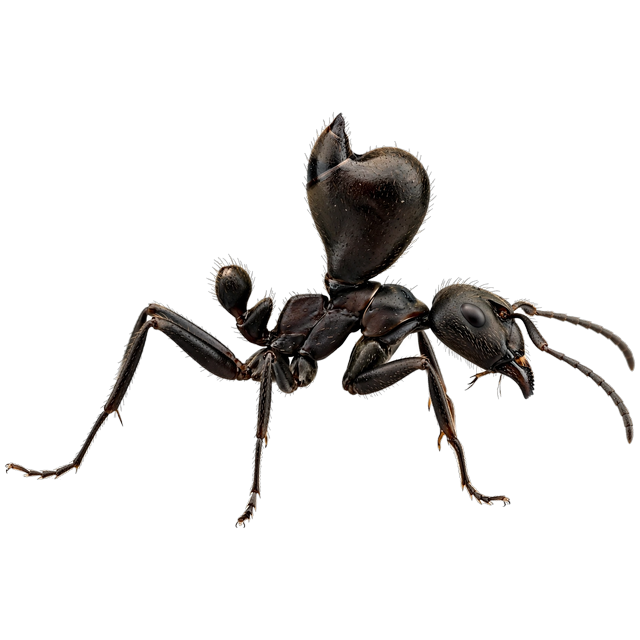
 Acrobat ant
Crematogaster spp. Lund, 1831
Acrobat ant
The ant that does a handstand, raising its heart-shaped abdomen overhead when alarmed.
- Order
- Hymenoptera
- Family
- Formicidae
- Group
- Ants
- Ontario status
- Native, established provincewide
Why it matters
Excavates damp wood and insulation, causing moderate structural damage over time. Often mistaken for carpenter ants, which changes the expected damage pattern.
Origin
Native to North American woodlands; several Crematogaster species occur in Ontario.
Behavior
When disturbed, workers raise their heart-shaped abdomen over their head like an acrobat, the source of the name. Forages in trails, day and night.
Living conditions
Nests in moist or decayed wood, tree cavities, stumps, and in houses: damp window frames, eaves and foam insulation. Likes the same damp wood as carpenter ants.
Signs of presence
- Small dark ants with heart-shaped abdomens, often near damp wood
- Fine frass near nest sites (smaller-grained than carpenter ant frass)
- Ants 'doing handstands' when disturbed
Weaknesses
- Needs damp or decayed wood, dry structures resist it
- Nests are noisy to find: workers are conspicuous when disturbed
- Galleries are smaller and shallower than carpenter ant damage
Myths and facts
Myth All big wood-nesting ants are carpenter ants.
Reality Acrobat ants also nest in wood but are smaller, with a heart-shaped gaster, and their control considerations differ.
Research notes
Morphology
Workers 2.5-4 mm, dark brown to black. Gaster heart-shaped, attached dorsally to the postpetiole and carried raised when alarmed. Two-segmented waist; 11-segmented antennae with 3-segmented club.
Diagnostics
Confirm by the heart-shaped gaster + raised-abdomen alarm posture + nesting in moist wood or insulation.
Easily confused with
- Carpenter ant, Camponotus pennsylvanicus Carpenter ants are much larger (6-13 mm) with a single waist node and rounded thorax; acrobat ants are small with two waist segments and a heart-shaped gaster.
Life cycle
- Adult
- Workers live several months; colonies perennial.
- Egg
- Eggs hatch in ~2-3 weeks at warm temperatures.
- Egg to adult
- ~6-8 weeks at warm temperatures
- Generations per year
- Continuous brood in season
- Nymph or larva
- Legless larvae; naked pupae.
Development
Complete metamorphosis: egg → larva → pupa → adult.
Reproduction
Multiple queens possible; colonies moderate (thousands of workers).
Distribution
- Global
- Worldwide genus; Ontario species native
- Native range
- North America (varies by species)
- Ontario
- Native; established provincewide
Ecology
Arboreal and wood-nesting; excavates galleries in moist/decayed wood and foam insulation. Omnivorous; tends honeydew-producing insects. Defensive gaster-flagging with repellent secretions.
Resistance
No published data.
IPM implications
Moisture-damaged wood is the common denominator, inspection should target the same damp-wood sites as carpenter ant work, but expect smaller, shallower galleries and foam-insulation nesting. The alarm posture makes workers conspicuous during inspection, aiding nest location.
Chemical ecology
Dufour's gland secretions used defensively during gaster-flagging; trail pheromones guide foraging.
Genetics and DNA
No reference genome for Ontario Crematogaster species published as of 2026.
Taxonomy
Order Hymenoptera, family Formicidae, subfamily Myrmicinae, genus Crematogaster. Multiple species in Ontario; treated here at genus level.
Open questions
Species-level identification of Ontario structural records; insulation-nesting frequency in modern construction.
References
- Hölldobler, B. & Wilson, E.O. 1990, The Ants, Harvard University Press
- Mallis Handbook of Pest Control