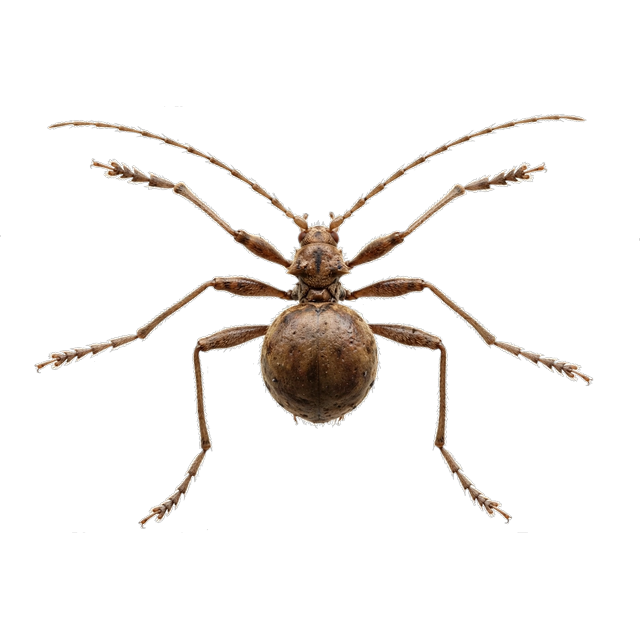
 American spider beetle
Mezium americanum (Laporte, 1840)
American spider beetle
A beetle that looks like a tiny spider, it can't fly, lives for over a year, and eats almost any spilled crumb.
- Order
- Coleoptera
- Family
- Ptinidae
- Group
- Stored-product beetles
- Ontario status
- Established, scattered in Ontario mills, warehouses, and older buildings; scavenger of spilled product
Why it matters
More a sanitation indicator than a major economic pest, its presence signals long-undisturbed food accumulations. Also a minor pest of museums (feeds on specimens).
Origin
Old World origins; now a cosmopolitan warehouse scavenger spread by commerce.
Behavior
Cannot fly, it walks everywhere on long spidery legs. Nocturnal and secretive; adults live an unusually long time for a stored-product beetle, over a year.
Living conditions
Dark, undisturbed places with spilled food, under pallets, in wall voids, in grain dust, in old pantries. Eats grain, flour, wool, dead insects, even its own shed skins.
Signs of presence
- Tiny spider-like beetles (1.5-3.5 mm) in dark corners of pantries or warehouses
- Beetles in old, undisturbed stored product
Weaknesses
- Flightless, cannot disperse far on its own
- Slow breeder compared with other pantry beetles
- Depends on undisturbed accumulations; thorough cleaning removes its habitat
Myths and facts
Myth It's a tick or a spider.
Reality The long legs and round body fool people, but it has six legs and antennae, unmistakably a beetle under magnification.
Research notes
Morphology
1.5-3.5 mm, reddish-brown, globular abdomen, long slender legs and antennae, giving a spider-like appearance. Apterous (wingless). Body covered in fine hairs; elytra fused.
Diagnostics
Spider-like habitus + flightlessness + stored-product habitat = spider beetle; Mezium americanum confirmed by the smooth globular elytra and size.
Easily confused with
- Whitemarked spider beetle, Ptinus fur Ptinus fur has patches of white scales on the elytra; Mezium americanum is uniformly reddish-brown and more globular.
Life cycle
- Adult
- Exceptionally long-lived, 1+ years
- Egg
- Laid in food debris; hatch in ~2 weeks
- Egg to adult
- 3-6 months depending on temperature
- Generations per year
- 1-2
- Nymph or larva
- C-shaped larvae feed for 2-4 months in debris
Development
Complete metamorphosis: egg → larva → pupa → adult.
Reproduction
Low fecundity (~50 eggs per female); slow population growth.
Distribution
- Global
- Cosmopolitan in commerce
- Native range
- Old World
- Ontario
- Established but scattered; warehouses, mills, older buildings
Ecology
Omnivorous scavenger, grains, dried animal matter, wool, fungi. Long adult life compensates for low fecundity.
Resistance
Unknown, no documented resistance; rarely targeted.
IPM implications
Treat as a sanitation indicator: its presence means food debris has sat undisturbed for months. Deep cleaning of the accumulation resolves most cases; the beetle's slow breeding and flightlessness make it a poor colonizer of well-kept storage.
Chemical ecology
Unknown, pheromone chemistry unstudied in this species.
Genetics and DNA
No reference genome published as of 2026.
Taxonomy
Order Coleoptera, family Ptinidae, subfamily Ptininae (spider beetles). Genus Mezium; globular flightless body is the subfamily hallmark.
Open questions
Population genetics of a flightless cosmopolitan, how does it disperse globally with such limited mobility?
References
- Hagstrum, D.W. & Subramanyam, B. (2006). Fundamentals of Stored-Product Entomology. AACC International.