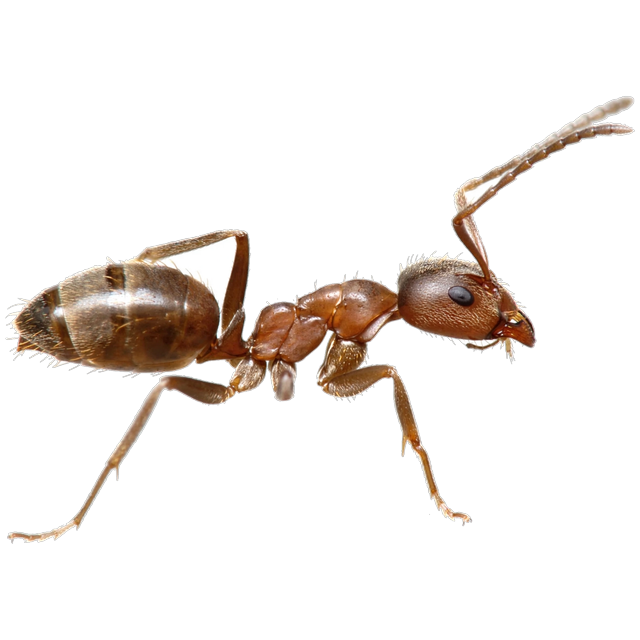
 Argentine ant
Linepithema humile (Mayr, 1868)
Argentine ant
A small brown ant that forms massive supercolonies, dominant in California homes.
- Order
- Hymenoptera
- Family
- Formicidae
- Group
- Ants
- Ontario status
- Not established in Ontario, dominant household ant in California and the Gulf Coast US
Why it matters
One of the world's worst invasive species, displaces native ants across entire landscapes and disrupts ecosystems. In homes it's a relentless kitchen invader; in agriculture it protects honeydew pests.
Origin
Native to the Paraná River basin of South America (Argentina, Paraguay); shipped worldwide in soil and plants, now on six continents.
Behavior
Forms foraging highways, dense trails of thousands of workers. Unlike most ants, neighboring nests don't fight; they merge into supercolonies spanning entire regions.
Living conditions
Nests in shallow soil, under stones, in mulch, wall voids and potted plants. Loves moisture and honeydew, tends aphids and scale insects for their sugary secretions.
Signs of presence
- Dense, fast-moving trails along baseboards and pipes
- Ants tending aphids on garden plants
- Nests under stones, in mulch, in potted plants
- No fighting between ants from different nests, all one colony
Weaknesses
- Not established in Ontario, cold winters are the barrier
- Workers are tiny and desiccate quickly in dry air
- Dependent on honeydew and moisture; drying a site out weakens it
- Colonies are diffuse, but every fragment needs queens and moisture to survive
Myths and facts
Myth Kill the queen and the colony dies.
Reality There are hundreds of queens per colony, and spraying workers just makes the colony split into more colonies.
Myth They're just like regular ants.
Reality The supercolony, millions of workers, hundreds of queens, zero internal aggression, has no equivalent among native ants.
Research notes
Morphology
Workers monomorphic, 2-3 mm, slender, dull light-to-dark brown. Twelve-segmented antennae without a club; single upright petiolar scale; no sting; sparse erect hairs. Queens ~4-6 mm.
Diagnostics
Confirm by size (2-3 mm) + dull brown + single upright petiolar scale + lack of aggression between nests + trailing behavior. No coconut odor.
Easily confused with
- Odorous house ant, Tapinoma sessile Similar size but emits a rotten-coconut odor when crushed; Argentine ant has no such odor.
Life cycle
- Adult
- Workers live weeks to months; queens live a year or more.
- Egg
- Tiny white ovals tended by workers; hatch in ~2-4 weeks.
- Egg to adult
- ~6-8 weeks at warm temperatures
- Generations per year
- Continuous in warm climates, colonies grow year-round
- Nymph or larva
- Legless larvae fed by workers over ~3-6 weeks.
Development
Complete metamorphosis: egg → larva → pupa → adult.
Reproduction
Polygynous, hundreds of queens per colony, each laying; colonies reproduce by budding (queens plus workers walk to new sites).
Distribution
- Global
- Six continents; Mediterranean climates, California, southeastern US
- Native range
- Paraná River basin, South America
- Ontario
- Not established, winters too cold
Ecology
Unicoloniality arises from reduced cuticular-hydrocarbon diversity in introduced populations, nestmates are recognized as kin across kilometers. Dominates by numerical superiority and interference competition; mutualism with honeydew producers.
Resistance
Insecticide resistance reported in some populations; bait aversion (behavioral resistance) documented.
IPM implications
Colony budding means disturbance-based tactics backfire, killing foragers fragments the colony into more colonies. Monitoring follows honeydew sources (aphids/scale on vegetation), since carbohydrate supply drives colony growth; bait logic must account for hundreds of queens, not one.
Chemical ecology
Trail pheromones from the pygidial gland organize mass foraging; cuticular-hydrocarbon homogenization underlies the loss of inter-nest aggression.
Genetics and DNA
Draft genome published 2011, one of the first ant genomes; noted reduced immune-gene diversity consistent with unicoloniality (Smith et al., PNAS).
Taxonomy
Order Hymenoptera, family Formicidae, subfamily Dolichoderinae. Described by Mayr, 1868. Unicolonial: mutually non-aggressive across vast populations.
Open questions
Genetic mechanisms maintaining unicoloniality; limits of cold tolerance.
References
- Smith et al. 2011, PNAS (genome)
- Hölldobler & Wilson 1990, The Ants
- Silverman, J. & Brightwell, R.J. (2008). The Argentine ant: challenges in urban pest management. Annual Review of Entomology, 53, 231-252.