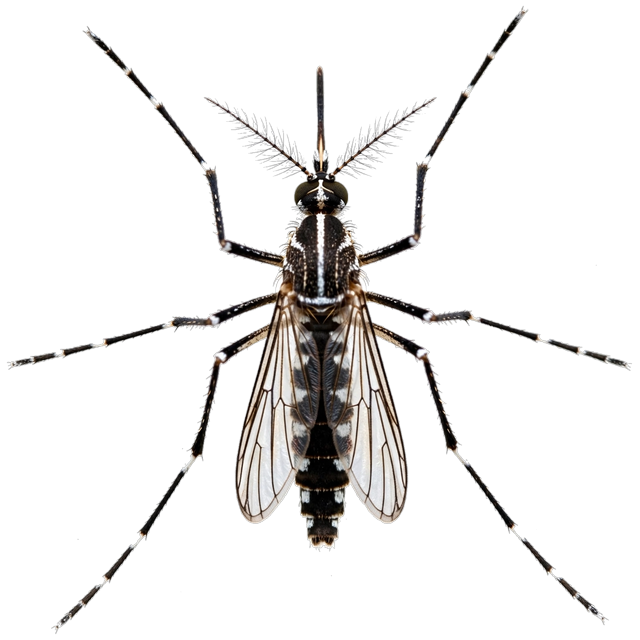
 Asian tiger mosquito
Aedes albopictus Skuse, 1894
Asian tiger mosquito
An aggressive daytime biter with white racing stripes, an invader marching north into Ontario.
- Order
- Diptera
- Family
- Culicidae
- Group
- Mosquitoes
- Ontario status
- Established, Windsor-Essex; expanding
Why it matters
A competent vector of dengue, chikungunya and Zika viruses, diseases not currently circulating in Ontario, but the vector's arrival is the prerequisite public-health event. Also simply one of the most annoying biters on earth.
Origin
Native to Southeast Asia; spread worldwide in used tires and ornamental plant shipments carrying its drought-proof eggs.
Behavior
Aggressive DAYTIME biter, mornings and late afternoons worst. Bites ankles and lower legs. Follows people into shade. Both a city and suburban mosquito.
Living conditions
Breeds in tiny containers: tires, saucers, toys, gutters, tree holes, any small water-holding object. Eggs survive drying for months, waiting for rain.
Signs of presence
- Daytime ankle-biting, unlike the evening Culex
- Black mosquitoes with bold white stripes and banded legs
- Wrigglers in saucers, tires, toys after rain
Weaknesses
- Eggs need containers, a yard with no water-holding junk has almost none
- Weekly dumping of all containers breaks the cycle completely
- Daytime biter, so screens and covered skin work when you're home
- Cold limits it: eggs diapause, but harsh winters still kill many
Myths and facts
Myth It's already everywhere in Ontario.
Reality As of the mid-2020s it is detected at the invasion front (Windsor-Essex interceptions), established pockets, not province-wide. Surveillance is tracking it.
Research notes
Morphology
Adult 3-6 mm; small, black with bold white markings: a single median white stripe on the scutum (dorsal thorax), the field diagnostic, plus white-banded legs and palps. Day-biting habit supports the ID.
Diagnostics
Confirm by: black-and-white pattern, single white scutal stripe, banded legs, aggressive daytime biting, container breeding.
Easily confused with
- Northern house mosquito, Culex pipiens Culex is plain brown, unbanded, and bites at night; Aedes albopictus is boldly black-and-white and bites by day.
Life cycle
- Egg
- Laid singly just above the waterline in containers; survive months of drying; hatch when flooded
- Nymph or larva
- Wrigglers in small containers; 4 instars; develop in days in summer heat
- Adult
- Females bite by day (peaks morning/late afternoon); live 2-4 weeks
- Egg to adult
- Approximately 7-10 days at 25 °C
- Generations per year
- Multiple; diapausing eggs overwinter in temperate zones
Development
Complete metamorphosis: egg (singly, desiccation-resistant) → larva (4 instars) → pupa → adult.
Reproduction
Egg desiccation resistance is the invasion engine: eggs ride out dry seasons and global shipping, hatching on flooding.
Distribution
- Native range
- Southeast Asia
- Ontario
- Invasion front: detections in Windsor-Essex; surveillance ongoing; not yet province-wide
- Global
- Tropical and temperate regions on every inhabited continent, one of the great modern invasions
Ecology
Container specialist; temperate adaptation via photoperiod-induced egg diapause, the trait that unlocked the northern invasion. Vector-competent for dengue, chikungunya, Zika and others. Day-biting shifts human exposure to outdoor daytime hours.
Resistance
Insecticide resistance documented in multiple regions (pyrethroids, organophosphates); monitoring accompanies the invasion.
IPM implications
Container management is the entire strategy: the biology confines breeding to small, findable, removable water-holding objects, systematic yard sanitation (tip, toss, cover) plus community participation, since one neglected yard seeds a neighbourhood. Larval monitoring of containers; adult trapping (BG-Sentinel) tracks the invasion front. This is a surveillance-and-sanitation pest, not a spray pest.
Chemical ecology
Host-seeking by day via vision, CO2 and skin odours; oviposition in containers cued by water and organic volatiles; eggs' desiccation tolerance is physiological, not chemical.
Genetics and DNA
Genome published 2015 (~1.9 Gb, highly repetitive; Chen et al.), invasion genomics an active field.
Taxonomy
Diptera: Culicidae. Aedes albopictus (Skuse, 1894). One of the world's most invasive mosquitoes.
Open questions
The northern overwintering boundary in Ontario under warming winters; competitive displacement dynamics with Aedes aegypti at range edges (not Ontario-relevant) and native container species.
References
- Chen et al. (2015), Aedes albopictus genome
- Kraemer et al. (2015), eLife, global spread mapping
- Ontario public health surveillance, invasive mosquito monitoring