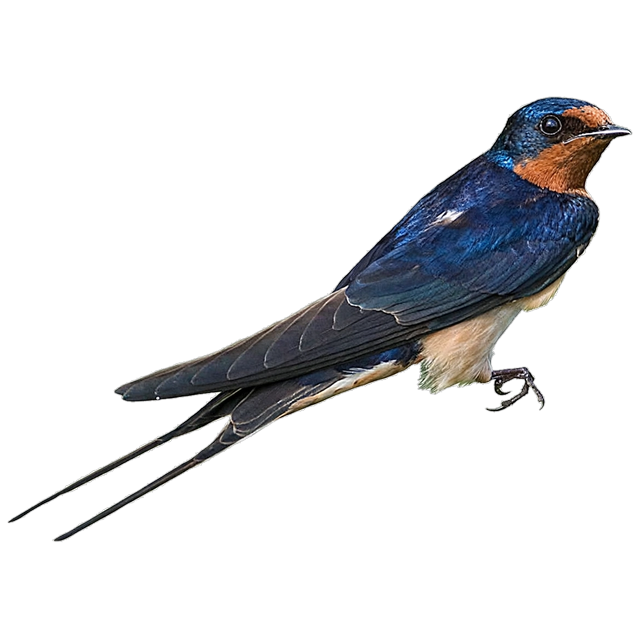
 Barn swallow
Hirundo rustica Linnaeus, 1758
Barn swallow
A graceful swallow with a forked tail that nests in mud cups under eaves.
- Order
- Passeriformes
- Family
- Hirundinidae
- Group
- Birds
- Ontario status
- Established, nests in mud cups under eaves provincewide
Why it matters
A beloved insect-eater, a single family eats thousands of flies and mosquitoes a summer. The conflict is droppings under nests on porches and patios. And critically: barn swallows are Special Concern in Ontario (down-listed from Threatened by COSSARO in 2021), their active nests are protected federally under the Migratory Birds Convention Act and cannot be removed while occupied.
Origin
Native across the northern hemisphere, a bird that moved into human buildings centuries ago and never looked back. Ontario's swallows return from South America every spring.
Behavior
Hawks insects on the wing all day in graceful swooping flight. Builds neat mud cups on vertical walls under overhangs, often in loose colonies. Migrates to South America for winter, gone from Ontario roughly September to April.
Living conditions
Open country near structures: barns, sheds, bridges, and house eaves for mud-cup nests; open fields and wetlands for aerial insect hunting. Needs a mud source (puddles, pond edges) for nest building.
Signs of presence
- Mud-cup nests stuck to walls under eaves, often in rows
- Deeply forked tails flashing over fields on summer evenings
- Mud-gathering at puddle edges in spring
- Chattering, twittering calls around the nest site
Weaknesses
- Completely dependent on human structures for nesting in Ontario, no barns or eaves, no swallows
- Needs accessible mud; paved-over landscapes starve nest building
- Aerial insectivore, insect declines hit it directly
- Long migration (~10,000 km each way) with all its hazards
Myths and facts
Myth You can knock down swallow nests to stop the mess.
Reality Wrong legal basis, right instinct to hesitate: barn swallows were down-listed to Special Concern in Ontario in 2021, so the Ontario Endangered Species Act carries no nest-disturbance offence for them. But active nests are protected federally under the Migratory Birds Convention Act, nests with a live bird or viable eggs cannot be disturbed. Deterrence must happen before building starts, and even that has rules.
Research notes
Morphology
Length 150-190 mm including the deeply forked tail streamers, wingspan 290-320 mm, weight 17-22 g. Steel-blue back, rust-red throat and forehead, pale belly. Outer tail feathers elongated into streamers (longer in males).
Diagnostics
Confirm by: deeply forked tail + steel-blue back + rust throat. Tree swallows share the eaves but have a square-tipped tail and clean white belly; cliff swallows build enclosed gourd-shaped mud nests, not open cups.
Easily confused with
- Tree swallow, Tachycineta bicolor Tree swallow has a notched-but-not-forked tail and nests in cavities and boxes, never in mud cups under eaves.
- Cliff swallow, Petrochelidon pyrrhonota Cliff swallow builds enclosed jug-shaped mud nests in colonies; the barn swallow builds open cups.
Life cycle
- Egg
- Clutch 4-5 speckled eggs; incubation 13-17 days by the female
- Nymph or larva
- Chicks fledge at ~3 weeks; parents feed fledglings for another week
- Adult
- Lifespan 4-8 years typical; strong nest-site fidelity, returns to the same building yearly
- Egg to adult
- Hatch to fledging ~21 days
- Generations per year
- 1-2 broods per year
Development
Oviparous; altricial chicks in a mud-cup nest.
Reproduction
4-5 eggs per clutch × 1-2 broods/year.
Distribution
- Native range
- Holarctic, North America, Europe, Asia
- Ontario
- Breeds provincewide wherever open foraging meets nesting structures; declining
- Global
- The most widespread swallow species on Earth
Ecology
Obligate aerial insectivore, flies, beetles, wasps taken on the wing. Mud-cup nests on vertical surfaces under overhangs; often reuses and repairs the same nest across years. Long-distance migrant: winters in South America. Population declining across the northeast, Special Concern in Ontario (COSSARO down-listing from Threatened, 2021); still listed Threatened on federal SARA Schedule 1 (COSEWIC reassessed Special Concern in May 2021; Governor in Council decision pending).
Resistance
N/A, not a pesticide target species.
IPM implications
THE legal fact first: Special Concern on Ontario's Species at Risk in Ontario List (COSSARO 2021 down-listing from Threatened), Ontario ESA species/habitat offences do not apply, but occupied nests are federally protected under the Migratory Birds Convention Act, 1994: disturbing a nest with a live bird or viable eggs is an offence. Beneficial species regardless: each pair removes thousands of flying insects per season. Monitoring: spring nest-building surveys map the colony. The only lawful lever is pre-season deterrence (netting and ledges before mud pellets appear), and Ontario's recovery strategy favours providing alternative nesting structures over exclusion. Any plan starts with the MBCA, not the technique.
Chemical ecology
Minimal published work; colony and pair coordination is vocal and visual.
Genetics and DNA
Reference genome published: Formenti et al. 2019 (GigaScience), high-quality barn swallow reference genome; VGP bHirRus1 (2021, GCF_015227805.2).
Taxonomy
Passeriformes: Hirundinidae. Hirundo rustica Linnaeus, 1758, the most widespread swallow on Earth.
Open questions
Drivers of the Ontario decline: relative roles of insect loss, nesting-site loss, and conditions on South American wintering grounds.
References
- COSEWIC assessment and Ontario recovery strategy, Barn Swallow (ontario.ca species at risk)
- Brown & Brown, Barn Swallow (Hirundo rustica), Birds of the World, Cornell Lab of Ornithology
- Barn Swallow, Species at risk in Ontario (ontario.ca/page/barn-swallow; status: Special Concern)