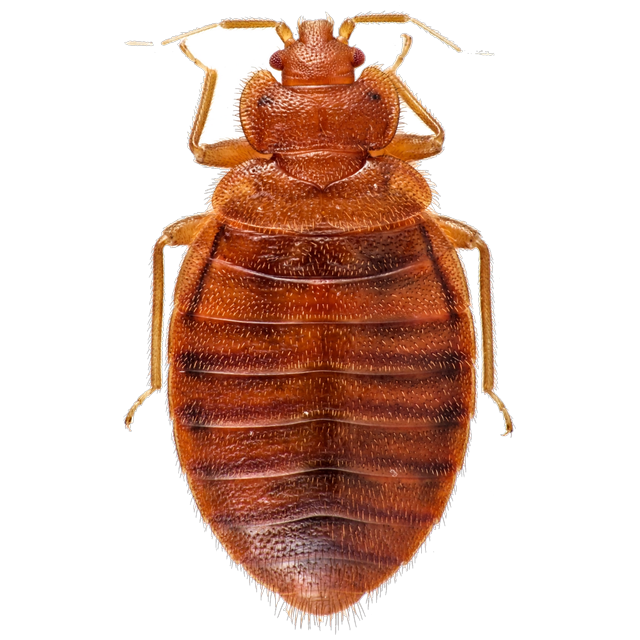
 Bed bug
Cimex lectularius Linnaeus, 1758
Bed bug
The apple-seed-sized night feeder, hiding in mattress seams by day, feeding on sleeping people by night.
- Order
- Hemiptera
- Family
- Cimicidae
- Group
- Bed bugs & relatives
- Ontario status
- Established provincewide; resurgent since ~2000
Why it matters
Does not spread disease, but causes itchy bites, sleeplessness, anxiety and social stigma. Ontario saw a major resurgence starting around 2000, and it remains the most emotionally charged urban pest.
Origin
An ancient human companion, likely moved from bat roosts to human dwellings thousands of years ago in the Middle East.
Behavior
Feeds at night, usually in the hours before dawn, guided by body heat and exhaled carbon dioxide. Hides by day in tight cracks; can survive months without feeding.
Living conditions
Lives within a few metres of where people sleep: mattress seams, bed frames, headboards, baseboards, nightstands. Needs only a sleeping host and a dark crack.
Signs of presence
- Small rusty or dark spots (fecal stains) on mattress seams and sheets
- Tiny white eggs (~1 mm) and shed skins in bed-frame cracks
- Live apple-seed-sized bugs in mattress seams or behind headboards
- Itchy welts in lines or clusters after sleeping
Weaknesses
- Cannot fly or jump, it must crawl to its host
- Must feed on blood to grow and reproduce, no blood, no population growth
- Hides close to the bed, so inspection of the sleeping area finds it
- Dies at sustained high heat (a biological fact, not a DIY instruction)
Myths and facts
Myth Bed bugs mean a dirty home.
Reality They feed on blood, not filth, spotless hotel rooms get them too. Clutter helps them hide, but cleanliness does not prevent them.
Myth Bed bugs spread diseases.
Reality Despite decades of study, bed bugs are not proven vectors of human disease. The harm is bites, sleep loss and distress.
Research notes
Morphology
Adults 4-5 mm unfed, oval, dorsoventrally flattened, reddish-brown; engorged individuals darker and elongated. Wingless (vestigial wing pads). Pronotum with short fringe hairs (shorter than eye width, key vs. bat bug). Rostrum 3-segmented, tucked under head.
Diagnostics
Confirm by apple-seed size/shape + fecal spotting + cast skins + pronotal hair length (shorter than eye width). Smell: sweet-musty 'buggy' odor in heavy infestations.
Easily confused with
- Bat bug, Cimex pilosellus Bat bug pronotal fringe hairs are longer than the eye width; bed bug hairs are shorter than the eye width. Bat bugs associate with bat roosts.
- Swallow bug, Oeciacus vicarius Nearly identical morphologically; swallow bugs associate with bird nests on buildings rather than beds.
Life cycle
- Adult
- Lifespan 6-12 months; adults survive months without feeding (up to ~12 months in cool conditions).
- Egg
- White, ~1 mm, barrel-shaped; female lays ~200-500 in her lifetime, glued in cracks; hatch in ~6-10 days at 21-28 °C.
- Egg to adult
- 5-10 weeks at 21-28 °C; faster near 30 °C, much slower when cool
- Generations per year
- 3-4+ indoors (continuous)
- Nymph or larva
- 5 nymphal instars; each instar requires a blood meal to molt; nymphs translucent, reddening after feeding.
Development
Incomplete metamorphosis: egg → nymph → adult.
Reproduction
Traumatic insemination (male pierces female's abdomen wall). ~200-500 eggs per female lifetime; mating and feeding both required for sustained reproduction.
Distribution
- Global
- Cosmopolitan, the most widespread human ectoparasite
- Native range
- Likely Middle East (with early human settlements)
- Ontario
- Established provincewide; resurgent since ~2000 in all housing types
Ecology
Nidicolous, lives in the host's nest (the bed). Harborage fidelity within metres of the sleeping host; disperses actively through wall voids and passively via luggage, furniture and clothing. Host cues: CO2, heat, odors.
Resistance
Widespread pyrethroid resistance via kdr target-site mutations plus metabolic mechanisms, documented globally including North America. Resistance is the central fact of modern bed bug management.
IPM implications
Monitoring is inspection-led: mattress seams, bed frames, headboards, baseboards within metres of the sleeping host; passive monitors (pitfall interceptors) under bed legs quantify activity. Because every instar needs blood, host removal or sustained heat collapses populations, but reintroduction via belongings is the dominant failure mode, so intake inspection of luggage and secondhand furniture matters. Documented resistance means product efficacy cannot be assumed; resistance testing informs strategy. Clutter reduction is harborage reduction.
Chemical ecology
Aggregation pheromones (histamine and others) mark harborages; alarm pheromones ((E)-2-hexenal, (E)-2-octenal) produce the 'buggy' odor; host location via CO2 and heat.
Genetics and DNA
Genome sequenced 2016; revealed expansions in cuticle and detoxification genes and lateral gene transfer from Wolbachia endosymbiont (Benoit et al., Nature Communications).
Taxonomy
Order Hemiptera, family Cimicidae. Described by Linnaeus, 1758. Obligate hematophagous ectoparasite of humans (and historically bats).
Open questions
Long-term population genomics of the post-2000 resurgence; role of the Wolbachia endosymbiont in fitness and control.
References
- Benoit et al. 2016, Nature Communications (genome)
- Potter, M.F. University of Kentucky Entomology extension (bed bug biology)
- Mallis Handbook of Pest Control