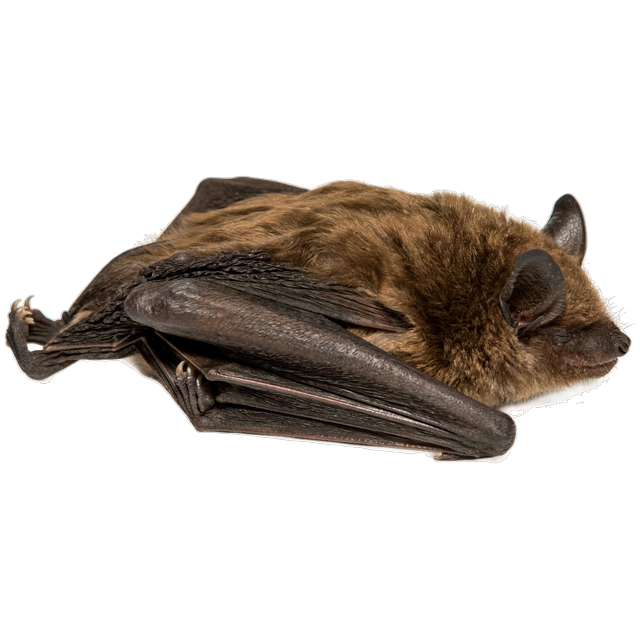
 Big brown bat
Eptesicus fuscus (Palisot de Beauvois, 1796)
Big brown bat
The attic's silent beetle-hunter, eats half its weight nightly.
- Order
- Chiroptera
- Family
- Vespertilionidae
- Group
- Wildlife
- Ontario status
- Native, common; rabies vector species
Why it matters
Guano accumulation and odour in attics; rabies-vector species in Ontario, any bat-human contact is a public-health matter; also a major beneficial insect predator.
Origin
Native across North America; the bat most often found in Ontario buildings.
Behavior
Nocturnal aerial insectivore; echolocates; slow steady flight; loyal to roost sites for years.
Living conditions
Maternity colonies in warm attics and barns (females, summer); hibernates in caves, mines, and cool building voids in winter.
Signs of presence
- Rice-grain-sized droppings (guano) under eaves or in attics, dry and crumbly, unlike mouse droppings
- Chirping and scratching at dusk as the colony exits
- Oily rub marks at small entry gaps
- Bats circling the building at dusk
Weaknesses
- Exquisitely loyal to roosts, colony location is stable year to year
- Cannot take off from the ground, needs a drop to launch
- Hibernation and maternity seasons create predictable absence and presence windows
Myths and facts
Myth Bats are blind and get tangled in hair.
Reality Bats see well and echolocate with centimetre precision, they avoid you far more skillfully than you avoid them.
Research notes
Morphology
Body 11-13 cm, wingspan 32-40 cm; weight 15-26 g. Glossy brown fur, broad nose; large for an Ontario bat.
Diagnostics
Largest common Ontario bat; slow deliberate flight; guano piles and dusk emergence identify the roost.
Easily confused with
- Little brown bat (Myotis lucifugus) Smaller (5-14 g) with faster, erratic flight; the big brown is the heavyweight with steadier wingbeats.
Life cycle
- Egg
- N/A, viviparous (placental mammal)
- Nymph or larva
- Pup: clings to mother, flight at about 1 month
- Adult
- Sexual maturity 1-2 years; lifespan up to 20 years, exceptional for its size
- Egg to adult
- Gestation about 60 days; weaning about 1 month
- Generations per year
- One pup per year (occasionally twins)
Development
Single pup nursed about 1 month; volant (flying) by 4-5 weeks.
Reproduction
1 pup (rarely 2) × 1 litter/year.
Distribution
- Native range
- North and Central America
- Ontario
- Native, common, the most building-associated Ontario bat
- Global
- Americas only
Ecology
Maternity colonies of 20-300 females in warm roosts; hibernates October, April in cool humid sites; diet dominated by beetles; forages within a few km of the roost.
Resistance
Unknown, not applicable.
IPM implications
Exclusion is the entire strategy and it is timing-critical: seal entries only when the colony is absent, never during maternity season when flightless pups are present. One-way exits exploit the nightly foraging behaviour. Bats are protected wildlife; handling and control are licensed activities, and any human contact triggers rabies protocol.
Chemical ecology
Roosts marked by accumulated guano odour and glandular secretions; social cohesion via vocal and olfactory cues. No defensive chemistry.
Genetics and DNA
Reference genome published: EptFus1.0 (2012, GCA_000308155.1); chromosome-level GCF_027574615.1 (2022).
Taxonomy
Order Chiroptera, family Vespertilionidae. Eptesicus fuscus (Palisot de Beauvois, 1796).
Open questions
White-nose syndrome affects this species less severely than Myotis, the resistance mechanism is an active research question.
References
- Animal Diversity Web, Eptesicus fuscus species account (University of Michigan)
- Kurta & Baker (1990), Eptesicus fuscus, Mammalian Species