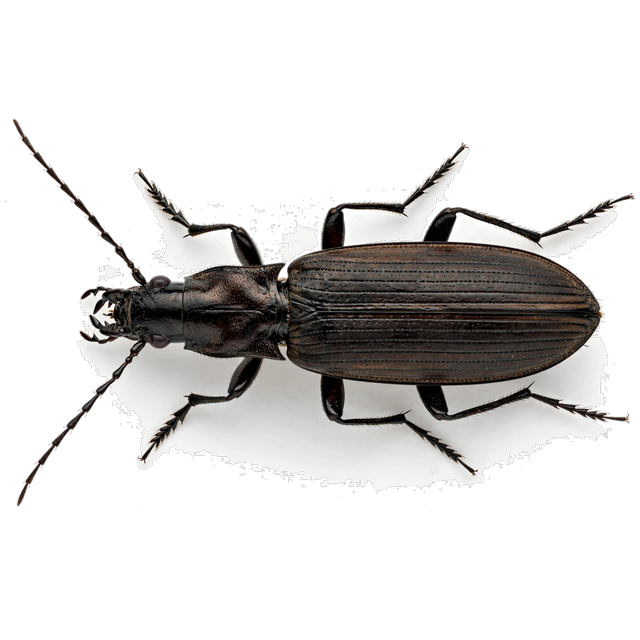
 Black carpet beetle
Attagenus unicolor (Brahm, 1791)
Black carpet beetle
Bigger, darker, and hungrier than its mottled cousins, the larvae can feed for nearly two years on a single wool rug.
- Order
- Coleoptera
- Family
- Dermestidae
- Group
- Fabric & structural beetles
- Ontario status
- Established, widespread in Ontario; the most destructive dermestid of homes and museums
Why it matters
The most damaging carpet beetle in North American homes and museums, larger larvae, longer feeding, tougher diet than Anthrenus species.
Origin
Likely Eurasian; now worldwide in homes and museums.
Behavior
Larvae avoid light and feed for many months, growing to about 8 mm, the largest of the home dermestid larvae. Adults are strong fliers found on windowsills in spring.
Living conditions
Larvae in the same dark places as other carpet beetles, but this species' larvae feed longer and on tougher material, including leather and heavy woolens. Adults also visit flowers.
Signs of presence
- Long (up to 8 mm) carrot-shaped hairy larvae with a tail tuft, in closets or under rugs
- Elongated dark beetles (3-5 mm) on windowsills
- Clean-edged damage to woolens, often in hidden areas (under collars, cuffs, rug edges)
Weaknesses
- Long larval stage means a long window for detection, shed skins accumulate
- Same keratin dependence; no keratin, no beetles
- Adults must exit to flowers; exclusion reduces breeding
Myths and facts
Myth Black carpet beetles bite people.
Reality Neither larvae nor adults bite. The itchy rash some people blame on them is usually irritation from the larval hairs (hastisetae) or an unrelated allergy.
Research notes
Morphology
Adult 3-5 mm, elongate-oval, uniformly dark brown to black, sparsely hairy (no colorful scales). Larva up to 8 mm, carrot-shaped, golden-brown hairs with a distinctive tuft of long hairs at the tail end.
Diagnostics
Uniform dark elongate adult + large carrot-shaped larva with tail tuft = black carpet beetle. The larval tail tuft is the field character.
Easily confused with
- Varied carpet beetle, Anthrenus verbasci Varied carpet beetle adults are smaller, oval, and mottled with scales; black carpet beetle adults are larger, elongate, and uniformly dark.
Life cycle
- Adult
- 2-4 weeks; pollen-feeding, mating, dispersal
- Egg
- Laid in lint, wool, or carcasses; hatch in ~2 weeks
- Egg to adult
- Often 1-2 years in temperate conditions
- Generations per year
- 1 per year, sometimes less
- Nymph or larva
- Larvae feed 6-24 months, exceptionally long; the tail-tufted final instars are the most damaging
Development
Complete metamorphosis; larvae pass through 6+ instars over many months.
Reproduction
Females lay ~50-100 eggs.
Distribution
- Global
- Cosmopolitan
- Native range
- Eurasia (probable)
- Ontario
- Established and widespread; homes, museums, warehouses
Ecology
Scavenger of high-protein animal matter, wool, fur, feathers, leather, dead insects. The long larval stage is an adaptation to patchy, low-quality food.
Resistance
Unknown, no significant documented resistance.
IPM implications
The long larval stage is both the damage and the opportunity: shed skins and frass accumulate, making infestations findable, and the slow cycle means a single thorough cleanout plus reservoir removal (attic nests, dead insects in voids) has lasting effect. In museums, quarantine and freezing of incoming materials.
Chemical ecology
Larval hastisetae (detachable barbed hairs) are a mechanical defense; adult floral visitation mediated by pollen volatiles.
Genetics and DNA
No reference genome published as of 2026.
Taxonomy
Order Coleoptera, family Dermestidae. Genus Attagenus; unicolor = 'one-colored,' for the uniform dark adult.
Open questions
What regulates the extreme plasticity of larval development time (6 months vs. 2 years).
References
- Hinton, H.E. (1945). A Monograph of the Beetles Associated with Stored Products, Vol. 1. British Museum (Natural History).