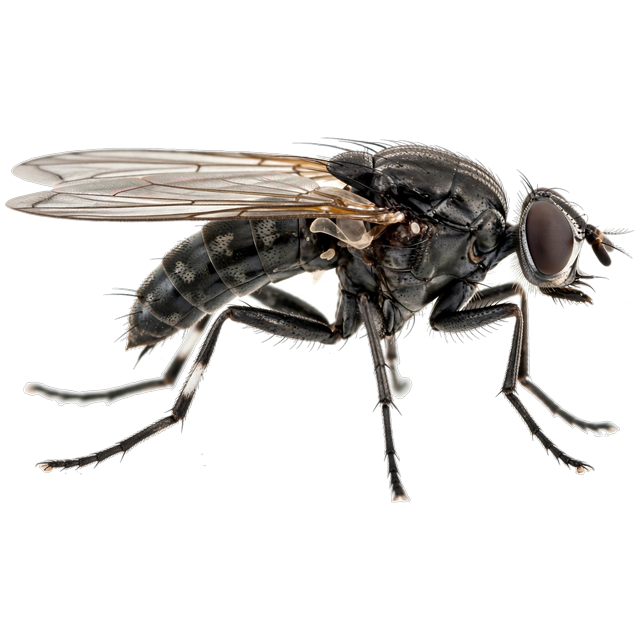
 Black fly
Simulium venustum Say, 1823
Black fly
A tiny humpbacked biting fly, the scourge of Ontario cottage country in spring.
- Order
- Diptera
- Family
- Simuliidae
- Group
- Flies
- Ontario status
- Established, abundant; major spring biting pest in cottage country
Why it matters
Ontario's worst spring biting pest, bites are painful, bleed, and can trigger strong local reactions; livestock and pets suffer too. In the tropics, related species transmit river blindness; in Ontario, the harm is bites and misery, not disease.
Origin
Native across Ontario wherever clean running streams occur, a defining torment of cottage country spring.
Behavior
Daytime biter, worst on calm humid mornings and evenings. Swarms around the head, crawls into hairlines and sleeves. Only females bite, males feed on nectar. Activity collapses in full sun, wind, and after the spring peak.
Living conditions
Larvae need clean, flowing, oxygenated water: streams and rivers. Adults emerge in spring and swarm near breeding waters; females range out seeking blood meals.
Signs of presence
- Swarms orbiting heads near streams in May, June
- Small bleeding punctures at the hairline, ankles, and collar, black fly bites bleed freely
- Itchy welts lasting days
- Larval mats visible on rocks in fast water (for the curious)
Weaknesses
- Larvae absolutely require running water, no flow, no black flies
- Weak fliers: wind and open sunny ground defeat them
- Short adult season: the spring swarm burns out in weeks
- Only females bite, and only for protein to mature eggs, repellents and head nets break the contact
Myths and facts
Myth Black flies bite at night.
Reality They're daytime feeders, dawn and dusk are worst. Night biting is mosquitoes' shift.
Myth They breed in stagnant ponds like mosquitoes.
Reality Opposite: black fly larvae need clean flowing water. Draining a pond does nothing; the stream is the source.
Research notes
Morphology
Adult 2-5 mm, distinctly humpbacked (the thorax arches over the head), dark gray to black. Short broad wings; antennae 11-segmented. Females have blade-like mouthparts for slashing skin, pool feeders, not piercers.
Diagnostics
Confirm by: 2-5 mm humpbacked fly + short antennae + association with running water. Biting midges ('no-see-ums') are smaller (<2 mm) with longer antennae; stable flies are much larger (6-8 mm).
Easily confused with
- Biting midge / no-see-um, Culicoides spp. Midges are under 2 mm with long beaded antennae; black flies are 2-5 mm and humpbacked.
- Stable fly, Stomoxys calcitrans Stable fly is 6-8 mm with a forward-projecting bayonet proboscis; black flies are tiny humpbacked pool feeders.
Life cycle
- Egg
- Laid in masses on rocks and vegetation in fast water; hatch in days
- Nymph or larva
- Aquatic larvae attach to rocks by a silk pad and posterior hooks, filter-feeding with cephalic fans; 2-4 weeks depending on temperature
- Adult
- Lives 2-3 weeks; females need a blood meal per egg batch; males swarm in mating dances
- Egg to adult
- ~3-6 weeks in spring waters
- Generations per year
- Typically 1 per year in Ontario's cold streams; 2 where seasons allow
Development
Complete metamorphosis: egg → larva (aquatic, 6-7 instars) → pupa (aquatic, in a slipper-shaped cocoon) → adult.
Reproduction
200-500 eggs per female per batch; synchronized spring emergence produces the infamous swarms.
Distribution
- Native range
- Northern North America
- Ontario
- Abundant wherever clean running water exists; the defining spring biting pest of cottage country
- Global
- Northern hemisphere; ~2,300 described simuliid species worldwide
Ecology
Larvae are filter feeders and a major food source for trout and other stream fish, black flies are ecologically load-bearing in northern streams. Females are pool feeders: they slash skin and lap the blood pool. Peak adult activity in May, June in Ontario.
Resistance
Unknown for Ontario populations, not a routine pesticide target; larval control uses bacterial agents in managed programs.
IPM implications
Biology-first: the larval habitat is the entire program, flowing streams cannot be 'source-reduced' the way containers can, so management is personal protection (head nets, repellents, timing) and, in managed programs, targeted larval treatments by licensed operators. Monitoring: adult landing counts and larval rock sampling. No backyard breeding site exists to eliminate, set expectations accordingly.
Chemical ecology
Host-seeking driven by CO₂, body heat, sweat volatiles, and dark visual contrast. Larval silk and aggregation on optimal substrates.
Genetics and DNA
No reference genome published as of 2026.
Taxonomy
Diptera: Simuliidae. Simulium venustum Say, 1823, the S. venustum species complex ('venustum' = Latin for charming).
Open questions
Species-complex boundaries within S. venustum in Ontario; climate-driven shifts in emergence timing.
References
- Adler, Currie & Wood (2004) The Black Flies (Simuliidae) of North America, Cornell Univ. Press
- Health Canada, black fly biology and personal protection guidance