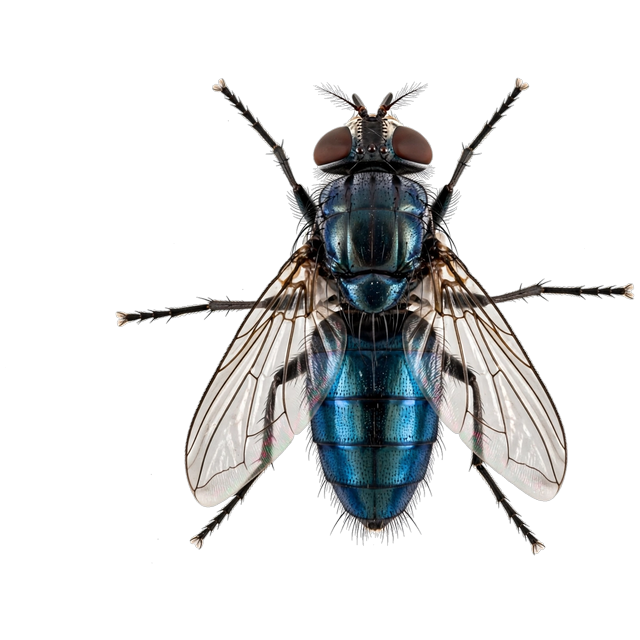
 Blue bottle fly
Calliphora spp. Robineau-Desvoidy, 1830
Blue bottle fly
Big metallic-blue flies that arrive within minutes wherever meat or a dead animal is decaying.
- Order
- Diptera
- Family
- Calliphoridae
- Group
- Flies
- Ontario status
- Established, common
Why it matters
Can carry germs from garbage and carrion to food. Its real professional importance is forensic: investigators use its predictable development to estimate time of death.
Origin
Native across the northern hemisphere; several closely related species do the same job worldwide.
Behavior
Loud, fast, powerful fliers. Active by day. Often the first insect on a carcass. Indoors, a sudden appearance of many large blue flies usually means a dead mouse, bird or squirrel in a wall void or attic.
Living conditions
Breeds in carrion, dead animals, raw meat, garbage with meat scraps. Females can smell decay from over a kilometre away and arrive within minutes.
Signs of presence
- A sudden indoor emergence of many large metallic-blue flies
- Loud buzzing concentrated near a wall, ceiling or attic area
- Maggots dropping from ceilings or appearing on windowsills
- A sweet-sickly decay odour in the same area
Weaknesses
- Needs carrion or meat waste to breed, remove the dead animal and breeding stops
- Maggots need moist decay; dried carcasses do not support them
- Screens and sealed bins break the cycle completely
- Cold halts development
Myths and facts
Myth Blue bottle flies come from filth in general.
Reality They are carrion specialists. A blue bottle problem indoors almost always traces to a dead animal, not general dirtiness.
Research notes
Morphology
Adult 10-14 mm; metallic blue abdomen; thorax dark with pale hairs. Arista plumose to the tip (vs. house fly, plumose at base only). Basicosta (small scale at wing base) dark, separates Calliphora from Lucilia (yellow basicosta). Loud in flight.
Diagnostics
Confirm by: 10-14 mm metallic blue, arista feathered to tip, dark basicosta. Loud buzzing and carrion association support the ID.
Easily confused with
- Green bottle fly, Lucilia spp. Lucilia is metallic green/copper with a yellow basicosta at the wing base; Calliphora is blue with a dark basicosta.
- Cluster fly, Pollenia rudis Cluster fly is dull grey with golden thoracic hairs and no metallic sheen; it invades in autumn, not around carrion.
Life cycle
- Egg
- Laid in batches on carrion, hatching within 24 hours in warmth
- Nymph or larva
- Maggots feed in aggregations (maggot masses generate heat); 3 instars; full-grown ~15 mm; wander off to pupate in soil
- Adult
- Lives several weeks; feeds on carrion fluids, nectar, and garbage
- Egg to adult
- 10-21 days depending on temperature; as fast as ~10 days at 25-30 °C
- Generations per year
- Multiple; continuous in warm weather, roughly 4-6 in Ontario
Development
Complete metamorphosis: egg → larva (maggot, 3 instars) → pupa (puparium in soil) → adult.
Reproduction
Females lay hundreds of eggs per batch on fresh carrion; first-arriver advantage makes Calliphora dominant on carcasses.
Distribution
- Native range
- Holarctic (northern hemisphere)
- Ontario
- Common throughout; active spring through autumn
- Global
- Temperate regions worldwide
Ecology
Breeding media: carrion, meat waste, garbage. Dispersal: several kilometres. Forensically pivotal, development rates are temperature-calibrated and used worldwide for post-mortem interval estimation. Overwinters as adults or pupae in sheltered sites.
Resistance
Limited documentation; not a primary insecticide target. Some tolerance reported in agricultural settings.
IPM implications
The biology points at the carcass: indoor blue bottle emergences resolve by locating and removing the dead animal (often with odour tracking and inspection of wall voids/attics), then sanitation of the site. Exclusion and sealed waste handling prevent recurrence. Monitoring is visual, sudden adult appearance is itself the signal.
Chemical ecology
Females detect sulfur volatiles (dimethyl disulfide, dimethyl trisulfide) released by decay, the long-range carrion cue. Oviposition follows within minutes of arrival.
Genetics and DNA
Reference genome of Calliphora vicina published 2024 (Sivell et al., Darwin Tree of Life, Wellcome Open Research; 706.5 Mb in 6 chromosomal pseudomolecules, 13,436 protein-coding genes).
Taxonomy
Diptera: Calliphoridae. Genus Calliphora Robineau-Desvoidy, 1830. Ontario species include C. vicina and C. vomitoria.
Open questions
Population-level variation in cold tolerance among Ontario populations; competitive dynamics with Lucilia on shared carcasses.
References
- Byrd & Castner (2010), Forensic Entomology: The Utility of Arthropods in Legal Investigations (CRC Press)
- Fremdt & Amendt (2014), Calliphora development data, primary literature
- UF/IFAS Extension, blow fly biology