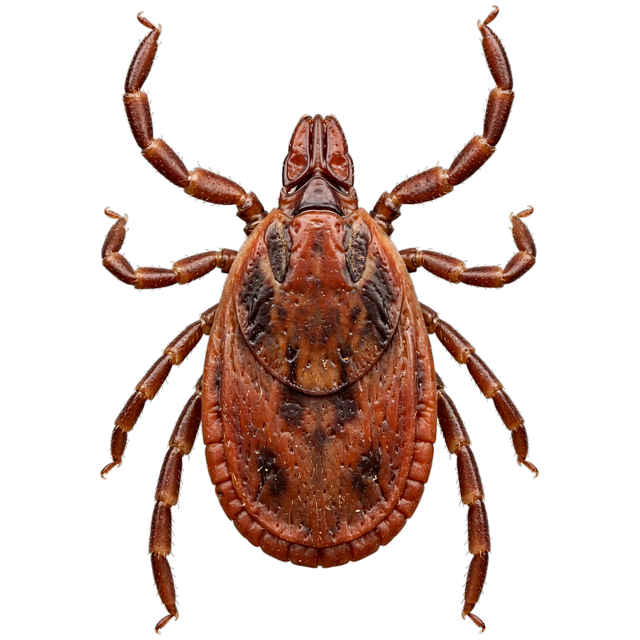
 Brown dog tick
Rhipicephalus sanguineus (Latreille, 1806)
Brown dog tick
A reddish-brown tick that infests homes and kennels in the southern US.
- Order
- Ixodida
- Family
- Ixodidae
- Group
- Ticks & mites
- Ontario status
- Not established outdoors in Ontario, infests homes and kennels in the southern US
Why it matters
The only tick that infests buildings. Heavy infestations drain dogs (anemia), and it vectors canine ehrlichiosis and babesiosis, and in some regions, Rocky Mountain spotted fever in people.
Origin
Tropical/subtropical in origin; now worldwide wherever dogs live, it followed domestic dogs across the globe.
Behavior
Feeds almost exclusively on dogs but bites people when dogs are absent or infestations are heavy. Engorged ticks drop off and crawl upward to molt, often found high on walls.
Living conditions
Where dogs sleep: kennels, homes, dog runs. Uniquely among ticks, it can complete its whole life cycle INDOORS, in wall cracks, under rugs, behind baseboards.
Signs of presence
- Ticks clustered on dogs, especially ears and between toes
- Engorged gray-blue ticks crawling up walls
- Tick casings and eggs in cracks near dog bedding
- Dogs restless or anemic in heavy infestations
Weaknesses
- Cannot survive Ontario winters outdoors, indoor-only here
- Needs dogs (or dense hosts) to sustain a population
- Engorged ticks climbing walls are conspicuous
- Off-host stages hide in cracks, sealing and decluttering kennel areas removes shelter
Myths and facts
Myth Ticks can't live in houses.
Reality This is the one species that can, it completes its entire life cycle indoors.
Myth It's only a warm-climate problem.
Reality Outdoors yes, but heated kennels and homes let it persist anywhere dogs live.
Research notes
Morphology
Unfed adults 3-5 mm, reddish-brown, inornate (no white markings). Hexagonal basis capituli; festoons present. Engorged females swell to ~12 mm, gray-blue.
Diagnostics
Confirm by reddish-brown inornate body + hexagonal mouthpart base (basis capituli) + association with dogs and indoor habitat.
Easily confused with
- American dog tick, Dermacentor variabilis Ornate white scutal patterning and a rectangular mouthpart base; does not infest buildings.
Life cycle
- Adult
- Adults feed 1-3 weeks and mate on the host; females lay one egg mass and die.
- Egg
- Hundreds to thousands laid in cracks near dog resting areas; hatch in ~2-6 weeks in warmth.
- Egg to adult
- ~2-4 months indoors in warm conditions
- Generations per year
- Multiple overlapping generations per year indoors
- Nymph or larva
- Larvae and nymphs feed on dogs (usually), drop off, and molt in cracks.
Development
Egg → larva → nymph → adult; one blood meal per stage, usually on dogs.
Reproduction
Females lay 1,000-4,000 eggs per mass.
Distribution
- Global
- Cosmopolitan with domestic dogs
- Native range
- Tropical/subtropical (probable)
- Ontario
- Not established outdoors; indoor kennel infestations possible
Ecology
Endophilic, uniquely adapted to indoor and kennel microhabitats. Questing is minimal; ticks wait in cracks near dog resting sites. Dogs are the maintenance host.
Resistance
Acaricide resistance (including amitraz and pyrethroid tolerance) documented in some populations.
IPM implications
Monitoring targets dog resting areas and the cracks around them, not vegetation. Because the whole cycle happens indoors, inspection logic is structural: baseboards, crate seams, wall voids near dog beds. Populations grow geometrically in kennels, so early detection via the conspicuous wall-climbing engorged stage matters.
Chemical ecology
Assembly pheromones concentrate off-host stages in cracks near hosts; males produce attractants that draw females to feeding sites.
Genetics and DNA
Reference genome available: NCBI RefSeq GCF_013339695.2 (chromosome-level; from Jia et al., 2020, Cell, large-scale comparative tick genomics).
Taxonomy
Order Ixodida, family Ixodidae. Described by Latreille, 1806. A three-host tick strongly associated with domestic dogs; a species complex currently under revision.
Open questions
Species-complex taxonomy (tropical vs. temperate lineages); molecular mechanisms of acaricide resistance.
References
- Dantas-Torres, F., Rhipicephalus sanguineus reviews, Vet. Parasitol.
- Sonenshine & Roe 2014, Biology of Ticks
- CDC, Tick-borne disease resources