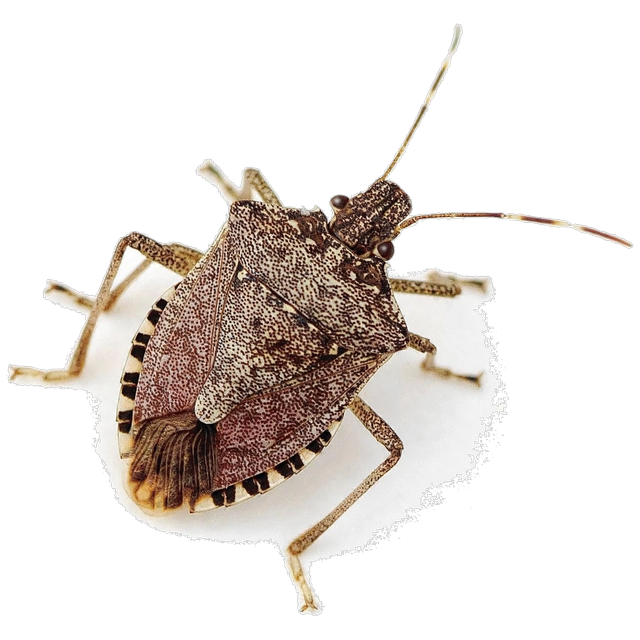
 Brown marmorated stink bug
Halyomorpha halys (Stål, 1855)
Brown marmorated stink bug
An invasive stink bug that invades homes in fall and crops in summer.
- Order
- Hemiptera
- Family
- Pentatomidae
- Group
- Occasional invaders
- Ontario status
- Established invasive, expanding
Why it matters
Two problems in one insect: a serious agricultural pest (apples, peaches, soy, corn, millions in crop losses) and a major household nuisance as an overwintering invader. In Ontario the nuisance side currently dominates; the agricultural side is the growing concern.
Origin
Native to East Asia (China, Japan, Korea). Accidentally introduced to North America, first detected in Pennsylvania in the late 1990s, and now an established, expanding invasive in Ontario.
Behavior
When disturbed or crushed it releases a sharp, cilantro-like defensive odor, the 'stink.' It does not bite people or damage structures; the odor and the sheer numbers are the complaint. Strong flier; active on warm days into late fall.
Living conditions
A plant feeder outdoors in summer on fruits, vegetables, and ornamentals. In fall, adults seek sheltered overwintering sites and pour into homes through tiny gaps, gathering in attics, wall voids, and behind shutters.
Signs of presence
- Shield-shaped brown bugs on walls and window screens in fall
- A sharp, pungent odor when one is crushed or vacuumed
- Bugs emerging indoors on warm midwinter days
- Speckled feeding damage on garden fruits and tomatoes in summer
Weaknesses
- Exclusion before fall: the same late-summer sealing as boxelder bugs
- Its visibility, large, slow, and easy to vacuum up indoors
- Cold: northern winters still limit its range and generations
Myths and facts
Myth The smell is venomous or dangerous.
Reality The defensive aldehydes are a repellent, not a venom. Unpleasant, harmless, and they dissipate.
Myth Vacuuming them makes the infestation worse.
Reality Vacuuming removes them effectively. The odor in the vacuum is temporary, empty it outside and the problem is gone.
Research notes
Morphology
Adults 14-17 mm; mottled brown-gray shield-shaped body; white bands on the last two antennal segments; alternating pale and dark bands on the connexivum (abdominal edge); pronotal margins smoothly rounded, not toothed.
Diagnostics
Antennal white bands + banded connexivum + smooth (untoothed) pronotal shoulders separate it from native lookalikes. Nymphs: early instars orange-red with black; later instars dark with white leg bands.
Easily confused with
- Rough stink bug, Brochymena spp. Native Brochymena has distinctly toothed, jagged pronotal margins; BMSB's shoulders are smooth and rounded.
Life cycle
- Adult
- Overwinters in reproductive diapause in structures and dead trees
- Egg
- ~28 per mass on leaf undersides; hatch in under a week in summer warmth
- Egg to adult
- 6-8 weeks in summer
- Generations per year
- 1 in Ontario and northern range; 2 in warmer regions
- Nymph or larva
- 5 instars over 4-6 weeks in summer
Development
Incomplete metamorphosis: egg → 5 nymphal instars → adult. Barrel-shaped eggs laid in clusters of ~20-30 on leaf undersides.
Reproduction
Sexual; females lay multiple egg masses through summer. Photoperiod triggers adult diapause in fall, synchronizing the overwintering invasion of structures.
Distribution
- Global
- Invasive across North America and Europe; spreading
- Native range
- East Asia, China, Japan, Korea
- Ontario
- Established invasive, first detected early 2010s; expanding, currently concentrated in southern Ontario
Ecology
Extremely polyphagous, 100+ host plants including tree fruits, vegetables, and ornamentals. Native Asian parasitoids (notably the samurai wasp, Trissolcus japonicus, now also adventive in North America) are the key biocontrol research front. Strong flier; disperses kilometers.
Resistance
Documented tolerance concerns are emerging in agricultural settings, but no stable, characterized resistance mechanisms published as of 2026. Monitoring status.
IPM implications
Structural program is exclusion timed to late summer: seal the envelope before fall aggregation flights, screen attic and soffit vents, weatherstrip. Indoors: vacuum and discard, no indoor breeding occurs. Agricultural monitoring uses pheromone-baited traps; management decisions there belong to licensed professionals and growers. Do not recommend crushing (odor, staining), vacuum is the mechanical control.
Chemical ecology
Defensive secretion: trans-2-decenal and trans-2-octenal (aldehydes) from dorsal abdominal glands in nymphs and metathoracic glands in adults. Aggregation pheromone identified as stereoisomers of 10,11-epoxy-1-bisabolen-3-ol (Khrimian et al., 2014), the basis for monitoring lures used in agricultural surveillance.
Genetics and DNA
A 1.15-Gb draft reference genome was published in 2020 (i5K community annotation project; NCBI assembly GCA_000696795).
Taxonomy
Order Hemiptera, suborder Heteroptera, family Pentatomidae (stink bugs). Halyomorpha halys (Stål, 1855).
Open questions
Northern range limits under climate change; efficacy and non-target effects of Trissolcus japonicus releases in Ontario; overwintering survival in unheated Ontario structures.
References
- Penn State Extension, Brown Marmorated Stink Bug (stopbmsb.org)
- Rutgers NJAES, Brown Marmorated Stink Bug Fact Sheet
- USDA APHIS, Brown Marmorated Stink Bug pest alert