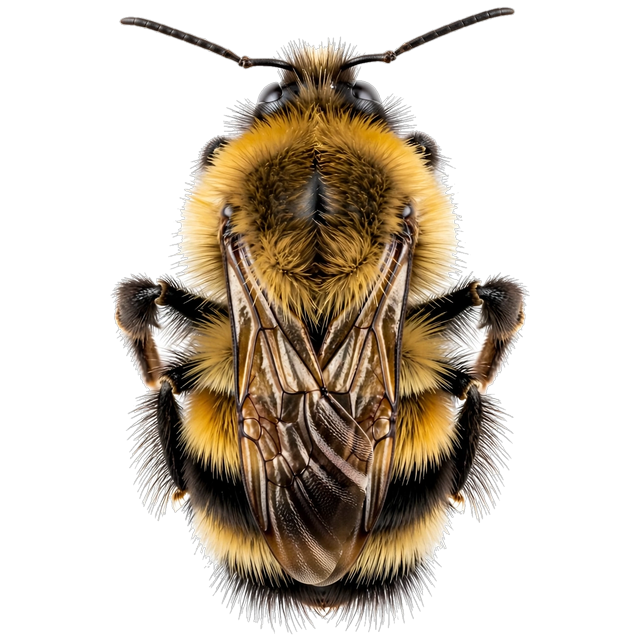
 Bumblebee
Bombus spp. Latreille, 1802
Bumblebee
Big fuzzy native pollinators, including endangered species that need protection, not pest control.
- Order
- Hymenoptera
- Family
- Apidae
- Group
- Wasps, hornets & bees
- Ontario status
- Established, native; some species declining
Why it matters
Premier native pollinators, including buzz-pollination of tomatoes and blueberries that honeybees cannot do. Several species are in steep decline, the rusty-patched bumblebee is endangered in Canada. They are conservation subjects, not pests.
Origin
Native; Ontario hosts roughly 18+ species (18 documented in southern Ontario alone), all wild, none managed like honeybees.
Behavior
Gentle giants: bumblebees are among the least aggressive stinging insects, stinging only if grabbed or their nest is disturbed. Superb cold-weather pollinators, flying when honeybees stay home.
Living conditions
Queens nest in abandoned rodent burrows, grass tussocks, compost piles and bird boxes, small colonies of dozens to a few hundred.
Signs of presence
- Large fuzzy bees working flowers methodically
- A low buzzing from a compost pile or burrow entrance
- Queens foraging in early spring, the year's first big bees
Weaknesses
- Colonies are annual, every nest dies naturally in autumn except the new queens
- Nests are small and hidden; most are never noticed
- They need flowers from spring to autumn, gardens help them
- Pesticide exposure is their real threat, not people
Myths and facts
Myth Big bees near the house must be dealt with.
Reality A bumblebee nest in the compost is a conservation win, not a problem. The colony vanishes by autumn on its own, the kindest 'control' is patience.
Research notes
Morphology
Workers 10-23 mm depending on species and caste; robust, densely hairy ('pile') all over including the abdomen, the anti-carpenter-bee character. Colour patterns (yellow/black/orange bands) are species-diagnostic. Corbiculae present but less developed than honeybees.
Diagnostics
Confirm by: large, round, fuzzy all over (including abdomen), ground/cavity nesting, gentle behavior, annual colony.
Easily confused with
- Carpenter bee, Xylocopa virginica Carpenter bees have a shiny, hairless black abdomen and drill wood; bumblebees are fuzzy everywhere and nest underground.
- Honeybee, Apis mellifera Honeybees are smaller, slimmer, live in perennial hives and dance; bumblebees are bigger, rounder, and their colonies die each autumn.
Life cycle
- Egg
- Overwintered queen lays the first brood in spring in a reused burrow
- Nymph or larva
- Larvae fed pollen and nectar by the queen, then by workers
- Adult
- Colony grows to dozens, hundreds; new queens and males in late summer; colony dies with frost
- Egg to adult
- Approximately 4-5 weeks per brood
- Generations per year
- One colony cycle per year; overlapping worker broods
Development
Complete metamorphosis: egg → larva → pupa → adult. Annual eusocial colony: queen overwinters alone.
Reproduction
Single overwintered queen founds; the colony is an annual investment ending in new queens.
Distribution
- Native range
- Northern hemisphere (native species)
- Ontario
- Widespread; community composition shifting, some species declining
- Global
- Temperate northern hemisphere; also South America
Ecology
Buzz pollination (sonication), unique value for tomatoes, blueberries, cranberries. Forage in cold, rain and low light when honeybees cannot. Declines driven by habitat loss, pesticides (especially neonicotinoids), pathogens spillover from managed bees, and climate change. B. affinis (rusty-patched) listed as endangered in Canada (COSEWIC).
Resistance
Not applicable, conservation subjects; pesticide exposure is studied as a threat, not managed as resistance.
IPM implications
The professional standard is protection: bumblebee nests are never treatment targets. Client education (annual colony, autumn self-resolution, pollinator value) resolves nearly all complaints. Where a nest truly conflicts (e.g., inside a wall at a doorway), the options are seasonal tolerance or careful relocation by knowledgeable handlers, never insecticide. Documenting declining species (with photos, not specimens) contributes to conservation datasets.
Chemical ecology
Queen pheromones regulate colony development; scent-marking of flowers guides foraging; male patrol pheromones at mating sites.
Genetics and DNA
Genomes published for Bombus terrestris and B. impatiens (Sadd et al., 2015, Genome Biology), comparative social-insect genomics.
Taxonomy
Hymenoptera: Apidae. Genus Bombus Latreille, 1802. Ontario species include B. impatiens (common eastern), B. bimaculatus, B. griseocollis; B. affinis (rusty-patched) endangered.
Open questions
Drivers of species-specific declines in Ontario; pathogen spillover dynamics between managed and wild bees.
References
- Sadd et al. (2015), Genome Biology, Bombus terrestris and B. impatiens genomes
- COSEWIC, rusty-patched bumblebee (Bombus affinis) status report
- Colla & Packer, bumblebee declines in eastern North America, primary literature