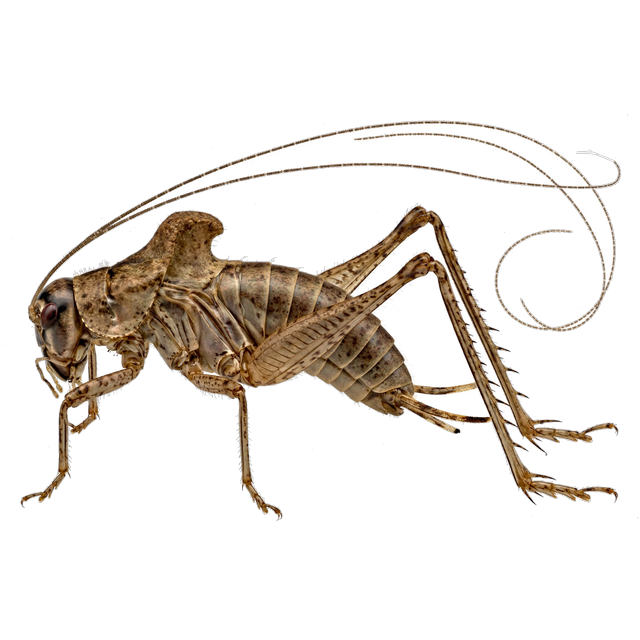
 Camel cricket
Ceuthophilus spp. Scudder, 1862
Camel cricket
The silent humpbacked jumper in your crawlspace, it never sings, it just startles.
- Order
- Orthoptera
- Family
- Rhaphidophoridae
- Group
- Occasional invaders
- Ontario status
- Present, damp basements, crawlspaces, wells; patchy in Ontario
Why it matters
Harmless detritivores that clean up organic debris in places you'd rather not visit. Their real message is about the building: a thriving camel cricket population means a damp, undisturbed void that deserves attention.
Origin
Native to North American forests and caves, your crawlspace is just a concrete cave.
Behavior
Silent, no chirping ever. Hides in dark damp places by day and startles into huge jumps when disturbed. Completely harmless.
Living conditions
Crawlspaces, damp basements, wells, and cellars, the closest thing to a cave in a modern house.
Signs of presence
- Humpbacked silent crickets that jump when the crawlspace light comes on
- Long-antennaed insects in wells, sump pits, and damp storage areas
- No chirping, ever, silence distinguishes them immediately
Weaknesses
- Needs constant dampness, dry the void and they vanish
- Cannot chirp, cannot bite, and rarely damages anything beyond paper and fabrics
- Poor dispersers; each population is confined to its damp void
- Removed with the clutter and moisture they depend on
Myths and facts
Myth They're baby cockroaches or some kind of cave monster.
Reality They're crickets that traded wings and song for life in the dark. Ugly to some, but they eat debris and bother no one.
Research notes
Morphology
Wingless, humpbacked cricket; body ~10-33 mm depending on species (C. maculatus 10-19 mm); antennae as long as or longer than the body; greatly enlarged hind femora for jumping; females with a nearly straight, stout ovipositor; no stridulatory apparatus, no wings.
Diagnostics
Humpbacked, wingless cricket with extremely long antennae + complete silence (no stridulation) + large jumping hind legs. C. maculatus: glossy dark brown with yellowish-brown to reddish-brown spots on thorax and hind legs.
Easily confused with
- Greenhouse camel cricket (Diestrammena/Tachycines spp.) Introduced Asian rhaphidophorids now common in buildings and reported to be displacing native camel crickets in houses; separation from native Ceuthophilus needs a specialist.
- Spiders Long legs and powerful jumps can suggest a spider at a glance; camel crickets have six legs, very long antennae, and a cricket body.
Life cycle
- Adult
- Adults active late summer through fall; lifespan roughly 1-2 years
- Egg
- Eggs deposited in soil, typically in spring; overwinter in the egg or nymph stage depending on species
- Egg to adult
- Nymphs develop through the warm season
- Generations per year
- One
- Nymph or larva
- Nymphs are wingless miniatures of adults; develop through summer
Development
Hemimetabolous (simple metamorphosis), egg to nymph to adult. Females deposit eggs in soil (typically spring); nymphs are wingless miniatures of the adults; all life stages are wingless.
Reproduction
Females deposit eggs in soil.
Distribution
- Global
- North America (genus Ceuthophilus)
- Native range
- North America; C. maculatus in eastern North America
- Ontario
- Present, native; patchy; C. maculatus recorded in Ontario (Vickery & Kevan 1967, Proc. Ent. Soc. Ontario; Vickery & Kevan 1986, Insects and Arachnids of Canada)
Ecology
Nocturnal omnivorous scavenger of organic debris, fungi, roots, foliage, fruits, dead and living insects; in buildings may chew paper goods and fabrics. Moisture-dependent; confined to damp voids.
Resistance
Unknown, not a pesticide target; no documented resistance.
IPM implications
Monitoring by visual inspection of damp voids (no pheromone monitoring exists for this insect). Management is moisture and harborage reduction: dry the crawlspace/basement, remove clutter and organic debris, seal ground-level entries. Indoor individuals are a damp-void signal, not an infestation.
Chemical ecology
No stridulation and no notable defensive chemistry, camel crickets are silent and chemically unremarkable.
Genetics and DNA
No reference genome published as of 2026 (only transcriptomic and mitochondrial data available for the genus).
Taxonomy
Order Orthoptera, family Rhaphidophoridae, subfamily Ceuthophilinae. Ceuthophilus Scudder, 1862.
Open questions
Species-level identification of Ontario indoor records, native Ceuthophilus vs. introduced greenhouse camel cricket (Diestrammena/Tachycines), is unresolved; the northern range limits of the introduced species are poorly documented.
References
- Hubbell, T.H. (1936). A monographic revision of the genus Ceuthophilus (Orthoptera, Gryllacrididae, Rhaphidophoridae). University of Florida.
- Vickery, V.R. & Kevan, D.K.McE. (1986). The Insects and Arachnids of Canada, No. 14: The grasshoppers, crickets, and related insects of Canada and adjacent regions.