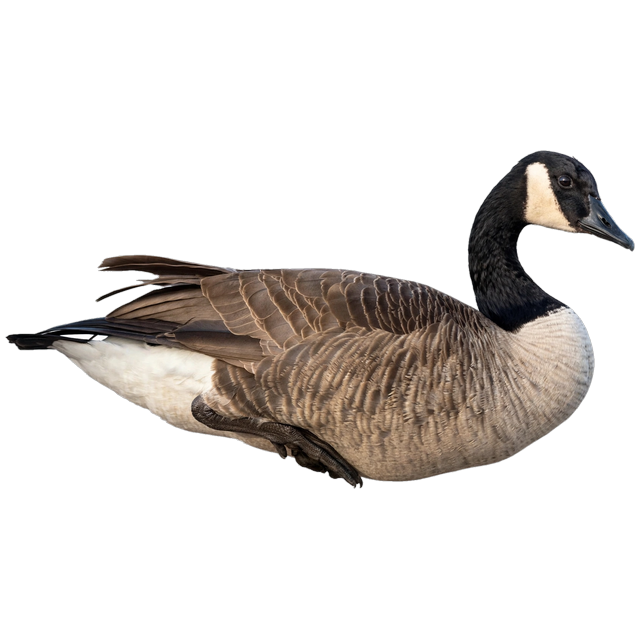
 Canada goose
Branta canadensis (Linnaeus, 1758)
Canada goose
A large familiar goose, a noisy, messy nester on lawns and waterfronts.
- Order
- Anseriformes
- Family
- Anatidae
- Group
- Birds
- Ontario status
- Established, abundant provincewide; major nuisance on lawns and waterfronts
Why it matters
Droppings foul lawns, beaches, and paths (E. coli advisories at swimming areas); aggressive nest defense injures people and pets each spring; grazing damages turf and crops. And critically: Canada geese are PROTECTED by federal law, nests and eggs cannot be touched without a permit.
Origin
Native to North America, this is a Canadian bird, not an import. The giant resident subspecies now living on our lawns descends from mid-20th-century reintroduction programs.
Behavior
Grazes lawns in flocks by day; roosts on water at night. Pairs are strongly territorial around the nest in spring, a nesting goose will confront people and dogs. Resident (non-migratory) flocks stay year-round in southern Ontario.
Living conditions
Short grass near water: lawns, parks, golf courses, waterfronts, storm ponds. Needs open sightlines to spot predators and calm water nearby for night roosting. Hand-fed, mowed landscapes are ideal.
Signs of presence
- Large cylindrical droppings ~75 mm fouling lawns and paths
- Feather drifts and grazed patches on waterfront grass
- Hissing, outstretched-neck confrontations near nests in April, May
- V-formation skeins overhead in spring and fall (migrants, distinct from residents)
Weaknesses
- Grazing-dependent: long grass and unmowed shorelines are far less attractive than manicured lawns
- Needs open sightlines, visual barriers and shoreline planting break up preferred loafing areas
- Flightless for weeks during the summer molt, the one window of genuine vulnerability
- Strong nest-site fidelity cuts both ways: deterred once, pairs often relocate
Myths and facts
Myth Geese are pests, so you can remove nests or eggs.
Reality False and illegal: the Migratory Birds Convention Act protects them. Nest and egg interference requires a federal permit, fines apply.
Myth All Canada geese migrate.
Reality Southern Ontario's problem birds are mostly resident giants that never leave. Scaring 'migrants' away in fall does nothing about them.
Research notes
Morphology
Length 760-1,100 mm, wingspan 1.3-1.8 m, weight 2.6-6.5 kg (resident giants at the top end). Black head and neck with a white cheek patch ('chinstrap'); brown-gray body; black bill and feet.
Diagnostics
Confirm by: black neck + white cheek patch + large size. The cackling goose (Branta hutchinsii) is a small lookalike with a stubby bill and higher-pitched call.
Easily confused with
- Cackling goose, Branta hutchinsii Cackling goose is much smaller (about mallard-sized) with a short stubby bill; Canada goose is large with a long bill and neck.
Life cycle
- Egg
- Clutch 4-7 creamy eggs in a ground nest near water; incubation 25-30 days by the female
- Nymph or larva
- Goslings fledge at 6-9 weeks; family groups stay together through the first winter
- Adult
- Lifespan 10-20+ years in the wild; pairs mate for life; breeds at 2-3 years
- Egg to adult
- Hatch to flight ~6-9 weeks
- Generations per year
- 1 brood per year
Development
Oviparous; precocial goslings, hatch downy and follow parents within a day.
Reproduction
4-7 eggs per clutch × 1 brood/year; high gosling survival in urban settings drives population growth.
Distribution
- Native range
- North America
- Ontario
- Abundant provincewide; resident giants concentrated in southern Ontario cities and waterfronts
- Global
- North America; introduced populations in Europe and New Zealand
Ecology
Grazer of grasses and sedges; needs roughly 0.5-1 kg of forage daily for an adult. Strong pair bonds and nest-site fidelity. Resident populations are non-migratory; northern breeders still migrate through. Molts flight feathers in midsummer, flightless ~4 weeks.
Resistance
N/A, not a pesticide target species.
IPM implications
THE legal fact first: protected under the Migratory Birds Convention Act, 1994, nests, eggs, and birds cannot be harmed or moved without a federal permit from Environment and Climate Change Canada. Monitoring: flock counts and nest mapping in April. Habitat modification is the lawful lever, long grass, shoreline planting, and visual barriers reduce loafing; egg addling or oiling is done only under permit. Any intervention plan starts with the permit question, not the technique.
Chemical ecology
Limited published work; pair-bond and parent-offspring recognition is vocal and visual. Gosling distress calls trigger aggressive parental defense.
Genetics and DNA
No reference genome published as of 2026.
Taxonomy
Anseriformes: Anatidae. Branta canadensis (Linnaeus, 1758), 'branta' from Old Norse for burnt (the black neck); the giant resident subspecies is B. c. maxima.
Open questions
Carrying capacity of urban southern Ontario for resident geese; long-term efficacy of permitted egg-management programs.
References
- Mowbray et al., Canada Goose (Branta canadensis), Birds of the World, Cornell Lab of Ornithology
- Environment and Climate Change Canada, Migratory Birds Convention Act guidance