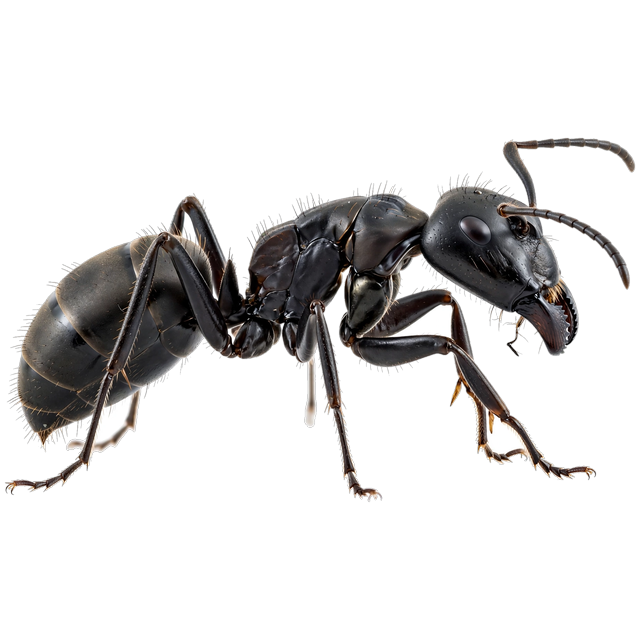
 Carpenter ant
Camponotus pennsylvanicus (De Geer, 1773)
Carpenter ant
Ontario's biggest house ant, it doesn't eat wood, it excavates it, hollowing beams from the inside.
- Order
- Hymenoptera
- Family
- Formicidae
- Group
- Ants
- Ontario status
- Native, established provincewide; principal structural ant pest
Why it matters
The most structurally damaging ant in Ontario, galleries weaken beams, sills and frames over years. It does not sting and rarely bites, but the repair bills are real.
Origin
Native to eastern North American forests, it evolved to nest in dead trees, and our damp houses look like dead trees to it.
Behavior
Mostly nocturnal foragers; you may hear faint rustling in walls at night. Winged swarmers appear in spring. Foraging trails can run many metres from the nest.
Living conditions
Nests in moist or decayed wood: window frames, roof eaves, decks, hollow doors. Needs damp wood to start, then expands into sound wood. Forages indoors for sweets and protein.
Signs of presence
- Large black ants (6-13 mm) indoors, especially at night or in spring
- Piles of fine sawdust-like frass (wood shavings) below nest sites
- Faint rustling or crinkling sounds inside walls
- Winged ants emerging indoors in spring
Weaknesses
- Needs damp or decayed wood to establish, dry, sound structures resist it
- Colonies take years to mature; early nests are small and removable
- Foragers follow trails, which reveal the nest location
Myths and facts
Myth Carpenter ants eat wood like termites.
Reality They excavate wood for nesting and push the shavings out, they do not eat it. The frass piles are the telltale sign.
Myth Seeing a few ants means a small problem.
Reality Foragers are a fraction of the colony; a mature nest can hold thousands of workers plus satellite nests.
Research notes
Morphology
Polymorphic workers 6-13 mm, uniformly black (some with dark reddish thorax). Single node (petiole), thorax evenly rounded in profile (no spines), 12-segmented antennae without club. Queens ~15-20 mm; males smaller, winged.
Diagnostics
Confirm by large size + black coloration + evenly rounded thoracic profile + single node + frass (not mud tubes). Nocturnal foraging supports ID.
Easily confused with
- Field ant, Formica spp. Field ants are smaller, often bicolored, nest in outdoor soil mounds and rarely nest in structures.
- Termite (winged), Reticulitermes flavipes Termite swarmers have straight antennae, broad waist and equal-length wings; ant swarmers have elbowed antennae, narrow waist and unequal wings.
Life cycle
- Adult
- Workers live months; queens can live 10+ years. Colony takes 3-6 years to mature and produce swarmers.
- Egg
- Tiny white eggs laid by the queen; hatch in ~2-3 weeks at warm temperatures.
- Egg to adult
- ~60-70 days at 25-30 °C; slower in cool nests
- Generations per year
- Continuous brood in season; one colony persists for a decade or more
- Nymph or larva
- Legless grub-like larvae fed by workers; pupate in silk cocoons.
Development
Complete metamorphosis: egg → larva → pupa → adult.
Reproduction
Single queen (monogynous) in most colonies; mature colonies produce hundreds of winged swarmers each spring. Colony founding slow, first workers take months.
Distribution
- Global
- Eastern North America
- Native range
- Eastern North America
- Ontario
- Native and common provincewide; the principal structural ant
Ecology
Excavates galleries in moist/decayed wood, expanding into sound wood. Parent colony plus satellite nests (workers only). Nocturnal foraging up to ~90 m along pheromone trails; diet of honeydew, insects, sweets and proteins.
Resistance
Limited published data, not a primary insecticide target; control failures are usually ecological (missed satellite nests) rather than resistance.
IPM implications
Monitoring must locate the nest, not just the foragers, follow nocturnal trails, inspect moisture-damaged wood, and listen for wall activity. Because colonies are polydomous (parent + satellites), eliminating foragers without finding all nests fails. Moisture remediation is the primary long-term lever: dry wood is resistant wood. Frass location is the best nest indicator.
Chemical ecology
Trail pheromones from the hindgut guide foragers; alarm pheromones (formic acid in Formicinae) recruit defenders.
Genetics and DNA
De novo phased diploid genome of C. pennsylvanicus published 2023 (306 Mb, 97.0% BUSCO, nanopore; Faulk, Nucleic Acids Research 2023, 51(1):17-28); the related Camponotus floridanus genome was published 2010 (Bonasio et al., Science).
Taxonomy
Order Hymenoptera, family Formicidae, subfamily Formicinae, genus Camponotus. Described by De Geer, 1773. The black carpenter ant; eastern North America's largest Camponotus.
Open questions
Satellite-nest network mapping in structures; foraging-range variation in urban vs. forest habitats.
References
- Hölldobler, B. & Wilson, E.O. 1990, The Ants, Harvard University Press
- Mallis Handbook of Pest Control
- Bonasio et al. 2010, Science (Camponotus floridanus genome)