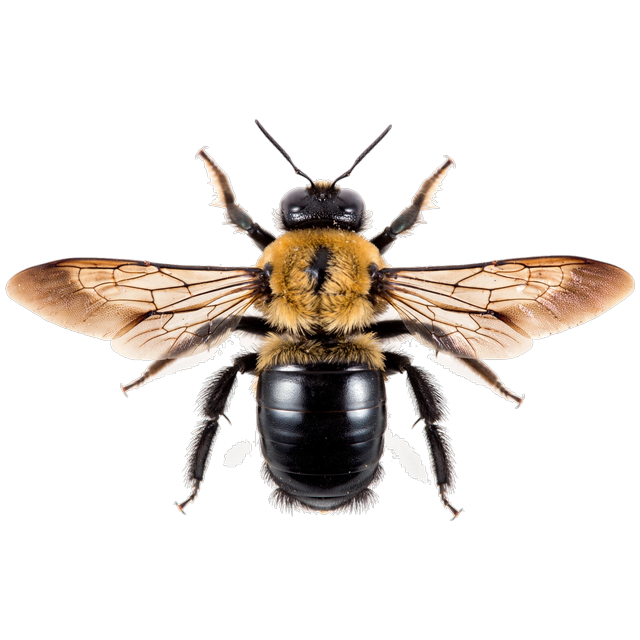
 Carpenter bee
Xylocopa virginica Linnaeus, 1771
Carpenter bee
Big bees that drill perfect round holes in your deck, the noisy males can't sting at all.
- Order
- Hymenoptera
- Family
- Apidae
- Group
- Wasps, hornets & bees
- Ontario status
- Established, native
Why it matters
Cosmetic and minor structural damage to wooden structures from tunnel networks reused and expanded over years. Also important native pollinators, the conflict is real but manageable.
Origin
Native to eastern North America.
Behavior
Males hover noisily around nest entrances, darting at intruders, but males have no stinger at all. Females can sting but rarely do. Often confused with bumblebees.
Living conditions
Excavates nesting galleries in dead wood: decks, eaves, fascia, fences, firewood. Prefers weathered, unpainted softwood.
Signs of presence
- Perfectly round 12-13 mm holes in wood, with sawdust piles below
- Large bees hovering and darting around eaves and decks in spring
- A loud buzzing from inside the wood
Weaknesses
- Painted or stained wood is strongly resisted, finish is prevention
- Existing holes are reused yearly; plugging them in autumn (after bees leave) ends the cycle
- They prefer old softwood; hardwood and pressure-treated lumber resist
- Nesting is in dead wood only, they never eat houses structurally like termites
Myths and facts
Myth They eat wood like termites and will destroy the house.
Reality They excavate nesting tunnels but do not eat wood, and colonies are small. Damage is real over years but never termite-scale.
Myth The big aggressive one will sting me.
Reality The big noisy hoverer is the male, stingless by anatomy. The female is usually inside the tunnel.
Research notes
Morphology
Adult 20-25 mm; robust. Diagnostic: abdomen shiny black and nearly hairless (vs. bumblebee's fuzzy abdomen). Males with a pale/white face patch; females all dark. Entrance holes a precise ~12-13 mm diameter; galleries run with the grain.
Diagnostics
Confirm by: 20-25 mm, shiny bare abdomen, round 12-13 mm holes in wood with frass piles, hovering stingless males in spring.
Easily confused with
- Bumblebee, Bombus spp. Bumblebees are fuzzy all over including the abdomen and nest in the ground or cavities, never drill wood. Shiny abdomen means carpenter bee.
Life cycle
- Egg
- Laid in individual wood cells stocked with pollen balls
- Nymph or larva
- Larvae develop in the sealed gallery cells through summer
- Adult
- New adults emerge in late summer, overwinter as adults in the galleries, and nest the following spring
- Egg to adult
- Several weeks in summer; the full cycle spans a year with adult overwintering
- Generations per year
- One
Development
Complete metamorphosis: egg → larva (in wood cells provisioned with pollen) → pupa → adult. Subsocial: daughters may share the nest.
Reproduction
Females excavate and provision; galleries are reused and extended across years, which is why old damage compounds.
Distribution
- Native range
- Eastern North America
- Ontario
- Common in the south; expanding northward with warming
- Global
- Eastern North America
Ecology
Important native pollinators (buzz pollination of some flowers; nectar-robbing of others via slitting corollas). Nest in dead wood only. Woodpeckers often enlarge the galleries hunting larvae, secondary damage.
Resistance
Not applicable, no insecticide resistance documented.
IPM implications
Wood protection is the strategy, following the nesting biology: paint/stain all exposed softwood (the single best preventive), plug existing holes in autumn after emergence, replace badly damaged boards. Because they are valued native pollinators, the professional standard is exclusion and deterrence first, treatment of active galleries is a last resort at high-conflict sites, timed when bees are out foraging.
Chemical ecology
Males mark territories with pheromones from thoracic glands; females select wood by texture and previous-nest cues.
Genetics and DNA
No reference genome published as of 2026.
Taxonomy
Hymenoptera: Apidae. Xylocopa virginica (Linnaeus, 1771). The eastern carpenter bee; subsocial to solitary.
Open questions
Northward range expansion rate in Ontario; gallery reuse longevity and cumulative structural thresholds.
References
- Gerling et al., Xylocopa biology, primary literature
- Penn State Extension, carpenter bees
- Michener (2007), The Bees of the World (Johns Hopkins UP), taxonomic foundation