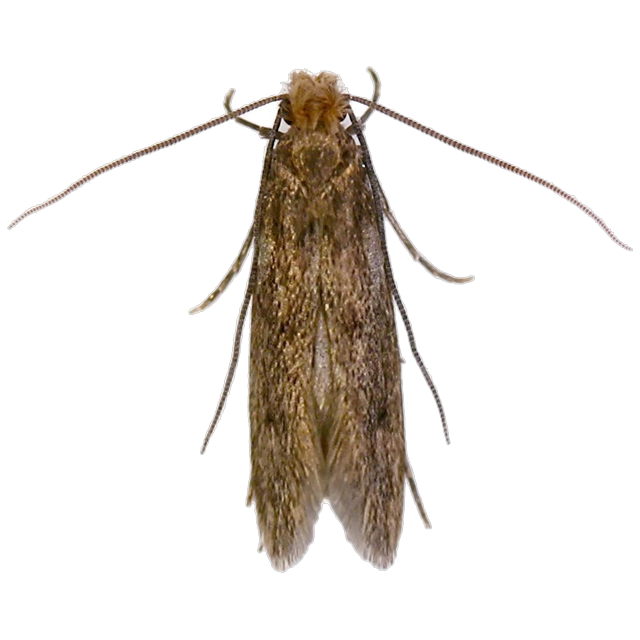
 Casemaking clothes moth
Tinea pellionella (Linnaeus, 1758)
Casemaking clothes moth
A clothes moth whose larvae carry a silken case as they feed on fabrics.
- Order
- Lepidoptera
- Family
- Tineidae
- Group
- Moths
- Ontario status
- Established, indoor fabric pest provincewide
Why it matters
Damages wool, fur, upholstery and carpets; the portable case lets larvae wander and spread damage across garments.
Origin
Old World in origin; spread worldwide with the trade in wool and furs.
Behavior
The larva builds itself a portable silken case, open at both ends, and carries it like a sleeping bag, enlarging it as it grows. It feeds with its head poking out and retreats inside when disturbed.
Living conditions
Same dark, undisturbed places as the webbing clothes moth, closets, storage, under rugs. Larvae eat wool, fur, feathers and silk.
Signs of presence
- Tiny silken cases (~10 mm) resembling grains of rice on fabric or walls
- Holes in woolens and furs
- Larvae retreating into cases when disturbed
- Mottled gray-brown moths in closets
Weaknesses
- Only larvae damage fabric; adults don't feed
- Needs animal fibers, synthetics are safe
- The carried case makes larvae easy to spot once you know the sign
- Heat and prolonged freezing kill all stages
Myths and facts
Myth Those little cases are the eggs.
Reality The case is the larva's portable shelter, the feeding stage itself, not eggs.
Myth Mothballs protect everything.
Reality They only work in sealed containers at full concentration; airy closets get no protection.
Research notes
Morphology
Adults 6-8 mm body, wingspan 12-16 mm; mottled gray-brown forewings with indistinct darker spots. Larva ~10 mm, cream with a brown head, living inside a portable silken case open at both ends, the diagnostic feature.
Diagnostics
Confirm by the carried case (vs. webbing tubes of Tineola) plus mottled adult wings.
Easily confused with
- Webbing clothes moth, Tineola bisselliella Larva spins stationary webbing, no portable case; adult uniformly buff, not mottled.
Life cycle
- Adult
- Lives 2-4 weeks; does not feed.
- Egg
- Laid on keratin; hatch in ~1-2 weeks.
- Egg to adult
- ~2-4 months at room temperature; longer when cool
- Generations per year
- 2-3 indoors per year
- Nymph or larva
- Feeds for 1-3 months (up to a year when cool), enlarging its case as it grows; pupates inside the case.
Development
Complete metamorphosis: egg → larva (case-bearing) → pupa (inside case) → adult.
Reproduction
Females lay ~40-100 eggs.
Distribution
- Global
- Cosmopolitan indoors
- Native range
- Old World (probable)
- Ontario
- Established, indoor fabric pest provincewide
Ecology
Keratin feeder like Tineola; the portable case is predator protection that also enables dispersal between garments.
Resistance
Unknown.
IPM implications
The case is both the diagnostic sign and the monitoring target, cases on walls and ceilings reveal dispersal routes. As with Tineola, control logic is keratin exclusion plus finding the undisturbed breeding material.
Chemical ecology
Sex pheromone monitoring exists; case silk is the larva's engineered microhabitat.
Genetics and DNA
No reference genome published as of 2026
Taxonomy
Order Lepidoptera, family Tineidae. Described by Linnaeus, 1758.
Open questions
Case silk composition and its protective properties.
References
- Ebeling, W. Urban Entomology, UC Riverside
- Mallis Handbook of Pest Control