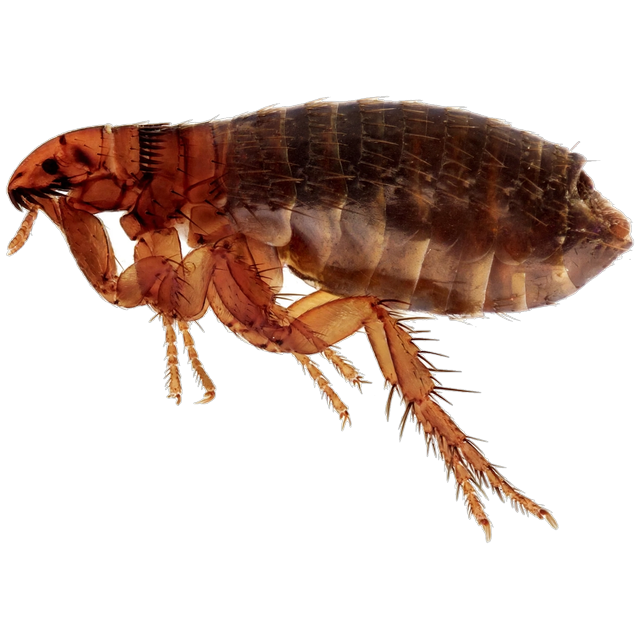
 Cat flea
Ctenocephalides felis (Bouché, 1835)
Cat flea
A tiny wingless jumping insect, the flea most commonly found on cats and dogs in Ontario homes.
- Order
- Siphonaptera
- Family
- Pulicidae
- Group
- Fleas
- Ontario status
- Established, the most common flea on Ontario pets; indoor infestations year-round
Why it matters
Flea bites cause intense itching and flea allergy dermatitis in pets, among the most common skin conditions vets see. Fleas also carry the tapeworm Dipylidium caninum and the bacteria behind cat-scratch disease and murine typhus.
Origin
Despite the name, the cat flea is the most common flea on both cats and dogs worldwide, likely African in origin, now cosmopolitan via pets and human movement.
Behavior
Adults rarely leave the host once aboard; they feed repeatedly. New adults wait in cocoons for vibration, warmth and carbon dioxide, a passing pet or person triggers mass emergence, which is why empty homes can 'explode' with fleas when someone returns.
Living conditions
Adults live on warm-blooded hosts, cats, dogs, and opportunistically people. Eggs, larvae and pupae live OFF the host: in pet bedding, carpets and floor cracks. Larvae need humidity above ~50% and feed on dried blood in adult flea droppings ('flea dirt').
Signs of presence
- Pets scratching, biting at skin, or losing fur
- Black pepper-like specks (flea dirt) in fur, turns reddish on a wet paper towel
- Tiny white eggs falling off the pet into bedding
- Bites around ankles after entering a room where pets rest
- Small dark insects jumping in pet bedding
Weaknesses
- Larvae dry out quickly below ~50% relative humidity
- Immature stages live in the environment, not on the pet, washing bedding and vacuuming removes them
- Unfed adults survive weeks without a blood meal (20-62 days depending on temperature and humidity); females must feed before laying eggs
- Pupae can't be rushed: the cocoon stage waits months, so a single treatment never ends it
Myths and facts
Myth Only the pet needs treatment.
Reality Roughly 95% of a flea population, eggs, larvae, pupae, lives in the home, not on the animal.
Myth Indoor cats can't get fleas.
Reality Fleas hitchhike on clothing, other pets and visitors; indoor-only cats get them regularly.
Research notes
Morphology
Adults 1.5-3.3 mm, reddish-brown, laterally compressed (thin side-to-side, unlike lice). Wingless; hind legs massively enlarged for jumping. Both genal and pronotal combs (ctenidia) present, spine rows that anchor the flea in fur.
Diagnostics
Confirm by lateral compression + jumping + both genal and pronotal combs under magnification. Flea dirt (black specks that bleed red on wet paper) confirms feeding even when no fleas are seen.
Easily confused with
- Dog flea, Ctenocephalides canis Nearly identical; dog flea has a more rounded head and shorter first genal spine, needs microscopy. Cat flea dominates in North America.
- Human flea, Pulex irritans Lacks both the genal and pronotal combs.
Life cycle
- Adult
- New adults stay in the cocoon until vibration, CO2 and heat signal a host, pupal dormancy can last months. Fed adults live weeks to months on a host.
- Egg
- Tiny white ovals (~0.5 mm) laid on the host but falling into the environment within hours; hatch in 2-14 days depending on warmth.
- Egg to adult
- As fast as ~2-3 weeks at 25-30 °C and high humidity; months when cool or when pupae wait dormant
- Generations per year
- Continuous indoors, many overlapping generations per year
- Nymph or larva
- Blind, wormlike larvae (~4-5 mm at maturity) feeding on adult flea feces (dried blood). Three instars over 5-11 days in warm, humid conditions.
Development
Complete metamorphosis: egg → larva (3 instars) → pupa (in silken cocoon) → adult.
Reproduction
Females lay 20-50 eggs per day after their first blood meal, several hundred to over 1,000 in a lifetime, one flea becomes thousands within weeks.
Distribution
- Global
- Cosmopolitan on domestic animals
- Native range
- Probably sub-Saharan Africa
- Ontario
- Established, the most common flea on Ontario pets; indoor infestations year-round
Ecology
Nidicolous, immature stages live in the host's bedding, not on the host. Larvae are negatively phototactic, burrowing into carpet fibers. New adults key on vibration, heat and exhaled CO2 to time emergence.
Resistance
Fipronil tolerance and pyrethroid resistance (kdr-type mechanisms) reported in some populations; resistance status varies regionally.
IPM implications
Monitoring targets the environment, not just the pet: flea dirt in bedding confirms activity. Because pupae are protected in cocoons and emergence is staggered over months, monitoring must continue long after visible fleas disappear, the cocoon stage is the biological reason single treatments fail.
Chemical ecology
Host location relies on carbon dioxide, heat and vibration rather than long-range pheromones; aggregation at feeding sites is host-cue driven.
Genetics and DNA
Chromosome-level genome assembly published 2020 (~433-551 Mb): extensive gene duplication (~38% of protein-coding genes duplicated, >4,000 tRNA genes), genome-size plasticity, two novel Wolbachia strains (Driscoll et al., BMC Biology 2020, 18:70).
Taxonomy
Order Siphonaptera, family Pulicidae. Described by Bouché, 1835. Wingless ectoparasites; the cat flea is the dominant flea of domestic cats and dogs in North America.
Open questions
Genetic basis of regional insecticide tolerance; role of the microbiome in blood-meal digestion.
References
- Dryden & Rust 1994, Annu. Rev. Entomol. (cat flea biology, ecology and control)
- Rust, M.K., UC Riverside flea research program
- Mallis Handbook of Pest Control