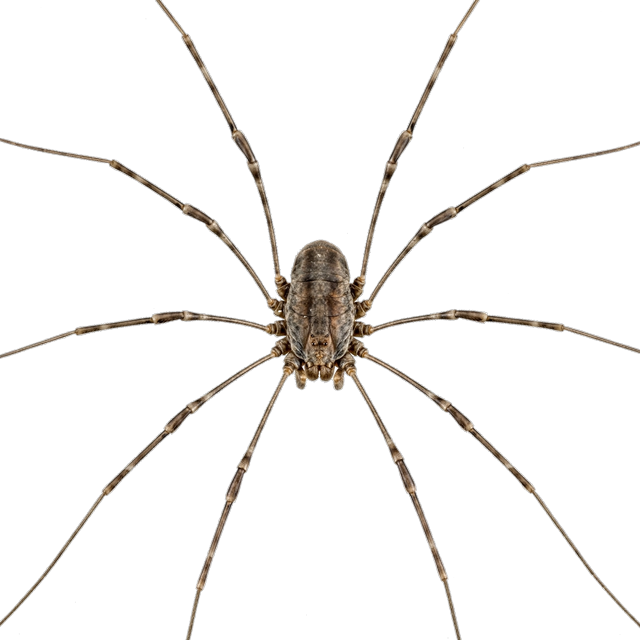
 Cellar spider
Pholcus phalangioides (Fuesslin, 1775)
Cellar spider
The spindly spider that bounces in its web when startled, it hunts and eats other spiders.
- Order
- Araneae
- Family
- Pholcidae
- Group
- Spiders
- Ontario status
- Established, common in basements and cellars across Ontario
Why it matters
It is the spider that eats other spiders, a single cellar spider clears house spiders, and it ignores people completely. Its venom is weak and not dangerous to humans. High numbers just mean your basement is damp.
Origin
Probably subtropical regions originally; now worldwide wherever humans have damp basements.
Behavior
Hangs upside down in its web; when disturbed it vibrates rapidly (blurring itself to confuse predators). Females carry their egg sac in their jaws. Hunts other spiders, including house spiders.
Living conditions
Damp, dim places, basements, cellars, crawlspaces, under sinks, behind stored boxes. Builds loose, messy sheet webs in ceiling corners.
Signs of presence
- Loose, tangled sheet webs in basement ceiling corners
- Spiders with tiny bodies and extremely long legs hanging in the webs
- A spider visibly vibrating its whole web when you approach
- Small clusters of eggs held in the jaws of a female
Weaknesses
- Fragile body, easily damaged and desiccates quickly in dry air
- Needs humidity; dry basements and dehumidifiers drive it out
- Web-bound; vacuuming the web removes both spider and egg sac at once
- Long legs tangle easily, it avoids cluttered, dusty zones it cannot navigate
Myths and facts
Myth Daddy longlegs are the most venomous spiders in the world, but their fangs are too short to bite people.
Reality Two errors in one. The venom is weak, not record-breaking, and true 'daddy longlegs' (harvestmen) are not spiders at all and have no venom. Cellar spiders can bite but the effect is trivial.
Research notes
Morphology
Body length 7-10 mm (small cylindrical cephalothorax and abdomen); leg span up to 50 mm, legs roughly 5-6x body length. Pale gray-brown; eight eyes in two triads plus a pair (distinctive arrangement).
Diagnostics
Unmistakable habitus: tiny body, extremely long thin legs, loose sheet web, web-vibrating behavior. Female carrying egg sac in chelicerae (characteristic of pholcids, though spitting spiders also carry sacs this way) is diagnostic for the family.
Easily confused with
- Harvestmen / daddy longlegs (Opiliones) Harvestmen have a single fused oval body with no waist and spin no webs; cellar spiders have two body segments and live in webs.
- Spitting spiders (Scytodes thoracica) Spitting spiders have a distinctly domed carapace and much shorter legs; they spit glue instead of vibrating webs.
Life cycle
- Adult
- Adults live about 1 year; females may produce several sacs
- Egg
- 20-30 eggs per sac, carried in the female's jaws for 2-3 weeks
- Egg to adult
- Several months at cool basement temperatures
- Generations per year
- 1-2 indoors
- Nymph or larva
- Spiderlings remain near the mother briefly, then disperse
Development
Egg to spiderling to adult through successive molts. Female carries the egg sac in her chelicerae until hatching, unusual maternal care among web spiders.
Reproduction
Low fecundity per sac (20-30 eggs) but high offspring survival due to maternal carrying. Males drum on female webs during courtship.
Distribution
- Global
- Cosmopolitan in human structures
- Native range
- Probably subtropical Old World
- Ontario
- Established in heated, humid buildings province-wide; absent from dry modern interiors
Ecology
Araneophagic specialist, actively invades other spiders' webs and preys on the residents, including spiders larger than itself. Regulates indoor spider communities. Requires relative humidity above ~60% for sustained populations.
Resistance
Unknown, not a pesticide target; no documented resistance.
IPM implications
Monitoring: web counts index humidity problems as much as spider numbers. This species is a biological control asset, removing it often increases house spider numbers. Manage by dehumidification and web vacuuming, not chemicals. Its presence is a diagnostic clue: look for the moisture source.
Chemical ecology
Venom is a simple, low-potency mix effective on small arthropods; proteomic studies show it lacks the mammal-active neurotoxins of widow or recluse venoms. Silk is a non-sticky sheet; prey capture relies on the spider's speed, not glue.
Genetics and DNA
No reference genome published as of 2026.
Taxonomy
Order Araneae, family Pholcidae. Authority (Fuesslin, 1775). Cosmopolitan synanthropic species; taxonomy stable.
Open questions
Venom composition still incompletely characterized; the full native range remains unresolved.
References
- Foelix, R.F. (2011). Biology of Spiders, 3rd ed., Oxford University Press.
- Vetter, R.S., UC Riverside spider-bite myth research (various publications).