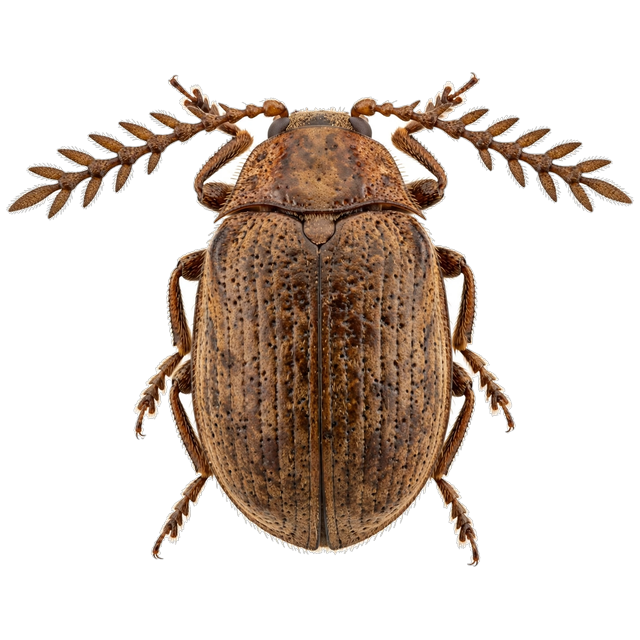
 Cigarette beetle
Lasioderma serricorne (Fabricius, 1792)
Cigarette beetle
A tiny humpbacked beetle that eats almost anything dry, tobacco, spices, dog food, even books.
- Order
- Coleoptera
- Family
- Ptinidae
- Group
- Stored-product beetles
- Ontario status
- Established, cosmopolitan in Ontario in tobacco, spices, pet food, and pantries
Why it matters
Its extraordinarily broad diet makes it a pest of homes, spice importers, tobacco shops, museums, and pet-food plants alike. Often the first suspect when 'something' is in the paprika.
Origin
Tropical origins; spread worldwide with the tobacco trade, hence the name.
Behavior
Good fliers, attracted to light, adults often found at windows, which confuses people. Larvae do the damage, tunneling through almost any dried plant or animal material.
Living conditions
One of the least picky stored-product pests: tobacco, spices, tea, pet food, cereal, dried flowers, and even book bindings and upholstery stuffing. Warm, undisturbed pantries and warehouses.
Signs of presence
- Tiny (2-3 mm) oval brown beetles at windows or in cupboards
- Pinhead-sized round holes in packaging, spices, or pet treats
- Fine powder in infested product
Weaknesses
- Killed by freezing
- Larvae need undisturbed product, regular pantry turnover prevents buildup
- Attracted to light, which makes monitoring traps effective
Myths and facts
Myth It's a drugstore beetle, same thing.
Reality Close cousins, different antennae: cigarette beetle antennae are saw-toothed (serrate); drugstore beetle antennae end in a distinct 3-segmented club.
Research notes
Morphology
2-3 mm, oval, humpbacked, light brown, densely hairy. Antennae serrate (saw-like), not clubbed. Head tucked beneath the pronotum. Strong fliers.
Diagnostics
Serrate antennae + humped oval body + 2-3 mm size = cigarette beetle. The antennal character separates it from the drugstore beetle under magnification.
Easily confused with
- Drugstore beetle, Stegobium paniceum Cigarette beetle: serrate (saw-like) antennae. Drugstore beetle: antennae ending in a loose 3-segmented club.
Life cycle
- Adult
- Live 2-4 weeks; feed little, the larva is the destructive stage
- Egg
- Laid in food material; hatch in ~1 week at 30 °C
- Egg to adult
- 6-10 weeks at 30 °C; up to 6 months in cool conditions
- Generations per year
- 3-6 indoors
- Nymph or larva
- C-shaped grubs feed 4-10 weeks, tunneling through product; pupate in cocoons
Development
Complete metamorphosis: egg → larva → pupa → adult.
Reproduction
Females lay ~100 eggs in the food substrate.
Distribution
- Global
- Cosmopolitan
- Native range
- Tropics (exact origin uncertain)
- Ontario
- Established indoors; common in homes, spice trade, and pet-food storage
Ecology
Extreme polyphagy, recorded from hundreds of commodities including pyrethrum (it eats insecticide plant material) and cayenne pepper. Sex pheromone (serricornin) produced by females attracts males.
Resistance
Phosphine resistance reported in some populations; generally susceptible compared with Tribolium and Rhyzopertha.
IPM implications
Broad diet means inspection must be broad: check spices, pet food, and non-food items (dried flowers, potpourri), not just flour. Light-attraction makes pheromone/light trap monitoring effective for mapping. Source removal ends most home infestations.
Chemical ecology
Female sex pheromone serricornin, one of the best-characterized beetle pheromones; used in monitoring lures. Larvae tolerate capsaicin and other plant defensive chemistry.
Genetics and DNA
No reference genome published as of 2026.
Taxonomy
Order Coleoptera, family Ptinidae (formerly Anobiidae, the deathwatch beetle family). Genus Lasioderma; serricorne = 'saw-horned,' for the antennae.
Open questions
Genetic basis of extreme polyphagy and detoxification capacity.
References
- Hagstrum, D.W. & Subramanyam, B. (2006). Fundamentals of Stored-Product Entomology. AACC International.