 Cluster fly
Pollenia rudis Fabricius, 1794
Cluster fly
Big, slow, golden-haired flies that crowd into attics each autumn, they don't breed in your house.
- Order
- Diptera
- Family
- Polleniidae
- Group
- Flies
- Ontario status
- Established, seasonal invader (autumn)
Why it matters
A pure nuisance pest. It does not bite, does not spread disease, and does not damage homes. The problem is numbers: hundreds can overwinter in one attic.
Origin
Native to Europe; introduced to North America, now widespread across the northern US and Canada.
Behavior
Sluggish fliers, often seen crawling on sunny windows in late autumn. Gather in large numbers inside wall voids and attics. On warm winter or spring days they wake up and wander indoors, then die at windows.
Living conditions
Outdoors in summer: larvae live in soil as parasites of earthworms. In autumn, adults seek sheltered cracks to spend the winter, wall voids, attics, window frames.
Signs of presence
- Large slow flies on sunny windows in October, November
- Buzzing inside wall voids on warm winter days
- Dead flies accumulating on windowsills and in light fixtures in spring
- Dark greasy spots around window frames where they squeeze in
Weaknesses
- Does not breed indoors, there is no indoor source to find, only entry points to seal
- Sluggish and easy to catch or vacuum
- Cannot survive long awake indoors in winter; they dehydrate
- Larvae depend entirely on earthworms outdoors
Myths and facts
Myth Cluster flies breed in the house and will multiply all winter.
Reality They cannot breed indoors. Every cluster fly in your attic arrived from outside in autumn; the population only shrinks over winter.
Myth They are blow flies from something dead in the walls.
Reality Blow flies arrive fast and loud around carrion. Cluster flies arrive slowly in autumn, are golden-haired, and have no carrion association.
Research notes
Morphology
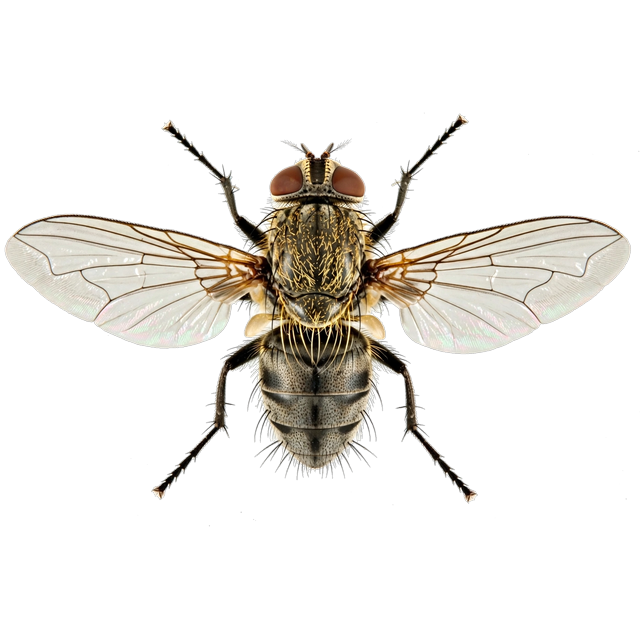
Adult 8-10 mm; dark grey abdomen; thorax covered in dense golden-yellow crinkled hairs, the field diagnostic. Wings overlap flat over the abdomen at rest. Non-metallic, unlike blow flies.
Diagnostics
Confirm by: 8-10 mm, golden thoracic hairs, sluggish behavior, autumn indoor invasion. The golden hairs separate it from all similar grey flies.
Easily confused with
- House fly, Musca domestica House fly is smaller (6-8 mm) with a striped bare thorax and no golden hairs; it is active and fast, not sluggish.
- Blow fly, Calliphora spp. Blow flies are metallic blue/green and loud; cluster flies are dull grey-gold and nearly silent in flight.
Life cycle
- Egg
- Laid in soil in summer
- Nymph or larva
- Larva penetrates and feeds inside earthworms, an obligate parasite; development in soil over summer
- Adult
- Emerges late summer; seeks overwintering shelter in autumn; overwinters in diapause inside structures
- Egg to adult
- Approximately 4-6 weeks in warm summer soil
- Generations per year
- One in northern climates (Ontario); 2-4 in warmer regions
Development
Complete metamorphosis: egg → larva (parasitic in earthworms) → pupa (in soil) → adult.
Reproduction
Females lay eggs in soil; fecundity moderate, the overwintering aggregation, not reproduction, creates the indoor numbers.
Distribution
- Native range
- Europe
- Ontario
- Widespread; a classic autumn invader across the province
- Global
- Europe, North America, New Zealand, Australia
Ecology
Larval host: earthworms in soil. Adults enter structures in autumn, strongly attracted to sun-warmed south- and west-facing walls. Overwinter in wall voids, attics, and window casings in diapause; arouse on warm days.
Resistance
Unknown, no significant insecticide resistance documented; rarely the target of insecticide programs.
IPM implications
Biology dictates exclusion, not elimination: seal exterior entry points (soffits, window frames, vents) before autumn. Because there is no indoor breeding, interior treatment cannot resolve the issue, only entry prevention and removal (vacuuming, light traps) of aroused adults. Timing is the control: work done in late summer beats work done in November.
Chemical ecology
Overwintering-site selection is driven by warmth and light cues on building faces; aggregation in voids appears thigmotactic rather than pheromone-driven. Limited published chemical ecology.
Genetics and DNA
No reference genome published as of 2026.
Taxonomy
Diptera: Polleniidae (formerly placed in Calliphoridae). Pollenia rudis (Fabricius, 1794).
Open questions
The precise cues that make certain buildings preferred overwintering sites year after year; larval host specificity among earthworm species in Ontario soils.
References
- Tawfik et al., Pollenia rudis earthworm parasitism, primary literature
- Penn State Extension, cluster fly biology and management
- Ontario Ministry of Agriculture fact sheets, nuisance flies in and around structures