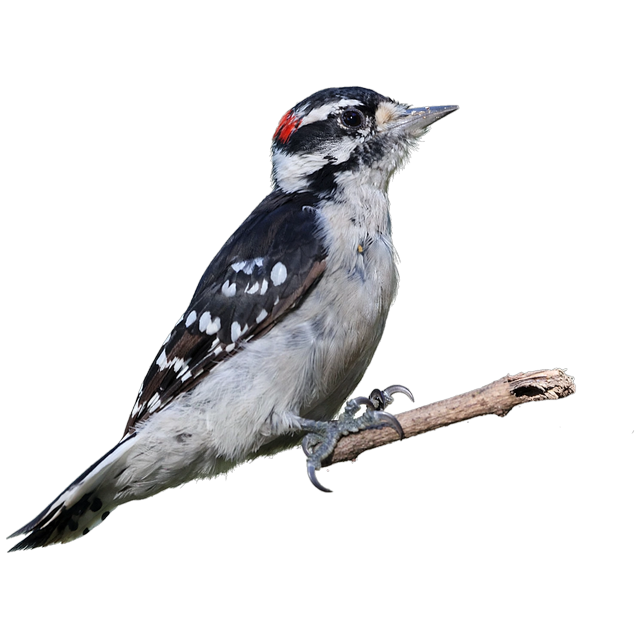
 Downy woodpecker
Dryobates pubescens (Linnaeus, 1766)
Downy woodpecker
A small black-and-white woodpecker that drums on houses and trees.
- Order
- Piciformes
- Family
- Picidae
- Group
- Birds
- Ontario status
- Established, common provincewide; drums on houses and trees
Why it matters
Overwhelmingly beneficial, a relentless predator of wood-boring beetles and other tree pests. The complaint is drumming on houses (usually metal flashing or siding in spring) and occasional siding excavation. It does not eat houses; it hunts insects and talks loudly.
Origin
Native to North America's forests, a year-round Ontarian, at home from deep woods to backyard feeders.
Behavior
Hitches up and down trunks probing bark for insects, often hanging upside down. In spring, males drum rapid bursts on resonant surfaces, trees, metal gutters, house siding, to claim territory. Pairs stay on territory year-round.
Living conditions
Deciduous and mixed woods, orchards, parks, and suburbs with mature trees. Excavates its own nest cavity in dead or soft wood each spring; visits suet feeders in winter.
Signs of presence
- Rapid machine-gun drumming bursts in spring (territorial, not feeding)
- Small neat round holes ~25 mm in dead branches (nest cavities)
- Shallow bark scaling and small feeding pits on trunks
- A tiny black-and-white bird at the suet feeder, often upside down
Weaknesses
- Dependent on dead wood for nesting, remove snags and it cannot breed
- Small size limits it to small-diameter branches and soft substrates
- Drumming needs resonant surfaces; it cannot resist advertising, which pinpoints its territory
- Winter-dependent on reliable food: suet, insects in bark, berries
Myths and facts
Myth Woodpeckers pecking the house means the house has bugs.
Reality Drumming is communication, not feeding, in spring it is almost always territorial drumming on a resonant surface, not evidence of insects.
Research notes
Morphology
Length 140-170 mm, wingspan 250-300 mm, weight 21-28 g. Black and white with a broad white back stripe; male has a small red patch on the back of the head. Bill short, shorter than the width of the head.
Diagnostics
Confirm by: tiny size + white back stripe + short bill. The hairy woodpecker is the near-twin but clearly larger (~230 mm) with a bill longer than its head is wide, bill proportion is the field mark.
Easily confused with
- Hairy woodpecker, Dryobates villosus Hairy is much larger with a long chisel bill (longer than head width); downy's bill is short and stubby (shorter than head width).
Life cycle
- Egg
- Clutch 4-5 white eggs in a fresh cavity each spring; incubation ~12 days shared by both parents
- Nymph or larva
- Chicks fledge at ~3 weeks; family groups forage together into summer
- Adult
- Lifespan 2-5 years typical; pairs often stay together on territory year-round
- Egg to adult
- Hatch to fledging ~21 days
- Generations per year
- 1 brood per year
Development
Oviparous; altricial chicks raised in an excavated cavity.
Reproduction
4-5 eggs per clutch × 1 brood/year.
Distribution
- Native range
- North America, Alaska to Florida
- Ontario
- Established provincewide wherever trees stand, including cities
- Global
- North America only
Ecology
Bark-gleaning insectivore: wood-boring beetle larvae, ants, caterpillars; suet and berries in winter. Excavates a new cavity yearly, old cavities become nest sites for chickadees, wrens, and other cavity nesters. Drumming is territorial advertisement, performed on the most resonant available surface.
Resistance
N/A, not a pesticide target species.
IPM implications
Beneficial species, management is about redirecting, not removing. Monitoring: drumming locations in spring identify the territory holder. Deterrence from houses uses visual and noise deterrents on the drumming surface during the short spring window; the underlying need is a resonant substitute (dead snags retained on the property). Protected as a migratory bird, nests cannot be disturbed.
Chemical ecology
Minimal published work; territory and pair communication is acoustic (drumming, calls) and visual.
Genetics and DNA
Reference genome published: included among the 363 bird reference genomes in Feng et al. 2020 (Nature, B10K).
Taxonomy
Piciformes: Picidae. Dryobates pubescens (Linnaeus, 1766), 'dryobates' = wood-walker; the smallest woodpecker in Ontario.
Open questions
Urban drumming-substrate preferences; the net pest-suppression value of downy foraging in managed orchards.
References
- All About Birds, Downy Woodpecker, Cornell Lab of Ornithology
- Jackson & Ouellet, Downy Woodpecker (Dryobates pubescens), Birds of the World, Cornell Lab