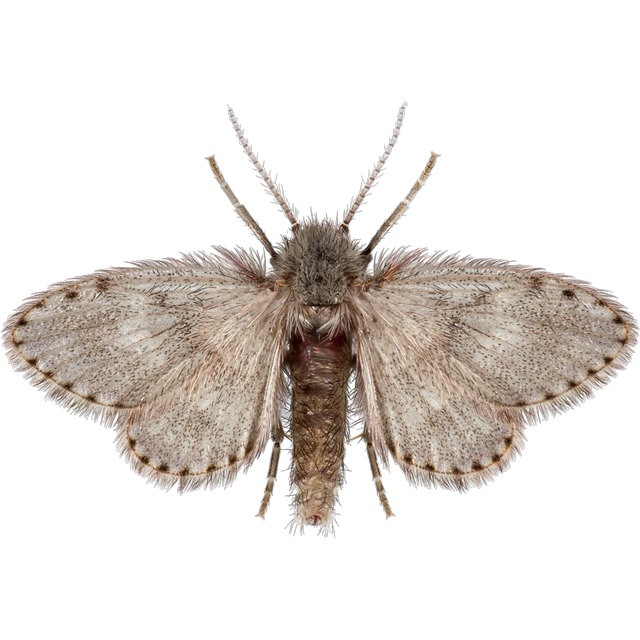
 Drain fly
Psychoda spp. Latreille, 1796
Drain fly
Tiny fuzzy moth-like flies that breed in the slime inside your drains.
- Order
- Diptera
- Family
- Psychodidae
- Group
- Flies
- Ontario status
- Established, ubiquitous in drains
Why it matters
Nuisance only, they do not bite and are not disease vectors. But a drain-fly bloom signals heavy biofilm, which is worth cleaning for its own sake.
Origin
A worldwide family of damp-habitat flies; the drain species live wherever people have plumbing.
Behavior
Weak, fluttery fliers, more like tiny moths. Rest on walls near drains. Most active at night. Do not bite.
Living conditions
Larvae live in the gelatinous bacterial slime (biofilm) coating the inside of drains, pipes, sump pits, and septic tanks. Any drain with a slime layer can breed them.
Signs of presence
- Small moth-like flies on bathroom or kitchen walls, especially at night
- Flies puffing up out of a drain when disturbed
- A jelly-like slime visible inside the drain
Weaknesses
- The slime is everything, scrub the biofilm out and breeding stops with no chemicals at all
- Boiling water alone does not remove slime; mechanical brushing does
- Dry traps and unused drains breed them; running water regularly helps
- They cannot fly far, the breeding drain is always close by
Myths and facts
Myth Pouring bleach down the drain kills them.
Reality Bleach kills surface adults and some slime, but the gelatinous biofilm protects larvae deeper in. Only physical removal of the slime, brushing, reliably ends breeding.
Research notes
Morphology
Adult 2-5 mm; body and wings densely covered in hairs, giving a moth-like appearance; wings held roof-like over the body at rest. Antennae long, beaded. Weak fliers with a characteristic fluttering flight.
Diagnostics
Confirm by: 2-5 mm, moth-like hairy wings, weak fluttery flight, association with drains. Nothing else in the drain habitat looks like a tiny moth.
Easily confused with
- Fungus gnat, Bradysia spp. Fungus gnats are slender, dark, mosquito-like flies around soil, not moth-like, and do not flutter; drain flies look distinctly furry.
Life cycle
- Egg
- Laid in gelatinous masses on the biofilm surface
- Nymph or larva
- Larvae graze on bacteria, algae and decaying matter within the slime; breathe through a siphon at the surface film
- Adult
- Short-lived; rests on nearby walls; poor disperser
- Egg to adult
- Approximately 1-3 weeks depending on temperature and biofilm richness
- Generations per year
- Continuous where drains stay wet and slimy
Development
Complete metamorphosis: egg → larva (aquatic, in biofilm) → pupa → adult.
Reproduction
Females lay eggs directly into the biofilm; a single slimy drain sustains overlapping generations indefinitely.
Distribution
- Native range
- Cosmopolitan family
- Ontario
- Ubiquitous in plumbing systems; year-round indoors
- Global
- Worldwide wherever drains exist
Ecology
Breeding media: bacterial biofilm in drains, sewers, sump pits, septic systems, wet organic sludge. Adults rarely travel more than a few metres from the breeding drain, the source is always local.
Resistance
Unknown, control is mechanical, not chemical; no resistance documented.
IPM implications
The textbook mechanical-control pest: the larval habitat is a removable film, so control is brushing and biofilm removal (drain brushes, enzymatic cleaners that digest organic matter), plus fixing leaks and drying unused drains. Insecticides are biologically pointless, the protected larvae sit under slime. Verify success by taping over the drain overnight and counting emerged adults.
Chemical ecology
Oviposition cued by bacterial volatiles from the biofilm; larvae are filter-grazers on the microbial community.
Genetics and DNA
No reference genome published as of 2026.
Taxonomy
Diptera: Psychodidae (moth flies). Genus Psychoda Latreille, 1796; the common drain species are P. alternata and P. cinerea.
Open questions
Species-level identification of Ontario drain populations (most records are genus-level); biofilm community composition that best supports breeding.
References
- Quate, Psychodidae taxonomy, primary literature
- Penn State Extension, drain fly / moth fly management
- UF/IFAS Extension, drain flies around homes