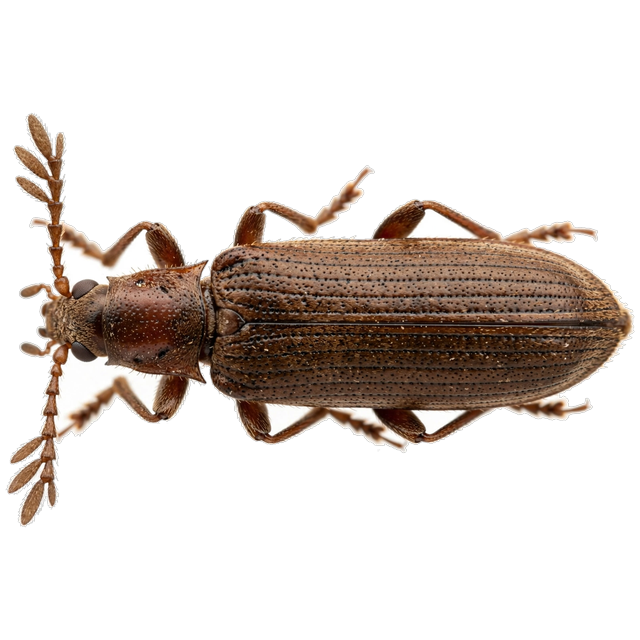
 Drugstore beetle
Stegobium paniceum (Linnaeus, 1761)
Drugstore beetle
Named for old pharmacies it once raided, this beetle eats dried herbs, bread, books, and almost anything else.
- Order
- Coleoptera
- Family
- Ptinidae
- Group
- Stored-product beetles
- Ontario status
- Established, cosmopolitan in Ontario homes, pharmacies (historically), libraries, and food plants
Why it matters
A pest of homes, bakeries, and, distinctively, libraries, herbaria, and museums, where larvae damage book bindings and specimens.
Origin
Worldwide for centuries, it earned its name infesting the dried herbs and roots of apothecary shops.
Behavior
Flies well and comes to light. Larvae tunnel inside the food, leaving it hollow. Adults are short-lived and mostly mate and disperse.
Living conditions
Bread, flour, spices, dried herbs, pet food, plus oddities like book bindings, leather, and museum specimens. Likes warm, undisturbed storage.
Signs of presence
- Tiny cylindrical beetles (2-3.5 mm) at windows
- Round shot-holes (~1.5 mm) in bread, crackers, pet treats, or book covers
- Fine frass in opened packages
Weaknesses
- Killed by freezing
- Needs undisturbed product, pantry rotation breaks the cycle
- Comes to light, making it easy to trap and detect
Myths and facts
Myth It's eating my medicine.
Reality The name is historical. Modern infestations are in food and paper goods, though it genuinely once infested apothecaries' dried herbs.
Research notes
Morphology
2-3.5 mm, cylindrical, brown, finely hairy with rows of pits (striae) on the elytra. Antennae end in a loose 3-segmented club, the key separator from Lasioderma. Good fliers.
Diagnostics
3-segmented antennal club + elytral striae + cylindrical body = drugstore beetle. Compare antennae directly with cigarette beetle.
Easily confused with
- Cigarette beetle, Lasioderma serricorne Drugstore beetle: antennae end in a 3-segmented club. Cigarette beetle: serrate (saw-like) antennae with no club.
Life cycle
- Adult
- 2-4 weeks; mate and disperse
- Egg
- Laid on food; hatch in ~1-2 weeks at warm temperatures
- Egg to adult
- 2-4 months depending on temperature and food
- Generations per year
- 2-4 indoors
- Nymph or larva
- C-shaped larvae tunnel 4-8 weeks, pupate in cocoons within the food
Development
Complete metamorphosis: egg → larva → pupa → adult.
Reproduction
Females lay ~75 eggs on suitable substrate.
Distribution
- Global
- Cosmopolitan
- Native range
- Uncertain; ancient association with human stores
- Ontario
- Established indoors across the province
Ecology
Broad polyphagy including non-food materials (leather, bookbinding, herbarium specimens). Female-produced sex pheromone stegobinone attracts males.
Resistance
No major resistance documented; generally susceptible.
IPM implications
In homes: source removal (the infested bread, spice, or pet food) plus inspection of unusual reservoirs (books, dried arrangements). In museums and libraries: monitoring traps and quarantine of incoming materials, the non-food diet makes standard pantry logic insufficient.
Chemical ecology
Female-produced sex pheromone stegobinone (plus stegobiol) attracts males - the basis of monitoring lures; larvae digest an exceptional range of substrates including tannin-rich materials.
Genetics and DNA
No reference genome published as of 2026.
Taxonomy
Order Coleoptera, family Ptinidae (formerly Anobiidae). Genus Stegobium; paniceum = 'of bread.'
Open questions
Detoxification pathways enabling feeding on pharmacologically active plant material.
References
- Hagstrum, D.W. & Subramanyam, B. (2006). Fundamentals of Stored-Product Entomology. AACC International.