 Eastern mole
Scalopus aquaticus (Linnaeus, 1758)
Eastern mole
A burrowing mole whose Canadian range is a small corner of extreme southwestern Ontario.
- Order
- Eulipotyphla
- Family
- Talpidae
- Group
- Wildlife
- Ontario status
- Native but rare and restricted: in Canada only in a small area of extreme southwestern Ontario (Essex and Chatham-Kent); a species at risk
Why it matters
Ridges and mounds disfigure lawns and can damage mower blades; tunnels expose plant roots to air. On the other hand, a mole eats cutworms, grubs, and other lawn pests around the clock. In Ontario it is rare and a species at risk, and most mole-like lawn damage elsewhere in the province is not this species.
Origin
Native to eastern North America, a true native, not an introduction. Moles have tunneled this continent's soils for millions of years.
Behavior
Nearly entirely underground and solitary. Active day and night in shifts, patrolling tunnel networks for earthworms. Each mole defends its own burrow system aggressively against other moles.
Living conditions
Moist, loose soil rich in earthworms: lawns, gardens, meadows, and open woods, within its small southwestern Ontario range. Needs soft diggable ground; compacted or rocky soil is unusable.
Signs of presence
- Raised ridges snaking across the lawn (surface feeding tunnels)
- Volcano-shaped mounds of loose soil pushed up from deep tunnels
- Soft, spongy ground that collapses underfoot along tunnel lines
- No surface runways clipped through the grass, that distinction separates mole work from vole work
Weaknesses
- Bound to soft soil, cannot tunnel through compacted ground, gravel, or rock
- Enormous appetite is its leash: must eat near its own weight daily, so poor soil starves it out
- Solitary and territorial, one mole per tunnel system, so all activity is a single animal's work
- Near-blind above ground and clumsy on the surface, helpless outside its tunnels
Myths and facts
Myth Moles eat plant roots and bulbs.
Reality Moles are insectivores, they eat earthworms, grubs, and insects. If bulbs are chewed, voles using the mole's tunnels are the culprit.
Myth A lawn full of tunnels means many moles.
Reality Moles are fiercely solitary, an extensive tunnel system is usually the work of a single animal.
Research notes
Morphology
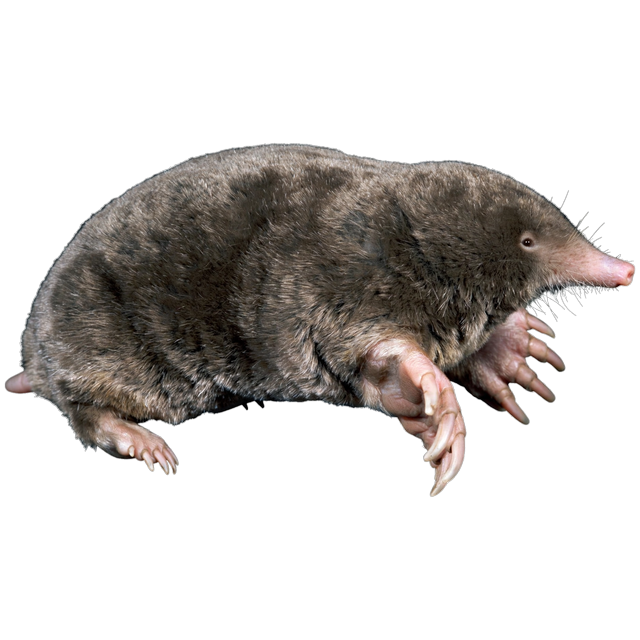
Body 140-180 mm, tail 25-40 mm, weight 75-140 g (males larger). Velvety fur with no nap direction, so it slides backward in tunnels. Huge paddle-like forepaws with long digging claws; tiny eyes, no external ears; pointed fleshy snout.
Diagnostics
Confirm by: raised soil ridges (not surface runways), volcano-shaped mounds, and, if glimpsed, the enormous naked forepaws. Star-nosed mole has a tentacled pink nose disc; the eastern mole's snout is plain and pointed.
Easily confused with
- Star-nosed mole, Condylura cristata Star-nosed has a ring of 22 pink fleshy tentacles on its nose; the eastern mole's snout is plain and pointed.
- Meadow vole, Microtus pennsylvanicus Voles clip visible surface runways through grass; moles push up raised soil ridges, runways mean vole, ridges mean mole.
Life cycle
- Egg
- N/A, viviparous
- Nymph or larva
- Pups born blind and hairless in spring; weaned in ~30 days; disperse to establish their own tunnels
- Adult
- Lifespan ~3 years in the wild; breeds the spring after birth
- Egg to adult
- Gestation ~42 days; single litter raised in a deep nest chamber
- Generations per year
- 1 litter per year
Development
Viviparous; altricial young born in a deep nest chamber.
Reproduction
2-5 pups per litter × 1 litter/year, born in spring (March, April).
Distribution
- Native range
- Eastern and central North America, from the Great Lakes region to the Gulf Coast and northern Mexico
- Ontario
- Restricted to a small area of extreme southwestern Ontario (southern Essex County and adjacent Chatham-Kent); never common in the province
- Global
- North America only
Ecology
Strictly solitary and territorial outside breeding season. Two tunnel systems: shallow surface feeding tunnels (the ridges) and deep permanent tunnels 150-300 mm down with a nest chamber. Diet overwhelmingly earthworms, plus grubs, beetles, and other soil invertebrates. Active year-round, does not hibernate.
Resistance
N/A, not a pesticide target species.
IPM implications
Monitoring is visual: fresh ridges and mounds map the active tunnel system. Because one animal works alone, activity extent does not equal population size. Soil compaction and grub reduction make ground less attractive; garden beds are protected with buried barriers. Because it is a species at risk in Canada, check Ontario regulations and conservation guidance before any intervention.
Chemical ecology
Scent glands on the belly and flanks mark tunnel walls; musky odor advertises occupancy to rival moles. Poor eyesight compensated by acute touch (Eimer's organs on the snout) and smell.
Genetics and DNA
Reference genome published: ScaAqu_v1_BIUU (GCA_004024925.1, NCBI; UCSC mammals hub).
Taxonomy
Eulipotyphla: Talpidae. Scalopus aquaticus (Linnaeus, 1758), the largest mole in eastern North America. In Canada it is restricted to extreme southwestern Ontario.
Open questions
Population density estimates for Ontario's urban and suburban soils are essentially unstudied.
References
- Naughton, D. (2012) The Natural History of Canadian Mammals, Univ. of Toronto Press
- Whitaker & Hamilton, Mammals of the Eastern United States, Cornell Univ. Press