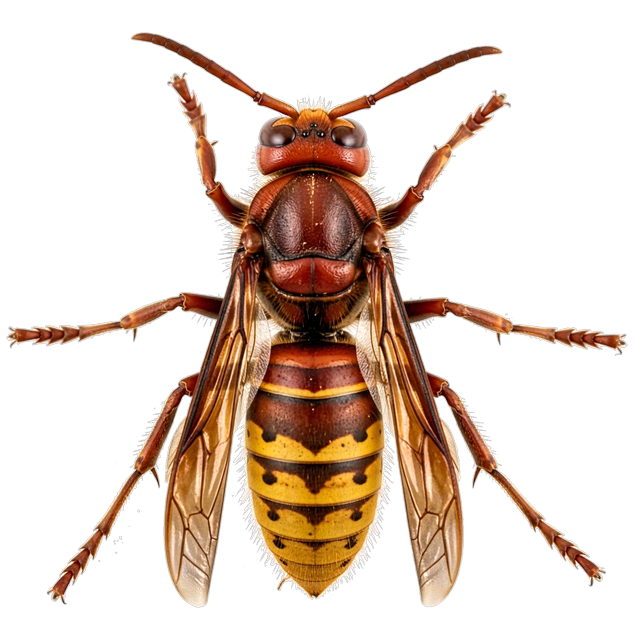
 European hornet
Vespa crabro Linnaeus, 1758
European hornet
Ontario's largest social wasp, brown and yellow, active at night, humming around porch lights in late summer.
- Order
- Hymenoptera
- Family
- Vespidae
- Group
- Wasps, hornets & bees
- Ontario status
- Established, introduced
Why it matters
Intimidating size and painful sting; nests in structures need professional attention. Predatory on insects, including honeybees at hive entrances in late season. Not aggressive without provocation at the nest.
Origin
Native to Europe and Asia; introduced to eastern North America in the 1800s, now established in Ontario.
Behavior
The only common Ontario wasp active at night, workers fly to porch lights after dark. Forages for insects, tree sap and fallen fruit. Less aggressive away from the nest than its size suggests, but the nest is vigorously defended and the sting is memorable.
Living conditions
Nests in hollow trees, wall voids, barns and sheds, large cavities. Needs mature trees and undisturbed voids.
Signs of presence
- Very large wasps (20-35 mm) around lights at night in late summer
- A deep, loud buzzing unlike smaller wasps
- Traffic at a tree hollow or wall void
Weaknesses
- Nocturnal habit makes it avoidable, turn off outdoor lights near seating areas
- Single-season colonies; winter ends the nest
- Nests in cavities, so exclusion (sealing voids) prevents establishment
- Forages widely; it is not tied to your garbage like yellowjackets
Myths and facts
Myth Three stings can kill a person / they're the 'murder hornet'.
Reality European hornets are not the Asian giant hornet (Vespa mandarinia, not established in Ontario). Their sting is painful but the venom is comparable to other wasps, the danger is allergy and multiple stings, not a super-venom.
Research notes
Morphology
Workers 20-25 mm; queens to 35 mm. Reddish-brown thorax, yellow-and-brown banded abdomen, brown where yellowjackets are black. Large head with powerful mandibles. Nests: large paper combs inside cavities (hollow trees, wall voids), brownish envelope.
Diagnostics
Confirm by: 20-35 mm, reddish-brown and yellow (not black), nocturnal flight to lights, cavity nesting.
Easily confused with
- Bald-faced hornet, Dolichovespula maculata Bald-faced hornets are black-and-white and build hanging aerial nests; European hornets are brown-and-yellow and nest inside cavities.
- Asian giant hornet, Vespa mandarinia (not in Ontario) V. mandarinia is larger still (queens to 50 mm) with an orange head; any suspected specimen in Ontario warrants reporting, but all records to date are V. crabro.
Life cycle
- Egg
- Queen initiates the cavity nest in spring
- Nymph or larva
- Larvae fed masticated insects and sap
- Adult
- Colonies reach several hundred workers; active into the night, unusual among vespids; only queens overwinter
- Egg to adult
- Approximately 4-5 weeks per worker generation
- Generations per year
- One colony cycle per year
Development
Complete metamorphosis: egg → larva → pupa → adult. Annual eusocial colony.
Reproduction
Single foundress; autumn mating of new queens; colony dies with frost.
Distribution
- Native range
- Europe and temperate Asia
- Ontario
- Established, most common in the south; expanding with mature suburbs
- Global
- Eurasia; introduced eastern North America
Ecology
Cavity nester; strips bark for paper pulp (damaging young trees ornamentally). Predatory on flies, caterpillars and honeybees; also takes sap and fruit. Nocturnal foraging is exceptional among social wasps and reduces competition.
Resistance
Not applicable, no insecticide resistance documented.
IPM implications
Cavity-nesting biology means prevention is structural: seal tree hollows near homes, screen vents, close wall voids. Active nests in structures require professional treatment (night work, full protection, large colony, powerful stings). Light management (yellow 'bug lights', lights off near doors) reduces nocturnal encounters. As with all annual vespids, winter ends the colony.
Chemical ecology
Foraging guided by visual and olfactory cues; nocturnal activity suggests reduced reliance on vision vs. diurnal vespids, an open research area.
Genetics and DNA
No reference genome published as of 2026.
Taxonomy
Hymenoptera: Vespidae. Vespa crabro Linnaeus, 1758. A true hornet (genus Vespa); the largest eusocial wasp in Ontario.
Open questions
Northward range dynamics in Ontario; nocturnal foraging energetics and sensory basis.
References
- Archer, Vespa crabro biology, primary literature
- Evans & Eberhard (1970), The Wasps (Univ. Michigan Press)
- Ontario apiculture resources, hornet predation at hives