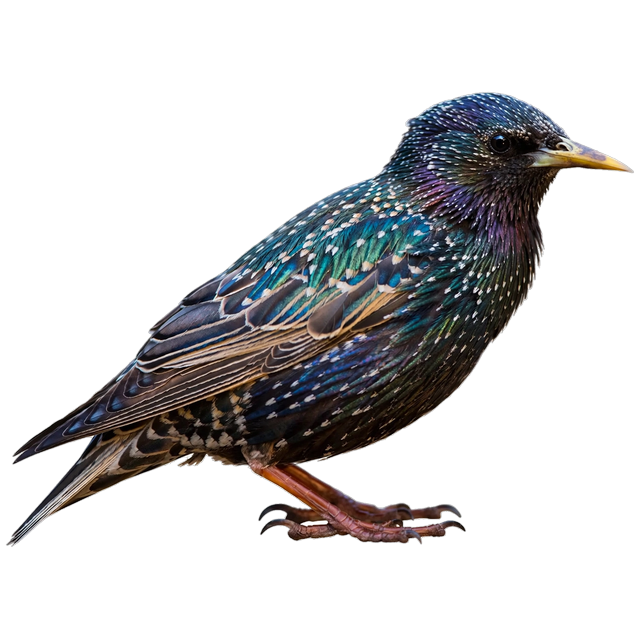
 European starling
Sturnus vulgaris Linnaeus, 1758
European starling
The 1890s introduction that became 200 million birds, master of the murmuration.
- Order
- Passeriformes
- Family
- Sturnidae
- Group
- Birds
- Ontario status
- Established, introduced 1890s
Why it matters
Agricultural damage to fruit and grain; massive roosts foul structures; displaces native cavity nesters.
Origin
Native to Eurasia; released in New York's Central Park in 1890-91, now roughly 200 million birds across North America.
Behavior
Diurnal; spectacular flocking murmurations; aggressive cavity competitor; a gifted mimic of other birds and sounds.
Living conditions
Nests in cavities: buildings, nest boxes, tree holes. Roosts in enormous flocks on structures, in trees, and under bridges.
Signs of presence
- Massive noisy roosts at dusk on buildings and in trees
- Whitewash droppings under roost structures
- Evicted native birds from nest boxes
- Flocks stripping fruit trees and grain
Weaknesses
- Cavity-nester: exclusion from buildings removes breeding sites
- Roosts are the problem, disperse the roost and the damage moves with it
- Agricultural damage is seasonal, netting timed to fruit ripening works
Myths and facts
Myth Starlings are native North American birds.
Reality Introduced in 1890-91, one of the continent's most successful biological invasions, and unprotected by migratory bird law.
Research notes
Morphology
Body 20-23 cm, weight 60-100 g. Iridescent black with pale speckles in winter plumage; yellow bill and glossy plumage in breeding season; short tail, pointed wings.
Diagnostics
Stout blackbird with short tail; speckled winter plumage; harsh chattering and mimicry.
Easily confused with
- Common grackle (Quiscalus quiscula) Grackle is larger with a long keel-shaped tail; starling is compact with a short square tail.
Life cycle
- Adult
- Lifespan 2-3 years wild; 15+ in captivity
- Egg
- Clutch 4-6; incubation 12-14 days
- Egg to adult
- Hatch to fledging ~21 days
- Generations per year
- 1-2 broods/year
- Nymph or larva
- Nestlings fledge at ~21 days
Development
Oviparous; altricial.
Reproduction
4-6 eggs per clutch × 1-2 broods/year.
Distribution
- Global
- Worldwide in temperate regions
- Native range
- Eurasia
- Ontario
- Established, abundant province-wide since the 1890s introduction
Ecology
Invasive cavity-nester; omnivorous flock forager; murmuration flocking as predator defense; among the most abundant birds in North America.
Resistance
Unknown.
IPM implications
Exclusion of roost and nest structures; roost dispersal timed before establishment; agricultural netting. Flock behavior means management is site-level, not individual birds. Unprotected status widens legal options, verify provincial regulations.
Chemical ecology
Uropygial gland secretions; song and visual display dominate communication.
Genetics and DNA
Reference genome published: S. vulgaris vAU/vNA reference genomes (GCF_001447265.1, Stuart et al. 2021); VGP bStuVul1.
Taxonomy
Order Passeriformes › family Sturnidae › Sturnus vulgaris Linnaeus, 1758.
Open questions
Efficacy of long-term roost dispersal without displacement to neighboring structures.
References
- Cornell Lab of Ornithology, European Starling (All About Birds)
- Internet Center for Wildlife Damage Management, European Starlings