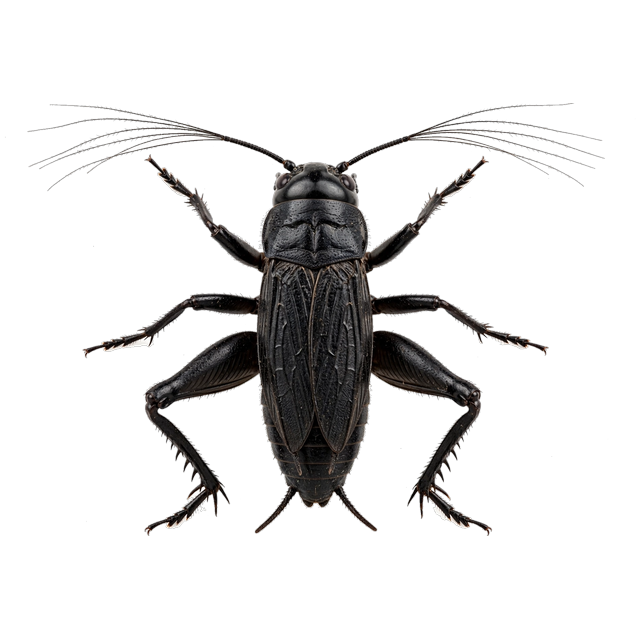
 Field cricket
Gryllus spp. Linnaeus, 1758
Field cricket
The big black singer at your doorstep every September, an outdoor cricket that got lost.
- Order
- Orthoptera
- Family
- Gryllidae
- Group
- Occasional invaders
- Ontario status
- Native, abundant outdoors; enters homes in late summer and fall
Why it matters
A noisy but harmless fall visitor, and a reminder to weatherstrip before September. It eats garden debris all summer and asks only for a warm crack in October.
Origin
Native to North America, they were singing in Ontario fields long before the houses.
Behavior
Sings loudly on late-summer nights from the grass, then wanders indoors as nights turn cold, following warmth and light through any ground-level gap.
Living conditions
Fields, gardens, and lawns all summer; your garage, mudroom, and basement in September and October.
Signs of presence
- Large black crickets near doors and in garages in September-October
- Loud chirping from outside foundation walls on warm fall nights
- Crickets clustered around porch lights
Weaknesses
- Cannot breed indoors without soil, the invasion ends with the individuals
- Blocked completely by door sweeps and sealed thresholds
- Attracted to light, so managing porch lighting reduces arrivals
- Dies with the first hard frosts; the season is self-limiting
Myths and facts
Myth The crickets coming inside will breed and take over the house.
Reality Field crickets rarely breed indoors, they need soil for their eggs. Each one is a lost outdoor cricket, not the start of an infestation.
Research notes
Morphology
Body 15-25 mm depending on species; black to dark brown; robust; long antennae; females with prominent ovipositor. Larger and darker than the house cricket.
Diagnostics
Large black cricket at ground-level entry points in late summer/fall. Outdoor origin confirmed by season and the absence of indoor nymphs.
Easily confused with
- House cricket (Acheta domesticus) House crickets are paler, smaller, and breed indoors; field crickets are black, larger, and outdoor natives.
Life cycle
- Adult
- Adults sing August-October; die with hard frost
- Egg
- Eggs overwinter in soil; hatch in late spring
- Egg to adult
- One summer of nymphal development
- Generations per year
- One
- Nymph or larva
- Nymphs develop through the summer in grass and garden debris
Development
Hemimetabolous, egg to nymph to adult. Overwinters as eggs in soil; nymphs develop through summer; adults sing from late summer into fall.
Reproduction
Males sing from burrow mouths; females choose mates by song. Eggs laid in soil with the ovipositor.
Distribution
- Global
- Temperate Northern Hemisphere
- Native range
- North America; several native Gryllus species in Ontario
- Ontario
- Native and abundant in fields and gardens; indoor records are fall wanderers
Ecology
Omnivorous ground-dweller; important prey for birds, mammals, and parasitoid flies. The fall indoor invasion is a shelter-seeking behavior as nights cool, not an infestation.
Resistance
Not applicable, not a pesticide target.
IPM implications
Exclusion insect: door sweeps, sealed thresholds, and weatherstripping installed before September prevent nearly all entry. Reduce outdoor lighting near doors (they aggregate at lights). No interior program needed, each indoor cricket is an individual wanderer.
Chemical ecology
Song is the chemistry here, species-specific calling songs maintain reproductive isolation between Gryllus species. Temperature-dependent chirp rate (Dolbear's law) is a classic biophysics teaching example.
Genetics and DNA
A reference genome exists for the genus: Gryllus bimaculatus (first assembly 2021, Ylla et al.; chromosome-level assembly 2026, Sci Data) and G. assimilis (2025). No published genome for Ontario's native species (e.g., G. pennsylvanicus).
Taxonomy
Order Orthoptera, family Gryllidae. Gryllus is a large genus; Ontario species include G. pennsylvanicus and relatives, species ID needs song analysis or genitalia.
Open questions
Species boundaries among Ontario Gryllus; effects of urban lighting on fall dispersal.
References
- Ebeling, W. (1978). Urban Entomology, University of California, Riverside.