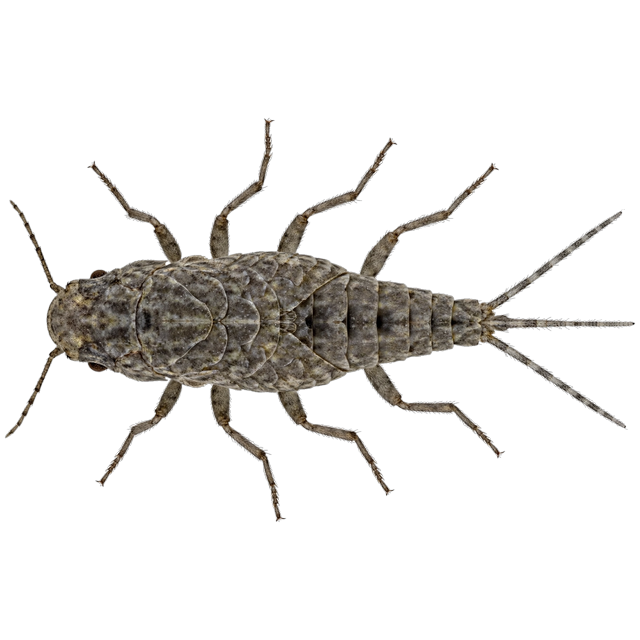
 Firebrat
Thermobia domestica (Packard, 1873)
Firebrat
The silverfish's heat-loving cousin, it lives where your furnace lives.
- Order
- Zygentoma
- Family
- Lepismatidae
- Group
- Silverfish, firebrats & booklice
- Ontario status
- Established, near heat sources: furnace rooms, bakeries, boiler rooms
Why it matters
A minor nuisance that damages stored paper and dry goods near heat sources, and a useful indicator that a hot void is undisturbed and unsealed.
Origin
Probably tropical regions originally; spread with heated buildings.
Behavior
Same shy nocturnal habits as the silverfish, but it wants heat, it lives where the house is warmest and eats the same starches.
Living conditions
Furnace rooms, boiler rooms, hot-water tank closets, bakeries, and the warm voids around heating pipes.
Signs of presence
- Mottled gray-brown fish-shaped insects near the furnace or hot-water tank
- Feeding damage on stored paper or pet food kept in warm utility rooms
- Sightings at night when the furnace room light comes on
Weaknesses
- Needs sustained warmth, cool the void and it cannot thrive
- Same slow reproduction and fragility as the silverfish
- Cannot fly or jump; confined to its hot microhabitat
- Sealing pipe chases and decluttering utility rooms removes its world
Myths and facts
Myth Firebrats start fires or damage heating equipment.
Reality They just enjoy the warmth, they damage paper and dry goods near the heat, not the equipment itself.
Research notes
Morphology
Body 10-15 mm; mottled gray-brown (never silvery); fish-shaped; three caudal filaments; long antennae. The mottling is the quick field separator from silverfish.
Diagnostics
Mottled gray-brown zygentoman found near heat sources (furnace, hot-water tank, bakery ovens). Temperature context is itself diagnostic.
Easily confused with
- Silverfish (Lepisma saccharina) Silverfish are uniformly silvery and cool-damp dwellers; firebrats are mottled and found near heat.
Life cycle
- Adult
- Adults live 2-5 years
- Egg
- Eggs laid in cracks near heat; hatch in ~2 weeks in warmth
- Egg to adult
- 2-4 months in its preferred heat
- Generations per year
- Overlapping; continuous
- Nymph or larva
- Nymphs miniature mottled adults; many molts
Development
Ametabolous like the silverfish, direct development, lifelong molting. Faster than silverfish because of the heat it lives in.
Reproduction
Same primitive indirect sperm transfer as silverfish; ~100 eggs per female lifetime.
Distribution
- Global
- Cosmopolitan in heated structures
- Native range
- Probably tropical Old World
- Ontario
- Indoor populations near heat sources province-wide
Ecology
Thermophilic detritivore, thrives at 30-40 °C near furnaces, boilers, and commercial ovens. Feeds on starches, book bindings near hot pipes, pet food. Nocturnal.
Resistance
Unknown, managed physically; no documented resistance.
IPM implications
Same playbook as silverfish, relocated to the hot zone: inspect furnace rooms and pipe chases, seal gaps around hot pipes, store susceptible materials away from heat sources. Monitoring traps placed near heat. Its presence maps hot, undisturbed voids.
Chemical ecology
Unremarkable chemically, like its cousin. Distribution is driven by temperature preference, not chemistry, it is one of the most heat-tolerant indoor insects.
Genetics and DNA
No reference genome published as of 2026.
Taxonomy
Order Zygentoma, family Lepismatidae. Authority (Packard, 1873). The thermophilic counterpart to Lepisma.
Open questions
Thermal tolerance physiology; why it remains less common than silverfish despite similar ecology.
References
- Ebeling, W. (1978). Urban Entomology, University of California, Riverside.