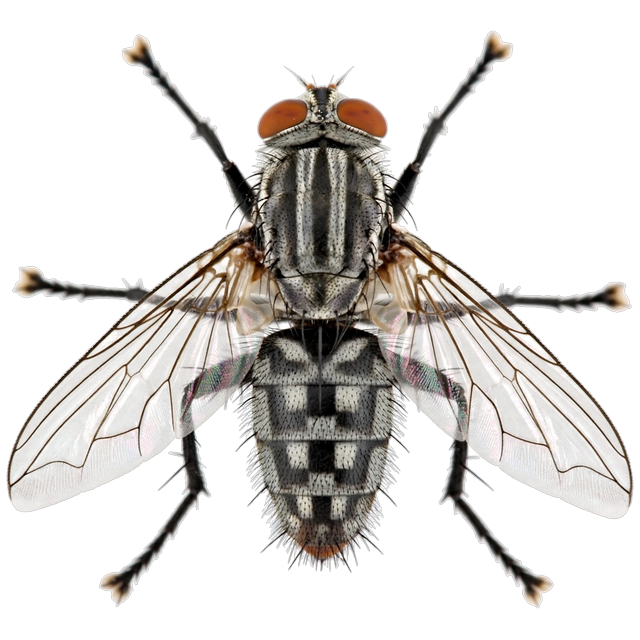
 Flesh fly
Sarcophaga spp. Meigen, 1826
Flesh fly
Grey flies with a checkerboard abdomen that give birth to live maggots instead of laying eggs.
- Order
- Diptera
- Family
- Sarcophagidae
- Group
- Flies
- Ontario status
- Established, common
Why it matters
Germ carriers from waste to food, like blow flies. Forensic scientists also use them, their live-birth habit changes the timing math at crime scenes.
Origin
A huge worldwide family; the common flesh flies are native across the northern hemisphere.
Behavior
Large grey flies, often seen on sunny walls and garbage. Loud. Larvae (maggots) appear in waste that has been sitting for days.
Living conditions
Breeds in carrion, garbage, and pet waste. Because mothers deposit live larvae instead of eggs, they colonize a carcass even faster than blow flies.
Signs of presence
- Large grey flies with black thoracic stripes around garbage or a decay odour
- Maggots appearing very quickly in waste (a day or two)
- Flies with a distinctive checkerboard-patterned abdomen
Weaknesses
- Needs carrion or decaying waste, sanitation removes it
- Larvae need moisture; dry waste is safe
- Live birth is fast, but the larvae still need days of feeding, prompt waste removal wins
Myths and facts
Myth The checkerboard pattern means it's a different, more dangerous fly.
Reality The tessellated abdomen is just the family's field mark. It signals flesh fly, not extra danger.
Research notes
Morphology
Adult 10-15 mm; grey thorax with 3 black longitudinal stripes; abdomen with a tessellated (checkerboard) pattern of grey and black. Arista bare or plumose only at the base, separates Sarcophagidae from Calliphoridae (plumose to tip) at a glance.
Diagnostics
Confirm by: 10-15 mm, 3 black thoracic stripes, checkered abdomen, arista bare beyond the base. Larviposition (live larvae, not eggs) is definitive in the field.
Easily confused with
- Blow flies, Calliphora / Lucilia spp. Blow flies are metallic blue or green with fully feathered aristae; flesh flies are non-metallic grey with a checkered abdomen.
Life cycle
- Egg
- Eggs hatch internally; the female deposits live first-instar larvae
- Nymph or larva
- Maggots feed in carrion or waste; 3 instars; rapid development
- Adult
- Several weeks; feeds on nectar, carrion fluids, feces
- Egg to adult
- Approximately 2-3 weeks at warm temperatures
- Generations per year
- Multiple; continuous in warm weather
Development
Complete metamorphosis with a twist: females are larviparous, they deposit active first-instar larvae directly onto the breeding medium. Larva (3 instars) → pupa → adult.
Reproduction
Larviposition skips the vulnerable egg stage, larvae begin feeding immediately, giving Sarcophaga a head start on shared carrion.
Distribution
- Native range
- Worldwide family; Holarctic species common
- Ontario
- Common throughout the province
- Global
- Cosmopolitan
Ecology
Carrion, garbage, feces, pet waste. Some species cause myiasis. Forensically important: larviposition must be factored into post-mortem interval estimates. Overwinters as pupae.
Resistance
Limited documentation; not a primary insecticide target.
IPM implications
Source-centred like the blow flies, with one adjustment: because larvae arrive pre-hatched, waste must be removed faster, a two-day-old garbage problem can already hold feeding maggots. Sanitation frequency is the control variable.
Chemical ecology
Attracted to carrion and fecal volatiles; larviposition cued by moisture and protein-rich substrates.
Genetics and DNA
Multiple Sarcophaga reference genomes published 2023 via the Darwin Tree of Life project (S. rosellei, S. caerulescens, S. subvicina, S. variegata; Falk & Mulley, Wellcome Open Research).
Taxonomy
Diptera: Sarcophagidae. Genus Sarcophaga Meigen, 1826, one of the largest dipteran genera, with many Ontario species.
Open questions
Species-level larval identification in Ontario (most ID keys are adult-based); local phenology of the common species.
References
- Byrd & Castner (2010), Forensic Entomology (CRC Press)
- Pape (1996), Catalogue of the Sarcophagidae of the World, taxonomic foundation
- UF/IFAS Extension, flesh fly biology