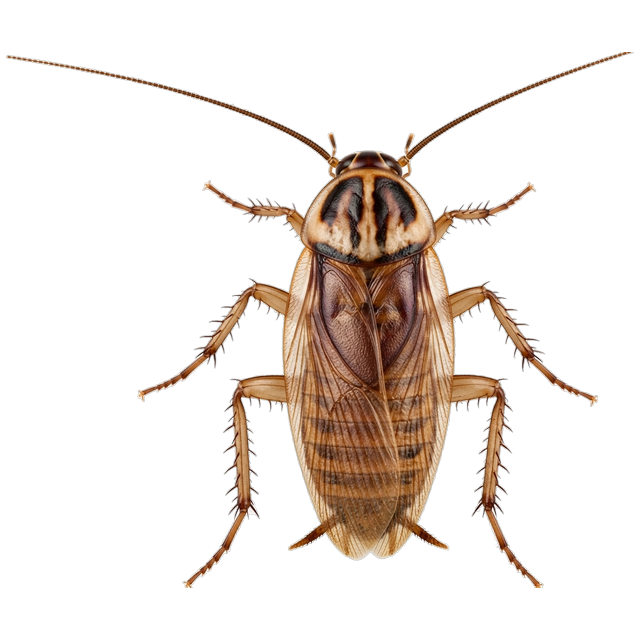
 German cockroach
Blattella germanica (Linnaeus, 1767)
German cockroach
A small, fast-breeding indoor cockroach, the most common cockroach found in Ontario homes and restaurants.
- Order
- Blattodea
- Family
- Ectobiidae
- Group
- Cockroaches
- Ontario status
- Established, indoor obligate; cannot overwinter outdoors
Why it matters
Can carry germs such as Salmonella on its body, and is a major indoor allergen, cockroach allergens are an established trigger for asthma, especially in children.
Origin
Despite the name, not from Germany, likely Southeast Asia in origin, now worldwide via human trade and shipping.
Behavior
Nocturnal; hides by day in tight cracks and comes out at night to feed. Gathers in groups using scent signals, where you see one, many are usually hidden nearby.
Living conditions
Strictly indoor in Ontario; cannot survive winter outdoors. Needs warmth (25-33 °C), moisture, and tight cracks near food, behind fridges, inside wall voids, under sinks.
Signs of presence
- Small dark droppings like ground pepper near food areas
- Musty, oily odor in heavy infestations
- Oval brown egg cases (oothecae) - carried by the female until ~1 day before hatching, so intact cases are rarely found
- Live insects scattering when lights turn on at night
Weaknesses
- Cannot overwinter outdoors in Ontario, indoor-only
- Nymphs dry out fast without humidity
- Needs accessible food, water and harborage, remove all three and populations collapse
Myths and facts
Myth Seeing one cockroach means there is only one.
Reality German cockroaches aggregate; a visible one usually means many hidden nearby.
Myth They bite people.
Reality They do not bite; the health concern is contamination and allergens, not bites.
Research notes
Morphology
Adults 13-16 mm, pale brown with two dark parallel stripes on the pronotum. Wings fully cover the abdomen in both sexes; rarely flies. Nymphs wingless, dark brown to black with a pale longitudinal band.
Diagnostics
Confirm by pronotal stripes + adult size 13-16 mm + female carrying ootheca. Nymphs: dark with pale band, no wing pads in early instars.
Easily confused with
- Asian cockroach, Blattella asahinai Nearly identical; Asian cockroach is a strong flier attracted to light outdoors, German cockroach is indoor and rarely flies.
- Brown-banded cockroach, Supella longipalpa Brown-banded shows two pale transverse bands across the back; German shows two dark stripes on the pronotum.
Life cycle
- Adult
- Lifespan ~100-200 days; females produce 4-8 oothecae in a lifetime.
- Egg
- Ootheca containing 30-40 eggs, carried by the female until ~24 hours before hatching.
- Egg to adult
- 50-60 days at 30 °C; markedly slower below 25 °C
- Generations per year
- 3-4+ indoors (continuous breeding)
- Nymph or larva
- 6-7 nymphal instars; wingless; dark with pale band.
Development
Incomplete metamorphosis: egg → nymph → adult.
Reproduction
30-40 eggs per ootheca, 4-8 oothecae per female, a single female can seed hundreds of descendants within months.
Distribution
- Global
- Cosmopolitan, worldwide in human buildings
- Native range
- Likely Southeast Asia
- Ontario
- Established provincewide indoors; cannot overwinter outdoors
Ecology
Thigmotactic, prefers tight cracks and crevices. Aggregates via aggregation pheromone deposited in feces. Foraging range small (a few metres from harborage); omnivorous scavenger.
Resistance
Widespread pyrethroid resistance via kdr target-site mutations; metabolic resistance (elevated cytochrome P450s, esterases) documented in North American populations.
IPM implications
Monitoring should target tight harborages near warmth, moisture and food (sticky traps placed in cracks and voids, not open floors). Reproduction is continuous and rapid, so monitoring intervals must be short and any visible count assumed to underrepresent the true population. Documented resistance means susceptibility cannot be assumed, resistance management (mode-of-action rotation) applies.
Chemical ecology
Aggregation pheromone in feces drives clustering at harborages; cuticular hydrocarbons mediate kin and nestmate recognition.
Genetics and DNA
Genome sequenced 2018 (~2.0 Gb), one of the largest insect genomes; expanded chemoreception and detoxification gene families (Harrison et al., Nature Ecology & Evolution).
Taxonomy
Order Blattodea, family Ectobiidae (formerly Blattellidae). Described by Linnaeus, 1767.
Open questions
Precise contribution of the Blattabacterium endosymbiont to insecticide tolerance; population genomics of Ontario infestations.
References
- Harrison et al. 2018, Nature Ecology & Evolution (genome)
- Ebeling, W. Urban Entomology, UC Riverside
- Mallis Handbook of Pest Control