 Ghost ant
Tapinoma melanocephalum (Fabricius, 1793)
Ghost ant
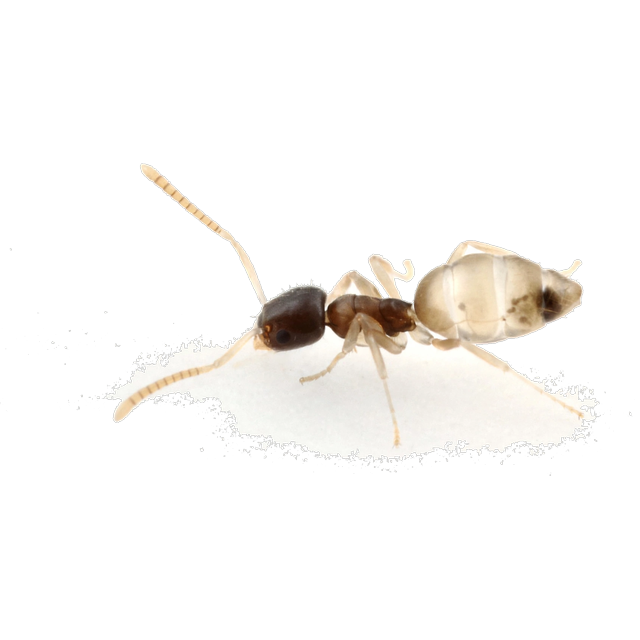
A tiny ant with a dark head and ghostly pale body, common in Florida homes.
- Order
- Hymenoptera
- Family
- Formicidae
- Group
- Ants
- Ontario status
- Not established in Ontario, common household ant in Florida and the Gulf Coast US
Why it matters
A persistent household and greenhouse pest in warm regions; contaminates food and is notoriously hard to eliminate because of its many-queen, many-nest structure.
Origin
Tropical in origin (probably Africa or Asia); now pantropical, moved worldwide in plant shipments and cargo.
Behavior
Tiny, fast and erratic, workers run in jerky bursts. Forages day and night for sweets and honeydew; multiple queens mean the colony never has a single point of failure.
Living conditions
Nests anywhere small and moist: in wall voids, under sinks, in potted plants, behind baseboards. Colonies split into many connected nests.
Signs of presence
- Tiny ants with dark heads and pale bodies trailing along counters and sinks
- Nests in moist spots: under dishwashers, in plant pots
- Ants tending aphids on houseplants
- Trails that seem to appear from nowhere, many small nest entrances
Weaknesses
- Not established in Ontario outdoors, needs tropical warmth
- Workers are fragile and desiccate quickly
- Colonies depend on constant moisture
- Trailing is conspicuous once you know the ghostly look
Myths and facts
Myth They're baby ants of a bigger species.
Reality Workers really are ~1.5 mm, it's a fully grown tiny species, not juveniles.
Myth One nest, one queen.
Reality Many queens across many connected nests, that's why it keeps coming back.
Research notes
Morphology
Workers monomorphic, ~1.3-1.5 mm, among the smallest pest ants. Head and thorax dark brown to black, gaster and legs pale and translucent, the 'ghost' look. Twelve-segmented antennae; single flattened petiole hidden beneath the gaster.
Diagnostics
Confirm by size (~1.5 mm) + bicolored body (dark head, pale translucent gaster) + erratic fast movement. No sting.
Easily confused with
- Pharaoh ant, Monomorium pharaonis Yellowish with a darker gaster tip and a two-segmented petiole; ghost ant has a single petiole node and a dark head.
Life cycle
- Adult
- Workers live weeks; queens a year or more.
- Egg
- Laid by many queens across nests; hatch in ~2-3 weeks in warmth.
- Egg to adult
- ~5-7 weeks at warm temperatures
- Generations per year
- Continuous in warm climates
- Nymph or larva
- Fed by workers over ~2-4 weeks.
Development
Complete metamorphosis: egg → larva → pupa → adult.
Reproduction
Highly polygynous and polydomous, colonies bud constantly; a fragment with queens founds a new colony.
Distribution
- Global
- Pantropical; Florida, Gulf Coast, greenhouses worldwide
- Native range
- Tropics (probably Africa or Asia)
- Ontario
- Not established, occasional greenhouse interceptions possible
Ecology
Opportunistic omnivore favoring honeydew and sweets. Nests are diffuse networks in moist microhabitats; foraging trails recruit rapidly to new finds.
Resistance
Unknown.
IPM implications
Polydomy means the visible trail is one tentacle of a network, monitoring must locate the moisture sources anchoring the nests (plants, plumbing voids). Budding biology punishes partial treatments the same way as Argentine ants.
Chemical ecology
Dolichoderine defensive chemistry, pygidial-gland iridoids; trail pheromones coordinate the diffuse nest network.
Genetics and DNA
No reference genome published as of 2026.
Taxonomy
Order Hymenoptera, family Formicidae, subfamily Dolichoderinae. Described by Fabricius, 1793.
Open questions
Cold-tolerance limits of temperate greenhouse populations.
References
- Ebeling, W. Urban Entomology, UC Riverside
- Mallis Handbook of Pest Control