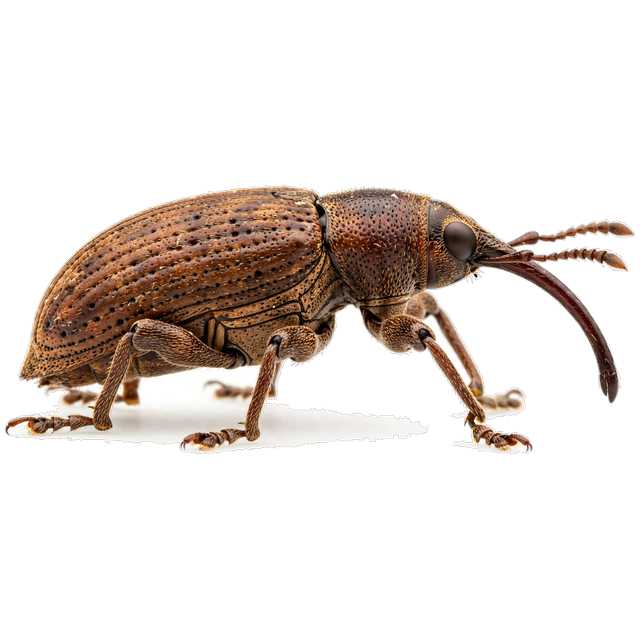
 Granary weevil
Sitophilus granarius (Linnaeus, 1758)
Granary weevil
A flightless weevil with a long snout that lays its eggs inside wheat kernels, the larva grows up hidden in the grain.
- Order
- Coleoptera
- Family
- Curculionidae
- Group
- Stored-product beetles
- Ontario status
- Established, the temperate grain weevil of Ontario farm bins and elevators; flightless
Why it matters
The classic temperate grain weevil, a primary pest that destroys the kernel from the inside. Flightlessness makes it a pest of place: it persists in the same bins and equipment year after year.
Origin
Ancient associate of stored grain, likely Middle Eastern in origin; spread with wheat farming over millennia.
Behavior
Cannot fly, every new infestation arrives in grain or on equipment. Adults feed on kernels; larvae develop entirely hidden inside a single kernel and chew their way out as adults.
Living conditions
Whole stored grain, wheat, barley, oats, in bins, elevators, and mills. The female chews a hole in a kernel, lays one egg inside, and seals it.
Signs of presence
- Small brown weevils (3-5 mm) with long snouts in stored grain
- Kernels with tiny sealed egg plugs or round adult exit holes
- Grain heating in the bin
Weaknesses
- Flightless, cannot spread on its own between storages
- Killed by freezing and by cooled, aerated grain
- The hidden larva is protected, but the adults are exposed and short-ranged
Myths and facts
Myth Weevils in flour come from the wheat field.
Reality The granary weevil cannot survive in the field, it lives only in stored grain, and infestations carry over in bins and equipment between harvests.
Research notes
Morphology
3-5 mm, dark brown, elongate, with a distinct long curved rostrum about 1 mm. Elytra with longitudinal grooves. Flightless, hind wings absent. Punctured pronotum.
Diagnostics
Snout + flightlessness + whole-grain habitat = granary weevil. The rice weevil flies and has elytral spots.
Easily confused with
- Rice weevil, Sitophilus oryzae Rice weevil flies, is smaller (2.5-3.5 mm), and has four pale spots on the elytra; granary weevil is spotless and flightless.
Life cycle
- Adult
- Chews out, feeds, mates; lives several months
- Egg
- One egg per kernel, sealed with a waxy plug; hatch in ~1 week at 27 °C
- Egg to adult
- 4-7 weeks at 27-30 °C; months in cool grain
- Generations per year
- 3-4 in warm storage; fewer in cool bins
- Nymph or larva
- Larva feeds inside the single kernel for ~3 weeks, pupates within
Development
Complete metamorphosis, entirely within the kernel: egg → larva → pupa → adult.
Reproduction
Females lay ~150-200 eggs, one per kernel.
Distribution
- Global
- Cosmopolitan in temperate grain trade
- Native range
- Likely Middle East / Fertile Crescent, with wheat domestication
- Ontario
- Established; the temperate Sitophilus of farm bins and elevators
Ecology
Internal feeder, the kernel is both food and shelter. Flightlessness restricts gene flow; populations are highly localized to facilities.
Resistance
Phosphine resistance documented in some populations; less extreme than in Rhyzopertha or Tribolium.
IPM implications
Flightlessness is the strategic fact: sanitation of bins and equipment between harvests breaks the carryover cycle, because the weevil cannot recolonize from afar. Grain cooling suppresses the internal development it depends on.
Chemical ecology
Aggregation pheromones mediate congregation in grain masses; host grain volatiles guide oviposition choice.
Genetics and DNA
No reference genome published as of 2026.
Taxonomy
Order Coleoptera, family Curculionidae (true weevils; sometimes placed in Dryophthoridae). The rostrum (snout) with chewing mouthparts at the tip is the weevil hallmark.
Open questions
Population structure across disconnected farm bins; endosymbiont complement compared with S. oryzae.
References
- Hagstrum, D.W. & Subramanyam, B. (2006). Fundamentals of Stored-Product Entomology. AACC International.