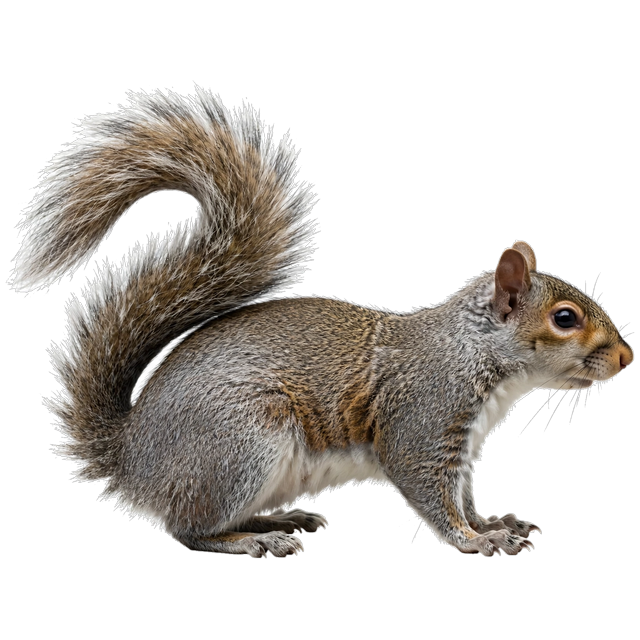
 Gray squirrel
Sciurus carolinensis Gmelin, 1788
Gray squirrel
The diurnal acrobat, plants forests by forgetting where lunch is.
- Order
- Rodentia
- Family
- Sciuridae
- Group
- Wildlife
- Ontario status
- Native, abundant
Why it matters
Chews into attics and gnaws wiring (fire risk); strips gardens; outcompetes native red squirrels in cities.
Origin
Native to eastern North America; the GTA's default urban squirrel.
Behavior
Diurnal; scatter-hoards thousands of nuts each autumn and forgets enough to plant trees; chews constantly because its incisors grow continuously.
Living conditions
Nests (dreys) in tree cavities and attics; needs mast (nuts, acorns) and buds; active year-round, does not hibernate.
Signs of presence
- Gnawed entry holes at rooflines and soffits
- Scampering and rolling-nut sounds in attics by day
- Stripped bark and clipped twigs under trees
- Leaf nests (dreys) high in branches
Weaknesses
- Incisors never stop growing, must gnaw, which makes entry points predictable
- Diurnal, activity is visible and easy to monitor
- Small territories, removing attractants works locally
Myths and facts
Myth Squirrels hibernate in winter.
Reality Gray squirrels stay active all winter on cached nuts, which is exactly why attic invasions peak when it gets cold.
Research notes
Morphology
Body 23-30 cm, tail 19-25 cm; weight 400-600 g. Gray-brown dorsum, pale venter; large bushy tail used for balance and signaling.
Diagnostics
Size + gray pelage + bushy tail; diurnal activity separates it from nocturnal attic invaders.
Easily confused with
- Red squirrel (Tamiasciurus hudsonicus) Half the size (200-250 g), rusty-red, far more vocal and territorial; makes smaller entry holes.
- Eastern chipmunk (Tamias striatus) Much smaller with dorsal stripes; ground-dwelling, rarely an attic pest.
Life cycle
- Egg
- N/A, viviparous (placental mammal)
- Nymph or larva
- Pups: nest-bound about 7 weeks
- Adult
- Sexual maturity about 1 year; lifespan about 6 years wild, up to 20 in captivity
- Egg to adult
- Gestation about 44 days; weaning about 10 weeks
- Generations per year
- Two litters per year (December, February and June, August breeding)
Development
Altricial; eyes open at about 5 weeks, weaned at about 10 weeks.
Reproduction
2-3 young per litter (range 1-5) × 2 litters/year.
Distribution
- Native range
- Eastern North America
- Ontario
- Native, abundant, the dominant urban squirrel
- Global
- Introduced and invasive in the UK, Ireland, Italy, and South Africa
Ecology
Dreys in cavities and attics; no true hibernation, winter activity fuelled by cached mast. Scatter-hoarder; urban home range under 1 ha.
Resistance
Unknown, not applicable; no chemical-control context for a native mammal.
IPM implications
Gnawing is physiological (ever-growing incisors), so exclusion must use gnaw-proof materials, repairs in soft materials get re-chewed. Trim tree limbs 2-3 m back from roofs to break access routes. Spring and autumn are the denning-pressure peaks. Licensed wildlife-control rules apply.
Chemical ecology
Scent-marks with urine and oral glands; tail-flagging and 'kuk' alarm calls coordinate predator warnings. No defensive chemistry, defence is speed and teeth.
Genetics and DNA
Reference genome published: chromosome-level mSciCar1 (GCA_902686445.1; Wellcome Sanger/DToL/VGP, 2020); DNA Zoo chromosome-length assembly.
Taxonomy
Order Rodentia, family Sciuridae. Sciurus carolinensis Gmelin, 1788.
Open questions
Urban population genetics and the mechanics of red-squirrel displacement in Ontario suburbs are active research areas.
References
- Animal Diversity Web, Sciurus carolinensis species account (University of Michigan)
- Koprowski (1994), Sciurus carolinensis, Mammalian Species