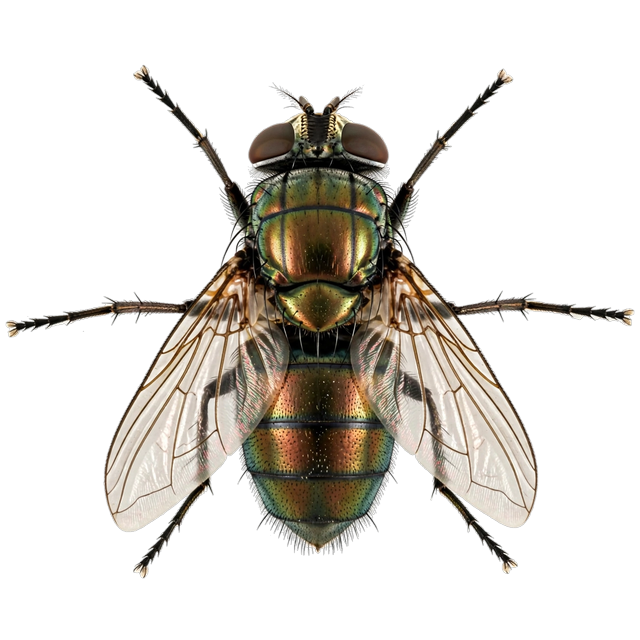
 Green bottle fly
Lucilia spp. Robineau-Desvoidy, 1830
Green bottle fly
Metallic-green carrion flies, one species' sterile maggots are used in hospitals to clean wounds.
- Order
- Diptera
- Family
- Calliphoridae
- Group
- Flies
- Ontario status
- Established, common
Why it matters
Germ carrier from waste to food. Remarkably, sterile larvae of Lucilia sericata are medical tools, maggot debridement therapy cleans dead tissue from wounds in hospitals.
Origin
Native across the northern hemisphere; the common green bottle (Lucilia sericata) is nearly worldwide.
Behavior
Fast, metallic-green fliers, active by day. Indoors, sudden numbers point to a dead animal or neglected garbage, same as blue bottles.
Living conditions
Breeds in carrion, garbage, and pet waste. Outdoors it is also the sheep blowfly, its maggots can infest living sheep (flystrike), a major livestock problem.
Signs of presence
- Metallic green flies indoors in numbers
- Maggots in garbage or near a decay odour
- Loud buzzing localized to one area
Weaknesses
- Same carrion dependence as blue bottles, remove the breeding material
- Maggots need moisture; drying ends the cycle
- Exclusion and waste management break it completely
Myths and facts
Myth All maggots in wounds are dangerous.
Reality Wild maggots in a wound signal neglect, but hospitals deliberately use sterile Lucilia sericata larvae to clean wounds, the context and the sterility make the difference.
Research notes
Morphology
Adult 8-10 mm; metallic green to coppery-bronze. Basicosta (wing-base scale) yellow to pale, the key separation from Calliphora (dark basicosta). Arista plumose to tip. Three postsutural dorsocentral bristles (a key character in the genus).
Diagnostics
Confirm by: 8-10 mm metallic green, yellow basicosta, arista feathered full length. Smaller and greener than Calliphora.
Easily confused with
- Blue bottle fly, Calliphora spp. Yellow basicosta at the wing base means Lucilia; dark basicosta means Calliphora. Colour alone can mislead in poor light.
Life cycle
- Egg
- Batches on carrion or soiled wool; hatch within a day in warmth
- Nymph or larva
- Maggots feed on carrion; L. sericata also causes myiasis (flystrike) in sheep; 3 instars
- Adult
- Several weeks; feeds on nectar, carrion fluids, waste
- Egg to adult
- Approximately 10-14 days at 25 °C; longer in cool weather
- Generations per year
- Multiple; roughly 5-8 in warm regions, fewer in Ontario
Development
Complete metamorphosis: egg → larva (maggot, 3 instars) → pupa → adult.
Reproduction
High fecundity on carrion; rapid colonization, often co-dominant with Calliphora on carcasses.
Distribution
- Native range
- Holarctic; L. sericata now cosmopolitan
- Ontario
- Common; L. sericata abundant in urban and agricultural settings
- Global
- Temperate and subtropical regions worldwide
Ecology
Carrion, garbage, pet waste; L. sericata is the primary sheep-strike blowfly in many regions. Forensically important alongside Calliphora. Overwinters as pupae or adults.
Resistance
Documented in L. sericata sheep-blowfly populations: organophosphate resistance historically significant in Australia; some pyrethroid tolerance reported.
IPM implications
Same carcass-centred logic as blue bottles: find and remove the breeding material, sanitize, exclude. In livestock contexts, the biology (strike-susceptible soiled wool in warm humid weather) drives preventive shearing and crutching schedules, management follows the life cycle, not the adult fly.
Chemical ecology
Carrion sulfur volatiles drive long-range attraction; oviposition also cued by moisture and bacterial volatiles on the substrate.
Genetics and DNA
Reference genome of Lucilia sericata published 2021 (Davis et al., Genomics 113:3978-3988; 565.3 Mb, 14,704 predicted protein-coding genes).
Taxonomy
Diptera: Calliphoridae. Genus Lucilia Robineau-Desvoidy, 1830. Ontario species include L. sericata, L. illustris, L. coeruleiviridis.
Open questions
Competitive partitioning between Lucilia and Calliphora on Ontario carcasses across seasons.
References
- Byrd & Castner (2010), Forensic Entomology (CRC Press)
- Wall & Shearer (2001), Veterinary Ectoparasites (Blackwell), blowfly strike
- Fischer, Lucilia sericata development data, primary literature