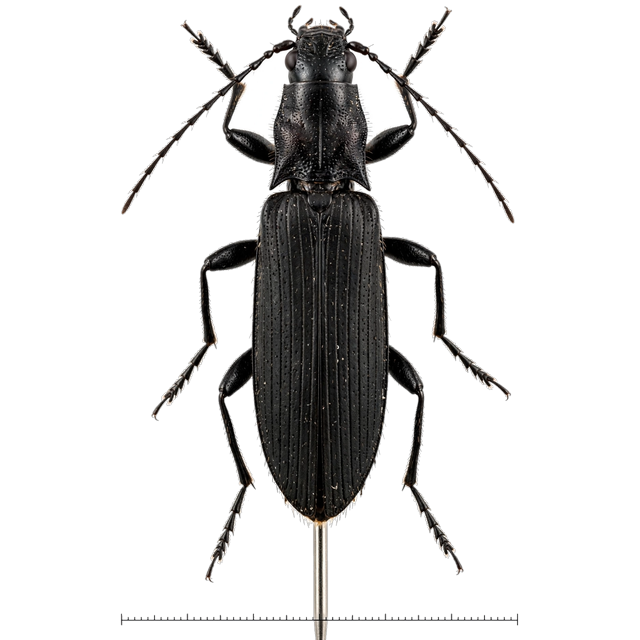
 Hide beetle
Dermestes maculatus (De Geer, 1774)
Hide beetle
The forensic scientist's beetle, it arrives at carrion on a predictable schedule, and museums fear its appetite for specimens.
- Order
- Coleoptera
- Family
- Dermestidae
- Group
- Fabric & structural beetles
- Ontario status
- Established, in Ontario mainly around animal remains, tanneries, and museums; occasional homes
Why it matters
A pest of tanneries, museums, and taxidermy, and a forensic indicator species. In homes it usually means a dead animal in a void or chimney.
Origin
Worldwide with the hide and leather trade, maculatus means 'spotted.'
Behavior
Adults and larvae feed on dried protein. In forensic science, its arrival time at remains helps estimate time since death, it colonizes late, when tissue is drying.
Living conditions
Dried animal matter: hides, leather, carrion, pet food, dead animals in chimneys or voids. The last large beetle to arrive at a carcass.
Signs of presence
- Dark beetles (7-10 mm) without the larder beetle's pale band, near animal remains or leather goods
- Hairy larvae in dried carcasses or hide storage
Weaknesses
- Needs dried animal protein, absent from clean homes
- Slow to colonize; thorough carcass/remains removal prevents buildup
- Killed by freezing
Myths and facts
Myth It's just a big larder beetle.
Reality Different species with different habits, the hide beetle prefers dried carrion and is the forensically important one.
Research notes
Morphology
Adult 7-10 mm, dark brown-black, no pale elytral band. Underside of the abdominal tip bears white hairs (vs. dark in some congeners); males have a pit and spine on the elytral apices. Larva hairy, up to ~12 mm.
Diagnostics
No elytral band + white ventral abdominal hairs + large size = hide beetle. Male elytral spines confirm.
Easily confused with
- Larder beetle, Dermestes lardarius Larder beetle has the pale yellow elytral band; hide beetle is uniformly dark with white hairs beneath the abdomen tip.
Life cycle
- Adult
- Several months
- Egg
- Laid on dried protein; ~1 week to hatch
- Egg to adult
- 2-4 months
- Generations per year
- 2-3
- Nymph or larva
- Feed 1-3 months depending on food quality
Development
Complete metamorphosis; larvae bore pupal chambers like other Dermestes.
Reproduction
~200 eggs per female on carrion or hides.
Distribution
- Global
- Cosmopolitan
- Native range
- Cosmopolitan with trade (exact origin uncertain)
- Ontario
- Established; tanneries, museums, rural properties
Ecology
Late-succession carrion colonizer, arrives as tissue dries; this predictability underpins its forensic use. Also a pest of museum mammal and insect collections.
Resistance
Unknown, no documented resistance.
IPM implications
In buildings, the beetle is a symptom: locate and remove the animal remains (chimney, wall void, attic) and the population has no future. In museums, quarantine and freezing protocols for incoming specimens.
Chemical ecology
Carrion volatile cues; cuticular chemistry studied in forensic contexts.
Genetics and DNA
No reference genome published as of 2026.
Taxonomy
Order Coleoptera, family Dermestidae. Described by Charles De Geer in 1774.
Open questions
Refining post-mortem interval estimates from succession data in northern climates.
References
- Hinton, H.E. (1945). A Monograph of the Beetles Associated with Stored Products, Vol. 1. British Museum (Natural History).