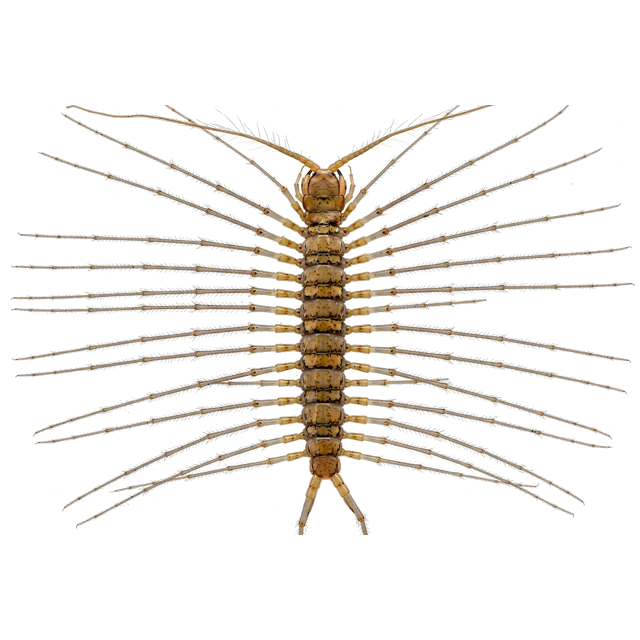
 House centipede
Scutigera coleoptrata (Linnaeus, 1758)
House centipede
The thirty-legged sprinter in your bathtub, it can't climb out, and it's hunting the real pests.
- Order
- Scutigeromorpha
- Family
- Scutigeridae
- Group
- Occasional invaders
- Ontario status
- Established, introduced; common in damp basements and bathrooms
Why it matters
It is the best pest controller you never hired, one house centipede eats the silverfish, carpet beetles, and young cockroaches you'd otherwise pay to remove. Its venom is for prey, not people. The sight of one means dampness and prey; fix those and it moves on.
Origin
The Mediterranean; now worldwide in damp human buildings.
Behavior
A nocturnal sprinter that hunts other household bugs all night, silverfish, roaches, spiders. By day it hides in damp dark places. It can deliver venom through modified front mouthparts (forcipules), but bites are rare and mild.
Living conditions
Damp basements, bathrooms, laundry rooms, and under boxes, anywhere humid with other small bugs to eat. Often found stuck in bathtubs and sinks (it can't climb smooth surfaces).
Signs of presence
- A fast gray-yellow many-legged sprinter at night in the basement or bathroom
- One stuck in the bathtub or sink in the morning
- Fewer silverfish and spiders in homes with resident centipedes
- Long-legged juveniles near floor drains and sump areas
Weaknesses
- Desiccates in dry air, dehumidifiers are kryptonite
- Cannot climb smooth surfaces; bathtubs and sinks are traps
- Completely dependent on humidity and a prey base, dry the basement and starve the hunters, and it leaves
- Fragile legs; it cannot survive long handling or dry exposure
Myths and facts
Myth It has a hundred legs and it's coming for me.
Reality Thirty legs, all for running away from you. It cannot climb smooth porcelain, which is why it's always the bathtub, it's trapped, not attacking.
Myth Its bite is dangerous.
Reality Bites are uncommon and comparable to a mild bee sting. It saves its venom for prey.
Research notes
Morphology
Body 25-35 mm; 15 pairs of long banded legs; the last pair extends rearward like antennae, causing frequent head-tail confusion. Grayish-yellow with dark stripes. Forcipules (venom claws) tucked under the head.
Diagnostics
15 leg pairs, extremely long legs, last pair elongated rearward (often mistaken for antennae, the 'head' is at the other end). Found in damp indoor zones. Speed is itself diagnostic.
Easily confused with
- Millipedes (Diplopoda) Millipedes have two leg pairs per segment, move slowly, and curl up; centipedes have one pair per segment and sprint.
- Silverfish (Lepisma saccharina) Silverfish are smaller, silvery, wingless insects with three tail filaments, no venomous front legs.
Life cycle
- Adult
- Adults live 1-3+ years
- Egg
- Eggs laid singly in damp soil or crevices
- Egg to adult
- About 1 year through successive molts
- Generations per year
- One
- Nymph or larva
- Hatchlings start with 4 leg pairs and gain segments with each molt
Development
Hemimetabolous (anamorphic), hatchlings have few leg pairs and add segments and legs with each molt, reaching 15 pairs as adults.
Reproduction
Males deposit spermatophores; females lay eggs singly in protected damp sites. Low fecundity, long life, a K-selected indoor predator.
Distribution
- Global
- Cosmopolitan in human structures
- Native range
- Mediterranean region
- Ontario
- Established indoors province-wide; cannot overwinter outdoors
Ecology
Apex indoor invertebrate predator, takes silverfish, cockroaches, spiders, carpet beetle larvae. Requires high humidity; desiccates rapidly in dry air. Strictly nocturnal.
Resistance
Unknown, not a pesticide target; no documented resistance.
IPM implications
The highest-value indoor predator in Ontario homes, a single centipede patrols for cockroaches and silverfish nightly. Management is moisture and prey reduction: dehumidify, fix leaks, seal entry points, reduce the prey base. Direct control is counterproductive; the professional advice is usually reassurance plus a dehumidifier. Sticky-trap counts index both centipedes and their prey.
Chemical ecology
Forcipules inject a fast-acting insecticidal venom; modified legs, not jaws. Mammal effects are mild local pain, the venom is tuned for arthropod prey. Antennae and the elongated last leg pair are chemosensory.
Genetics and DNA
No reference genome published as of 2026.
Taxonomy
Order Scutigeromorpha, family Scutigeridae, class Chilopoda. Authority (Linnaeus, 1758). The long-legged morphology is the scutigeromorph hallmark.
Open questions
Prey preferences in Ontario homes unquantified; overwintering limits in unheated structures.
References
- Lewis, J.G.E. (1981). The Biology of Centipedes, Cambridge University Press.
- Ebeling, W. (1978). Urban Entomology, University of California, Riverside.