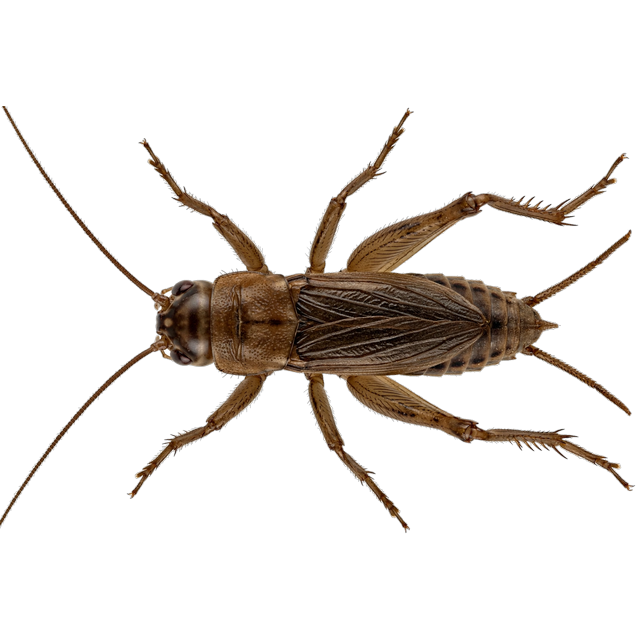
 House cricket
Acheta domesticus (Linnaeus, 1758)
House cricket
The midnight violinist behind your furnace, one male cricket, one very loud night.
- Order
- Orthoptera
- Family
- Gryllidae
- Group
- Occasional invaders
- Ontario status
- Established, heated buildings; often escapees from pet-feeder colonies
Why it matters
A fabric and stored-food pest and a world-class noise nuisance, but also a clue. Indoor breeding crickets mean a warm, food-rich void exists, often tracing back to an escaped pet-feeder colony. Find the warmth, find the crickets.
Origin
Probably southwestern Asia; now worldwide, and increasingly arriving via the pet trade as reptile food.
Behavior
The male rubs his wings together to sing, for a mate, for territory. One male in a quiet house sounds like an orchestra. Active at night, silent by day.
Living conditions
Warm indoor spots, furnace rooms, behind appliances, pet stores, and anywhere escaped feeder crickets found heat and crumbs.
Signs of presence
- Loud chirping at night from behind appliances or in utility rooms
- Chewed spots on wool, silk, or paper in warm storage areas
- Tiny dark droppings near the singing site
- Crickets of mixed sizes (nymphs to adults) indicating a breeding population
Weaknesses
- Needs warmth, cool rooms stop breeding entirely
- The song gives away the male's exact location every time
- Cannot survive an Ontario winter outdoors; the building is its whole world
- Dependent on crumbs and moisture; clean dry utility rooms starve it out
Myths and facts
Myth Crickets in the house mean good luck, so leave them.
Reality Folklore aside, a breeding population chews wool, silk, paper, and stored food, and the luck runs out around the third sleepless night.
Research notes
Morphology
Body 16-22 mm; yellowish-brown with darker markings; long antennae; females with a straight ovipositor; males with forewings modified for stridulation. Hind legs built for jumping.
Diagnostics
Pale brown cricket, chirping males, indoors in warm zones. Breeding populations (nymphs of mixed sizes plus singing males) confirm establishment rather than incidental entry.
Easily confused with
- Field cricket (Gryllus spp.) Field crickets are larger, blacker, and outdoor species that wander in; house crickets are paler and breed indoors.
- Camel cricket (Ceuthophilus spp.) Camel crickets are humpbacked, wingless, silent, and damp-basement dwellers; house crickets chirp and are warmth-loving.
Life cycle
- Adult
- Adults live 2-3 months; males sing, females lay eggs in moist crevices
- Egg
- Eggs laid in damp cracks and soil; hatch in ~2 weeks in warmth
- Egg to adult
- 2-3 months at 25-30 C; far longer when cool
- Generations per year
- 2-3 in heated buildings
- Nymph or larva
- Nymphs are wingless miniatures; 8-10 molts to adulthood
Development
Hemimetabolous, egg to nymph to adult through 8-10 instars. Warmth accelerates everything; a furnace room is a cricket incubator.
Reproduction
Males sing to attract females; females lay hundreds of eggs in moist substrate over their adult life. A single escaped pair near a furnace can found a building population.
Distribution
- Global
- Cosmopolitan in heated structures; also mass-reared as feeder insects and human food
- Native range
- Probably southwestern Asia
- Ontario
- Established in heated buildings; wild outdoor survival impossible in winter
Ecology
Omnivorous scavenger, fabrics, paper, pet food, crumbs. In Ontario buildings, populations often trace to escaped feeder crickets from pet stores and reptile keepers. Cannibalistic at high density.
Resistance
Unknown, managed physically; no documented resistance.
IPM implications
Monitoring: glue boards in warm utility areas; the song itself is a monitoring tool, one singing male locates the harborage. Management: find the warm breeding site (furnace rooms, pet-store stockrooms), remove food and harborage, seal entry, dehumidify. This is a warmth-and-food insect; cool, clean, and sealed beats any treatment.
Chemical ecology
Acoustic, not chemical, communication, males stridulate by rubbing forewings; females phonotax to the song. No defensive chemistry of note.
Genetics and DNA
A chromosome-level annotated reference genome was published in 2023 (Johnston et al., Biomolecules 13(4):589), the first high-quality genome assembly of A. domesticus, with CRISPR/RNAi resources.
Taxonomy
Order Orthoptera, family Gryllidae. Authority (Linnaeus, 1758). Now also a farmed insect, the same species is raised for pet food and human protein.
Open questions
Proportion of Ontario indoor populations derived from feeder-cricket escapees vs. long-established lines.
References
- Ebeling, W. (1978). Urban Entomology, University of California, Riverside.