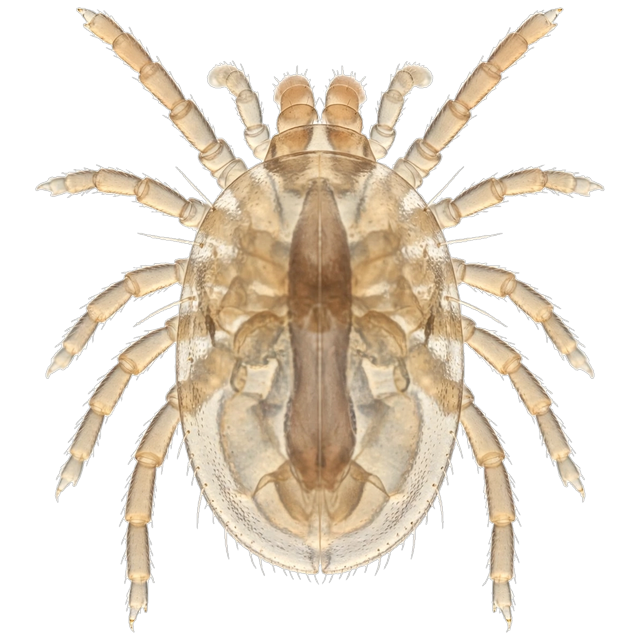
 House dust mite
Dermatophagoides spp. Bogdanov, 1864
House dust mite
The invisible roommate in your mattress, you can't see it, but your allergies can.
- Order
- Sarcoptiformes
- Family
- Pyroglyphidae
- Group
- Ticks & mites
- Ontario status
- Established, in every Ontario home with bedding and humidity
Why it matters
House dust mites are the leading indoor allergen source in Ontario, a major trigger for asthma and allergic rhinitis, especially in children. The good news: no chemicals needed. Dry air, encasements, and hot laundry control them completely.
Origin
Everywhere humans live, they are as old as our bedding.
Behavior
Eats the skin flakes you shed every day, about a million an hour go into your bedding. Does nothing to you directly; it is the droppings that cause allergies. Cannot bite.
Living conditions
Mattresses, pillows, carpets, upholstered furniture, and stuffed toys, anywhere skin flakes settle and humidity stays above 50%.
Signs of presence
- You cannot see them, 0.3 mm is below naked-eye visibility
- Worsening allergy or asthma symptoms in bed and in the morning
- A humid bedroom with old mattresses and wall-to-wall carpet
- Confirmed only by microscopy or dust-allergen testing
Weaknesses
- Dies back sharply when humidity drops below 50%, a dehumidifier is the strongest weapon
- Cannot survive hot-water laundering (above ~55 C)
- Allergen-proof encasements cut off its food supply in mattresses
- Has no mobility to recolonize quickly once a room is dried and cleaned
Myths and facts
Myth Dust mites bite and cause the itchy spots.
Reality They cannot bite, their mouthparts handle only dry flakes. Itchy spots blamed on dust mites are something else; what dust mites cause is sneezing, wheezing, and itchy eyes through allergy.
Research notes
Morphology
0.2-0.3 mm, invisible without magnification. Translucent whitish oval body, eight legs, striated cuticle. Looks like a tiny pale speck under a microscope.
Diagnostics
Confirmed by microscopy of dust samples or by allergen testing (Der p 1 immunoassay). Clinical diagnosis is by allergy testing, not by seeing mites, they are invisible to the naked eye.
Easily confused with
- Stored-product mite (Tyrophagus putrescentiae) Stored-product mites infest food and pantries; dust mites live in bedding and upholstery on skin flakes.
Life cycle
- Adult
- Adults live 2-3 months; females lay 1-3 eggs per day
- Egg
- Eggs laid singly in dust and fabric fibers
- Egg to adult
- 3-4 weeks in warm humid conditions; months in dry cool ones
- Generations per year
- Continuous indoors
- Nymph or larva
- One larval and two nymphal stages, all feeding on skin-flake detritus
Development
Egg to six-legged larva to protonymph to tritonymph to adult. Development ~1 month at 25 C and 75% humidity; stalls below 50% humidity.
Reproduction
Sexual reproduction; males attach to tritonymph females before their final molt. Steady low-rate egg laying sustains huge populations in stable indoor habitat.
Distribution
- Global
- Worldwide in human dwellings
- Native range
- Cosmopolitan with humans
- Ontario
- In every home with mattresses, carpets, and sufficient humidity, which is all of them
Ecology
Feeds on shed human skin flakes colonized by fungi; thrives at 20-30 C and >50% relative humidity. A single mattress can hold hundreds of thousands. Keystone indoor allergen source.
Resistance
Not applicable, not a pesticide target.
IPM implications
This is environmental management, not pest control: allergen-impermeable mattress and pillow encasements, keep bedroom humidity below 50%, hot-water laundering of bedding, HEPA vacuuming, reduce carpet and upholstery reservoirs. No pesticide has any legitimate role, anyone selling you a spray for dust mites is selling the wrong tool.
Chemical ecology
Allergenicity is enzymatic: Der p 1 / Der f 1 are cysteine proteases in mite feces that cleave human epithelial barriers, the mechanism behind the allergy. No venom, no bite; the chemistry that matters is in the droppings.
Genetics and DNA
Draft genomes published for D. farinae (Chan et al., 2015) and D. pteronyssinus (Waldron et al., 2017); chromosomal-level D. farinae genome published 2024 (Hu et al.).
Taxonomy
Order Sarcoptiformes, family Pyroglyphidae. Dermatophagoides farinae (American house dust mite) and D. pteronyssinus (European) are the two dominant indoor species; management identical.
Open questions
Microbiome interactions with human skin fungi; why some homes harbor far higher loads at identical humidity.
References
- Krantz, G.W. & Walter, D.E. (2009). A Manual of Acarology, 3rd ed., Texas Tech University Press.
- Arlian, L.G., house dust mite biology literature (various publications).