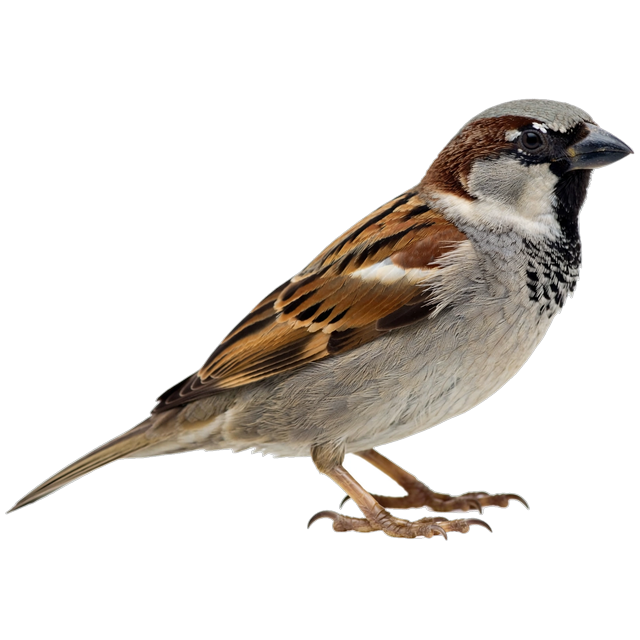
 House sparrow
Passer domesticus (Linnaeus, 1758)
House sparrow
The introduced sparrow that out-competes native birds for every cavity in town.
- Order
- Passeriformes
- Family
- Passeridae
- Group
- Birds
- Ontario status
- Established, ubiquitous
Why it matters
Displaces native cavity-nesting birds; fouls structures; contaminates livestock feed and food facilities.
Origin
Native to Eurasia; introduced to North America in the 1850s, now one of the continent's most familiar birds.
Behavior
Diurnal; gregarious; aggressive cavity competitor, evicts native nesters. Sedentary; rarely moves far from its colony.
Living conditions
Nests in cavities: eaves, vents, signs, nest boxes, and building crevices. Thrives wherever humans spill grain or food waste.
Signs of presence
- Coarse grass nests stuffed into eaves, vents, and signs
- Constant chirping colonies around buildings
- Droppings and feathers below nest cavities
- Evicted native birds' nests tossed below boxes
Weaknesses
- Cavity-dependent: 2 cm mesh over vents and eaves locks it out
- Sedentary, remove the local attractant and the local birds leave
- Nests are messy and obvious in the open
Myths and facts
Myth House sparrows are native songbirds.
Reality Introduced in the 1850s, an invasive species with no legal protection in Canada or the US, which is why management options differ from native birds.
Research notes
Morphology
Body 14-16 cm, weight 24-35 g. Male: grey crown, chestnut nape, black bib; female and juvenile: plain brown, streaked above.
Diagnostics
Stocky sparrow with conical bill; male plumage unmistakable; harsh chirping chorus at colonies.
Easily confused with
- Native sparrows (e.g., song sparrow) Native sparrows are slimmer, streaked, and lack the male's grey crown and black bib.
Life cycle
- Adult
- Lifespan 2-3 years wild; up to 10+ in captivity
- Egg
- Clutch 3-5; incubation 11-14 days
- Egg to adult
- Hatch to fledging ~15 days
- Generations per year
- 2-4 broods/year
- Nymph or larva
- Nestlings fledge at 14-17 days
Development
Oviparous; altricial.
Reproduction
3-5 eggs per clutch × 2-4 broods/year.
Distribution
- Global
- Worldwide in human settlements
- Native range
- Eurasia and North Africa
- Ontario
- Established, ubiquitous in settled areas
Ecology
Human commensal; cavity-nesting competitor; aggressive interspecific behavior, destroys eggs and young of native cavity nesters.
Resistance
Unknown.
IPM implications
Exclusion from eaves and vents with ≤2 cm mesh; nest removal outside breeding; reduce spilled grain and livestock feed. Because it is unprotected by migratory bird law, legal options are broader than for native species, verify current provincial regulations before work.
Chemical ecology
Limited; song and visual signaling dominate. Uropygial gland secretions for plumage.
Genetics and DNA
Reference genome published: NCBI GCA_001700915.1 (Passer_domesticus-1.0); annotated assembly in Kumar et al. 2025 (GigaByte).
Taxonomy
Order Passeriformes › family Passeridae › Passer domesticus (Linnaeus, 1758).
Open questions
Long-term population trends in Ontario cities amid building-envelope modernization.
References
- Cornell Lab of Ornithology, House Sparrow (All About Birds)
- Internet Center for Wildlife Damage Management, House Sparrows