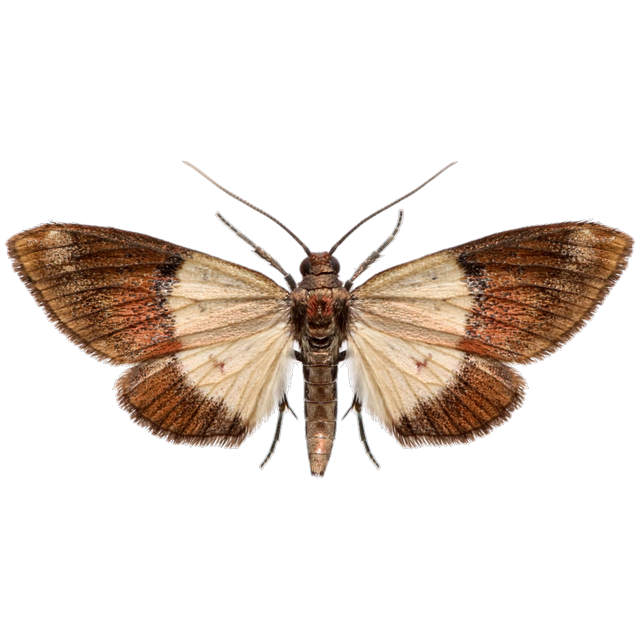
 Indianmeal moth
Plodia interpunctella (Hübner, 1813)
Indianmeal moth
A small pantry moth whose larvae infest flour, cereal, and dry pet food.
- Order
- Lepidoptera
- Family
- Pyralidae
- Group
- Moths
- Ontario status
- Established, common pantry pest provincewide
Why it matters
Contaminates and ruins stored food with webbing, droppings and shed skins, a single infested package can seed a whole pantry. A top economic pest of mills, warehouses and food plants.
Origin
Probably Old World in origin; now the most widespread stored-food moth on earth, moved globally in grain shipments.
Behavior
Adults fly mostly at dusk and don't eat at all, they mate and lay eggs. The larvae do all the damage, tunneling through food and webbing it together. Mature larvae wander away from food to pupate, often seen crawling up walls and ceilings.
Living conditions
Pantries, kitchens, pet-food bins, warehouses, anywhere dry stored food sits: flour, cereal, rice, nuts, chocolate, dry pet food, birdseed. Warmth speeds everything up.
Signs of presence
- Fine silken webbing clumping flour, cereal or pet food
- Small cream-colored caterpillars (~13 mm) in stored food
- Moths with bronze-tipped wings fluttering in the pantry at dusk
- Larvae crawling up walls or across ceilings away from food
- Musty smell and frass in infested packages
Weaknesses
- Adults don't feed, they live only ~1-2 weeks to mate and lay eggs
- Larvae need dry stored food; sealed airtight containers starve them out
- Cold stops development, infested goods can be frozen
- Wandering larvae are exposed and easily spotted
Myths and facts
Myth The moths are eating my food.
Reality Adult moths never feed; the larvae do 100% of the damage.
Myth They mean my kitchen is dirty.
Reality They almost always arrive inside infested products from the store, check birdseed and pet food first.
Research notes
Morphology
Adults 8-10 mm body length, wingspan 16-20 mm. Forewings pale gray at the base with a distinct bronze/copper outer third, the key field mark. Larvae cream to yellowish-green, ~13 mm at maturity, with a brown head capsule.
Diagnostics
Confirm by the two-toned forewing (gray base, bronze tip) at rest. Larvae in food with webbing and frass; wandering mature larvae on walls away from food.
Easily confused with
- Mediterranean flour moth, Ephestia kuehniella Uniformly pale gray forewings with dark zigzag markings, no bronze tips; larger, and a flour-mill specialist.
Life cycle
- Adult
- Lives ~5-14 days; does not feed; mates and lays eggs.
- Egg
- Tiny gray-white ovals laid singly or in clusters on food surfaces; hatch in 2-14 days.
- Egg to adult
- ~4 weeks at 30 °C; 8-10+ weeks at 20 °C
- Generations per year
- 4-7+ indoors per year (continuous in heated buildings)
- Nymph or larva
- 5-7 instars over 2-8 weeks; feeds while webbing food together; mature larva wanders to pupate in cracks or on walls.
Development
Complete metamorphosis: egg → larva (5-7 instars) → pupa → adult.
Reproduction
Females lay 60-400 eggs over a few nights, a single mated female can infest multiple packages.
Distribution
- Global
- Cosmopolitan in stored products
- Native range
- Probably Mediterranean / Old World
- Ontario
- Established, common pantry pest provincewide
Ecology
Larvae are generalist feeders on dry plant and animal products. Pre-pupal wandering disperses the infestation between packages and rooms.
Resistance
Phosphine resistance documented in some stored-product populations; susceptibility varies, monitor, don't assume.
IPM implications
Monitoring is pheromone-trap based: trap catch maps the infestation back to its source, since adults disperse from it. Because larvae wander to pupate away from food, inspection must extend beyond the pantry to wall and ceiling junctions. Source reduction, finding and discarding the infested package, resolves most cases; the biology says the breeding site is always a food mass.
Chemical ecology
Female sex pheromone ((Z,E)-9,12-tetradecadienyl acetate) attracts males, the basis of pheromone monitoring traps used across the food industry.
Genetics and DNA
No chromosome-level reference genome published as of 2026; a draft HiFi assembly was published in 2022 (Kawahara et al., GigaByte; N50 9.7 Mbp, BUSCO 99.3%).
Taxonomy
Order Lepidoptera, family Pyralidae (snout moths). Described by Hübner, 1813. The most economically important stored-product moth worldwide.
Open questions
Population genomics of phosphine-resistant strains; triggers of pre-pupal wandering.
References
- Phillips & Throne 2010, Annu. Rev. Entomol. (stored-product IPM)
- Hagstrum & Subramanyam 2006, Fundamentals of Stored-Product Entomology
- Mallis Handbook of Pest Control