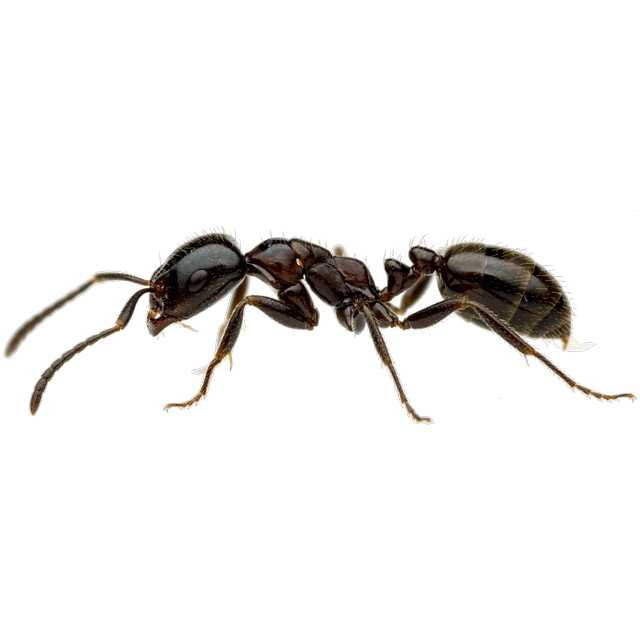
 Little black ant
Monomorium minimum (Buckley, 1867)
Little black ant
A 1.5 mm jet-black ant that marches in tight trails from lawn nests straight into kitchens.
- Order
- Hymenoptera
- Family
- Formicidae
- Group
- Ants
- Ontario status
- Native, established provincewide
Why it matters
A persistent food contaminator and one of the most frequent nuisance ants in Ontario homes. Does not sting or damage structures.
Origin
Native to North America; one of the continent's smallest common ants.
Behavior
Forages in dense, well-defined trails. Colonies are active through the warm season; indoor nests stay active in winter.
Living conditions
Nests in soil, under stones, in lawns, and in wall voids and under floors. Enters homes through tiny cracks seeking sweets and grease.
Signs of presence
- Dense trails of minute black ants along baseboards or sidewalks
- Small soil craters in lawns near foundations
- Ants in sweet foods and spills
Weaknesses
- Trails are conspicuous and traceable to nest entrances
- Outdoor lawn nests are visible as small soil craters
- Strongly attracted to sweets, making monitoring straightforward
Myths and facts
Myth Tiny black ants are baby ants of a bigger species.
Reality Ant workers do not grow, a 1.5 mm ant is a full-grown adult of a small species.
Research notes
Morphology
Workers ~1.5 mm, dark brown to black, shiny. Two-segmented waist; 12-segmented antennae with 3-segmented club; no propodeal spines.
Diagnostics
Confirm by minute black size + shiny cuticle + two-segmented waist + trailing behavior. Separated from pharaoh ant by color (black vs. yellow).
Easily confused with
- Pharaoh ant, Monomorium pharaonis Pharaoh ant is yellow-amber; little black ant is dark brown to black. Same genus, opposite color, different nesting biology.
- Pavement ant, Tetramorium caespitum Pavement ant is larger (2.5-4 mm) with grooved head sculpturing; little black ant is smaller (~1.5 mm) and smooth-shiny.
Life cycle
- Adult
- Workers live ~1-2 months in season.
- Egg
- Eggs hatch in ~2 weeks at warm temperatures.
- Egg to adult
- ~5-7 weeks at warm temperatures
- Generations per year
- Multiple in the warm season
- Nymph or larva
- Legless larvae; naked pupae.
Development
Complete metamorphosis: egg → larva → pupa → adult.
Reproduction
Multiple queens; colonies moderate (hundreds to a few thousand workers).
Distribution
- Global
- North America
- Native range
- North America
- Ontario
- Native; established provincewide
Ecology
Nests in soil, under objects and in wall voids; omnivorous with strong sugar preference. Dense recruitment trails.
Resistance
No published data.
IPM implications
Trail mapping is straightforward, follow the dense columns to nest entrances in lawns or wall voids. Outdoor nest treatment at the source outperforms indoor forager suppression. Sweet-based monitoring is highly effective given the strong sugar preference.
Chemical ecology
Trail pheromones support dense recruitment; typical myrmicine alarm chemistry.
Genetics and DNA
No reference genome published as of 2026.
Taxonomy
Order Hymenoptera, family Formicidae, subfamily Myrmicinae, genus Monomorium (same genus as the pharaoh ant). Described by Buckley, 1867.
Open questions
Queen number variation across urban vs. natural habitats.
References
- Hölldobler, B. & Wilson, E.O. 1990, The Ants, Harvard University Press
- Mallis Handbook of Pest Control