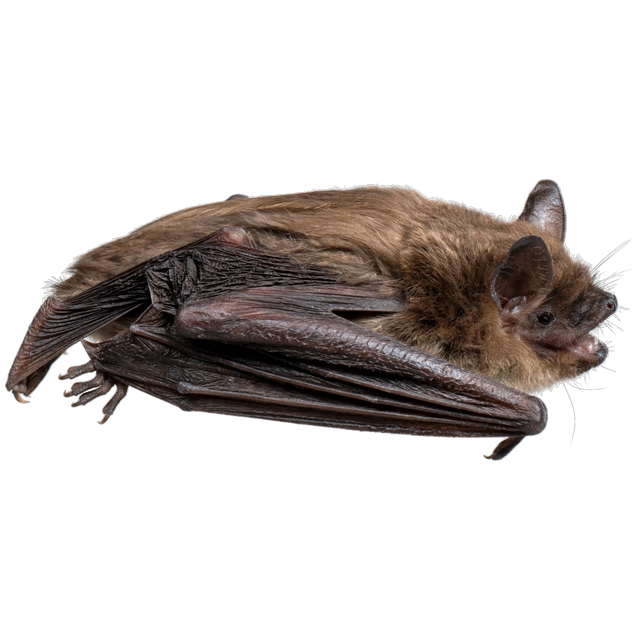
 Little brown bat
Myotis lucifugus (Le Conte, 1831)
Little brown bat
A 10-gram insect vacuum, and Ontario's most imperiled bat.
- Order
- Chiroptera
- Family
- Vespertilionidae
- Group
- Wildlife
- Ontario status
- Native, ENDANGERED in Ontario (white-nose syndrome); protected
Why it matters
ENDANGERED in Ontario and legally protected, colonies in buildings create human-wildlife conflict that must be resolved without harming the bats.
Origin
Native across North America; once Ontario's most abundant bat.
Behavior
Nocturnal; fast, erratic flight close to vegetation and water; reported to eat up to about 1,000 insects in a night.
Living conditions
Maternity colonies in attics and barns; hibernates in caves and mines; needs open water nearby for drinking and insect prey.
Signs of presence
- Fine guano piles beneath roost exits
- High-pitched chittering at dusk
- Bats skimming ponds at twilight
Weaknesses
- Devastated by white-nose syndrome, eastern populations crashed over 90%
- Tiny size limits roost entry to gaps of about 1.5 cm
- Hibernation clusters are countable, and fragile
Myths and facts
Myth All bats carry rabies.
Reality Under 1% of wild bats carry rabies, but because any exposure is serious, every bat contact is treated as a potential exposure. Respect, not panic.
Research notes
Morphology
Body 8-10 cm, wingspan 22-27 cm; weight 5-14 g. Glossy brown fur, dark wing membranes; small mouse-like face.
Diagnostics
Ontario's smallest common bat; rapid fluttering flight.
Easily confused with
- Big brown bat (Eptesicus fuscus) Nearly twice the mass with slower, steadier flight; the little brown is the darting one.
Life cycle
- Egg
- N/A, viviparous (placental mammal)
- Nymph or larva
- Pup: flight at about 3 weeks
- Adult
- Sexual maturity about 1 year; lifespan recorded beyond 30 years
- Egg to adult
- Gestation 50-60 days; weaning about 3 weeks
- Generations per year
- One pup per year
Development
Single pup; volant at about 3 weeks.
Reproduction
1 pup × 1 litter/year.
Distribution
- Native range
- North America
- Ontario
- Native, ENDANGERED under Ontario's Endangered Species Act (white-nose syndrome)
- Global
- North America only
Ecology
Maternity colonies in buildings; hibernates October, April in caves and mines; forages over water and forest edges; extremely long-lived for its size.
Resistance
Unknown, not applicable; note: no insecticide resistance context, but catastrophic susceptibility to the fungal pathogen Pseudogymnoascus destructans.
IPM implications
ENDANGERED and protected, exclusion only outside maternity season and only by authorized persons; disturbing a maternity colony is an offence under the Endangered Species Act. Conservation framing: this species is in crisis and every colony matters.
Chemical ecology
Olfactory and vocal social cues at roosts; no defensive chemistry.
Genetics and DNA
Reference genome published: Myoluc2.0 (GCF_000147115.1; Broad Institute; Lindblad-Toh et al. 2011, Nature).
Taxonomy
Order Chiroptera, family Vespertilionidae. Myotis lucifugus (Le Conte, 1831).
Open questions
White-nose syndrome tolerance mechanisms; why some hibernacula retain remnant populations.
References
- Animal Diversity Web, Myotis lucifugus species account (University of Michigan)
- Ontario Ministry species profile, Little brown myotis (Endangered)