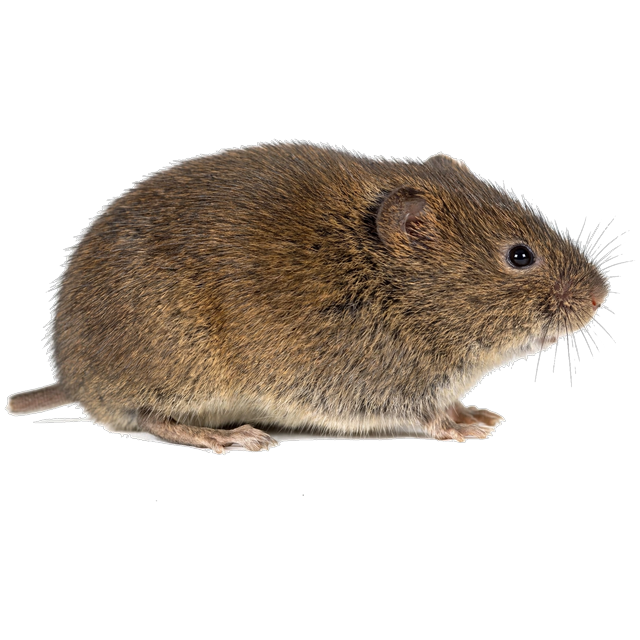
 Meadow vole
Microtus pennsylvanicus (Ord, 1815)
Meadow vole
The grassland tunneler, surface runways, winter bark-gnawing, and boom-bust cycles.
- Order
- Rodentia
- Family
- Cricetidae
- Group
- Rodents
- Ontario status
- Native, common
Why it matters
Girdles young trees and shrubs (orchard and nursery damage); damages turf; a key prey base for hawks and owls.
Origin
Native to North American meadows and grasslands, it was here long before the lawns.
Behavior
Active day and night; a strong swimmer. Populations boom and crash on roughly 3-5 year cycles.
Living conditions
Grassy fields, lawns, and gardens; builds surface runways under the thatch and burrows below. Rarely enters homes, this is an outdoor animal.
Signs of presence
- Surface runways 3-5 cm wide through lawns and meadows
- Girdled bark on young trees and shrubs in winter
- Small burrow openings with clipped-grass piles
- Greenish pellet droppings along runways
Weaknesses
- Runways make it visible, surface trails reveal the whole colony
- Winter bark damage is preventable with simple trunk guards
- Population crashes follow booms, habitat work outlasts any single cycle
Myths and facts
Myth Voles are just field mice.
Reality Voles are stockier with much shorter tails; they eat vegetation and bark, not stored food, and they rarely come indoors.
Research notes
Morphology
Body 90-130 mm, tail 30-50 mm (short), weight 20-70 g. Stocky; blunt muzzle; small ears hidden in fur; chestnut-brown above, grey below. Droppings small greenish-brown pellets ~3-5 mm, often in latrines along runways.
Diagnostics
Short tail (under half of body length) plus stocky build separates voles from all mice; surface runways are diagnostic of Microtus activity.
Easily confused with
- House mouse (Mus musculus) House mouse has a long tail (equal to body) and pointed muzzle; vole tail is stubby and the body barrel-shaped.
Life cycle
- Adult
- Lifespan ~12 months in the wild
- Egg
- N/A, viviparous
- Egg to adult
- Gestation 20-21 days; maturity at 3-6 weeks
- Generations per year
- Multiple; populations irrupt in boom years
- Nymph or larva
- Pups weaned at ~14 days; mature at 3-6 weeks
Development
Viviparous; altricial but fast-developing.
Reproduction
3-6 pups per litter × multiple litters/year.
Distribution
- Global
- North America only
- Native range
- North America
- Ontario
- Native, common province-wide in grassy habitats
Ecology
Herbivorous grazers of grasses, sedges, and bark; runway-and-burrow systems; famous multi-year population cycles driven by predation and food.
Resistance
Unknown.
IPM implications
Habitat modification is the lever: mow buffer strips, clear groundcover near structures, install trunk guards on vulnerable trees. Runway mapping shows colony extent. Voles are an outdoor problem, building exclusion is rarely the issue.
Chemical ecology
Scent marking along runways; urine and fecal latrines as territorial signals.
Genetics and DNA
Reference genome published: VGP chromosome-level assembly mMicPen1 (GCF_037038515.1, NCBI RefSeq, 2025).
Taxonomy
Order Rodentia › family Cricetidae › subfamily Arvicolinae › Microtus pennsylvanicus (Ord, 1815).
Open questions
Drivers of the local 3-5 year cycle amplitude in southern Ontario are not fully resolved.
References
- Internet Center for Wildlife Damage Management, Meadow Vole
- Cornell Cooperative Extension, Vole Damage Management