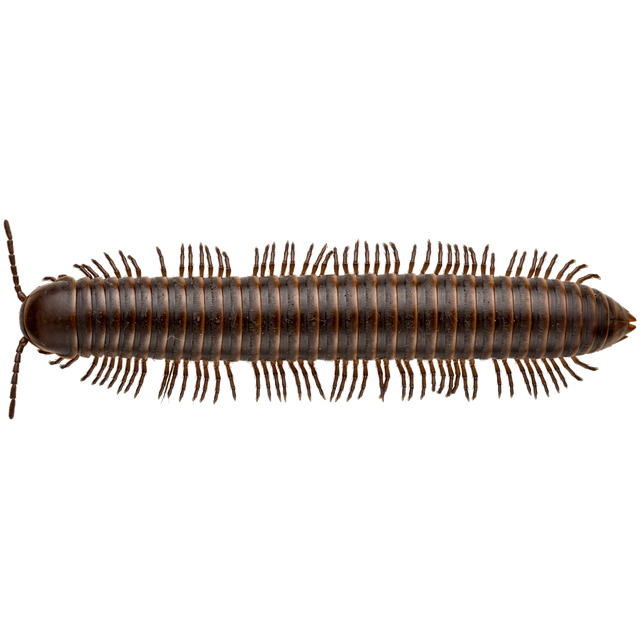
 Millipede
Diplopoda
Millipede
A slow, many-legged decomposer with two pairs of legs on most body segments.
- Order
- Diplopoda
- Group
- Occasional invaders
- Ontario status
- Native, common
Why it matters
Beneficial outdoors, a premier recycler of dead leaves. Indoors it is a harmless nuisance that signals excess moisture or mulch contact with the building.
Origin
An ancient lineage, millipedes are among the oldest land animals, over 400 million years old. Ontario's common species include native decomposers like the American giant millipede; the greenhouse millipede (Oxidus gracilis) is an introduced species, native to Asia.
Behavior
Slow-moving and harmless. When disturbed it coils into a tight spiral and may release a defensive fluid that can stain skin and irritate eyes, but it cannot bite or sting.
Living conditions
Needs damp soil and decaying matter: leaf litter, mulch beds, compost, rotting logs. Wanders indoors during very dry spells (seeking moisture) or in fall (seeking shelter).
Signs of presence
- Slow worm-like creatures with many legs in basements or on patios
- Curled-up spiral shapes under pots and doormats
- Appearing in numbers after heavy rain or during drought
- Brownish stains where handled (defensive secretion)
Weaknesses
- Dry conditions, it desiccates like all moisture pests
- Mulch and leaf litter piled against the foundation
- Gaps under doors and around ground-level windows
Myths and facts
Myth Millipedes are dangerous like centipedes.
Reality Millipedes have no venom and no bite. The fast, flat, venomous ones are centipedes, millipedes are the slow, round, peaceful ones.
Myth They have a thousand legs.
Reality Most have 30-400 legs; but one species does reach a thousand: Eumillipes persephone (described 2021, Western Australia) has up to 1,306 legs, the leggiest animal known. Most body segments carry two pairs of legs, the group's defining trait (the first few segments carry fewer).
Research notes
Morphology
Elongate cylindrical body, 20-100+ mm depending on species; each diplosegment bears two pairs of legs (vs. one pair per segment in centipedes); rounded head with short antennae; many species with defensive ozopores along the flanks.
Diagnostics
Two leg pairs per segment + cylindrical body + slow movement = millipede. Coiling into a spiral when disturbed is characteristic. Leg count and the absence of forcipules (venom claws) separate them from centipedes instantly.
Easily confused with
- House centipede, Scutigera coleoptrata The centipede is flattened, fast, and has one long leg pair per segment plus venom claws; the millipede is cylindrical, slow, with two leg pairs per segment.
Life cycle
- Adult
- Long-lived; 1-7+ years depending on species
- Egg
- Laid in moist soil or decaying matter; guarded by some species
- Egg to adult
- Months to over a year
- Generations per year
- Typically 1
- Nymph or larva
- Stadia add segments and legs with each molt
Development
Anamorphic development: hatchlings emerge with few segments and add segments and legs with each molt. No metamorphosis.
Reproduction
Sexual; males transfer sperm via modified legs (gonopods). Females lay tens to hundreds of eggs in soil cavities.
Distribution
- Global
- Worldwide in moist terrestrial habitats
- Native range
- Worldwide; Ontario fauna native (plus the introduced greenhouse millipede)
- Ontario
- Native, common in forests, gardens, mulch, and occasionally structures
Ecology
Detritivores, among the most important shredders of leaf litter in temperate forests. Defensive benzoquinone and (in some taxa) hydrogen cyanide secretions deter predators. Prey for ground beetles, shrews, and birds.
Resistance
Unknown, not a pesticide target; no documented resistance.
IPM implications
Habitat modification only: pull mulch and leaf litter back from the foundation, correct drainage, reduce irrigation against the building, and seal ground-level entries. Indoor individuals desiccate and die; vacuum and discard. Mass indoor movements after rain or drought are weather-driven and self-limiting.
Chemical ecology
Defensive secretions: benzoquinones in most juliform millipedes; hydrogen cyanide in some polydesmidans. Secretions are predator deterrents, released from lateral ozopores, biological defense, not a control target.
Genetics and DNA
A diplopod genome has been published: the rusty millipede Trigoniulus corallinus genome (Kenny et al., Genome Biology and Evolution, 2015), the first millipede genome sequenced.
Taxonomy
Class Diplopoda (within Myriapoda). This dossier covers the group; Ontario's frequently encountered species include the greenhouse millipede (Oxidus gracilis, Paradoxosomatidae) and the American giant millipede (Narceus americanus, Spirobolidae).
Open questions
Species-level distribution mapping across Ontario is incomplete; the northern range limits of the introduced greenhouse millipede are not well documented.
References
- Penn State Extension, Millipedes
- University of Kentucky Entomology, Millipedes
- Iowa State University Extension, Millipedes