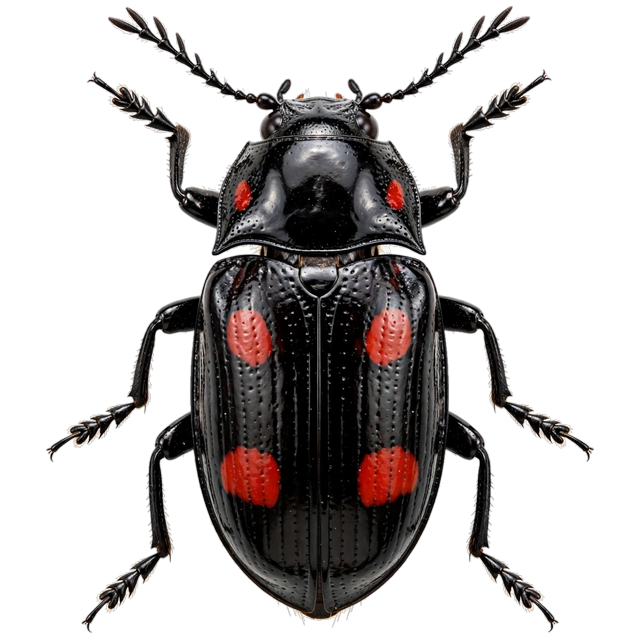
 Northern black widow
Latrodectus variolus Walckenaer, 1837
Northern black widow
Ontario's only spider with a medically significant bite, rare, shy, and almost never inside homes.
- Order
- Araneae
- Family
- Theridiidae
- Group
- Spiders
- Ontario status
- Native but rare, southern Ontario; secretive, almost never indoors
Why it matters
This is the one Ontario spider whose bite genuinely warrants medical attention, but context matters: encounters are rare, bites rarer, and fatalities essentially unheard of with modern care. Respect, not fear, is the right response. Wear gloves moving firewood.
Origin
Native to eastern North America, including southern Ontario, it belongs here.
Behavior
Extremely shy and non-aggressive. Bites happen only when the spider is pressed against skin, typically a hand reaching blindly into a woodpile. Spends its life in one web.
Living conditions
Outdoors and out of the way: woodpiles, sheds, stone walls, hollow stumps, undisturbed debris. Builds a strong irregular cobweb near the ground and hides in a retreat by day.
Signs of presence
- Unusually strong, messy cobwebs near ground level in woodpiles or sheds
- A glossy black spider with red markings hanging in the web (females)
- Round cream-colored egg sacs in the webbing
- Smaller brown males or juveniles nearby in season
Weaknesses
- Sedentary and web-bound, removing clutter and debris removes its habitat
- Bites only under direct pressure; gloves eliminate virtually all risk
- Rare and localized, most Ontarians will never encounter one
- Short outdoor season of peak activity; retreats deep in cold months
Myths and facts
Myth Black widows are aggressive and will chase people to bite them.
Reality They are among the shyest spiders in Ontario. The classic bite scenario is a bare hand crushing one accidentally, an accident, not an attack.
Myth A black widow bite is usually fatal.
Reality With modern medical care, deaths are extraordinarily rare. Most bites are medically manageable; antivenom exists for severe cases.
Research notes
Morphology
Female body 8-13 mm, glossy black, globose abdomen with red dorsal markings (spots or bars; pattern variable). Male 3-5 mm, brown with pale markings. Legs long, combed hind tarsi (theridiid silk-handling comb).
Diagnostics
Glossy black theridiid with red markings + extremely strong web silk + ground-level retreat web. Juveniles and males are brown and easily missed, confirm adults by dorsal pattern and range.
Easily confused with
- False widows (Steatoda spp.) Steatoda lacks red markings, has weaker silk, and is far more common indoors; when in doubt, assume Steatoda, true widows are rare in Ontario.
Life cycle
- Adult
- Females live 1-3 years; males die after mating season
- Egg
- 100-400 eggs per cream-colored sac; several sacs per female in summer
- Egg to adult
- One season to maturity in Ontario climate
- Generations per year
- One
- Nymph or larva
- Spiderlings disperse by ballooning; high early mortality
Development
Egg to spiderling to adult through successive molts. Spiderlings balloon to disperse.
Reproduction
Males court cautiously on the female's web (sexual cannibalism occurs but is not obligate). Females store sperm and produce multiple sacs across the season.
Distribution
- Global
- Eastern North America only; congeners worldwide
- Native range
- Eastern North America
- Ontario
- Native but uncommon; confirmed records concentrated in southern Ontario; essentially never established indoors
Ecology
Ground-level web predator of crawling insects. Native component of southern Ontario's fauna; populations localized to suitable microhabitat (rocky, debris-rich sites). Prey for mud daubers and birds.
Resistance
Unknown, not a pesticide target; no documented resistance.
IPM implications
Not a structural pest; no interior program warranted. Outdoor management is habitat-based: clear debris and woodpiles near high-traffic areas, store firewood off the ground and away from doors, enforce glove use. Client communication should be factual and calming, this spider's reputation causes more harm (panic spraying) than the spider does.
Chemical ecology
Venom contains alpha-latrotoxin, a potent presynaptic neurotoxin causing massive neurotransmitter release (latrodectism: muscle cramps, pain, autonomic effects). The most mammal-active spider venom in Ontario, which is precisely why the animal's shyness matters. Silk is exceptionally strong for its diameter.
Genetics and DNA
No L. variolus genome, but congeneric reference genomes exist: L. hesperus draft assembly (GCA_000697925.1), L. elegans chromosome-level genome 2022 (GigaScience, PMID 35639632), and L. hesperus chromosome-level genome 2026 (Genome Biology and Evolution).
Taxonomy
Order Araneae, family Theridiidae, genus Latrodectus. Authority Walckenaer, 1837. Northern species distinguished from L. mactans by dorsal red spots (variable) rather than a strict ventral hourglass; Ontario populations are variolus.
Open questions
Ontario population size, exact range limits, and overwintering survival rates are poorly documented.
References
- Foelix, R.F. (2011). Biology of Spiders, 3rd ed., Oxford University Press.
- Vetter, R.S., UC Riverside spider-bite myth research (various publications).