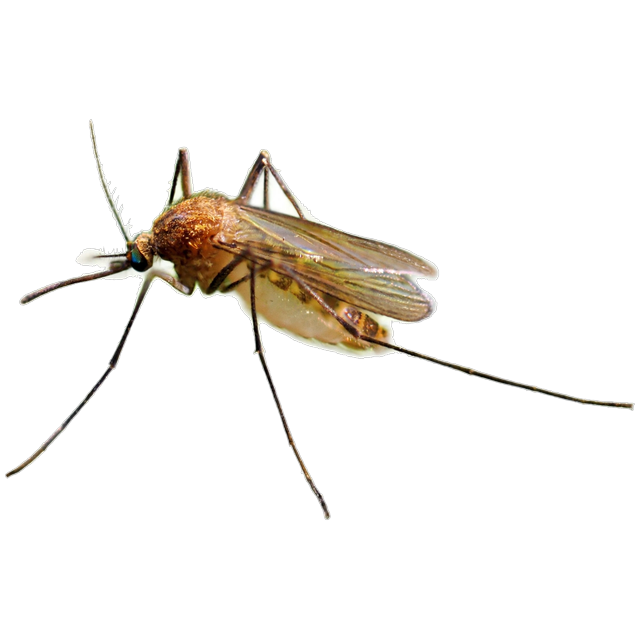
 Northern house mosquito
Culex pipiens Linnaeus, 1758
Northern house mosquito
The common evening mosquito of Ontario cities, and the main carrier of West Nile virus here.
- Order
- Diptera
- Family
- Culicidae
- Group
- Mosquitoes
- Ontario status
- Established, abundant
Why it matters
Ontario's primary West Nile virus vector. The virus cycles between birds and these mosquitoes; people are incidental hosts. Most infections are mild or silent, but a small fraction cause serious neurological illness.
Origin
Native to Europe and northern Asia; now one of the most widespread mosquitoes on earth.
Behavior
Bites mainly at dusk and through the night. Rests in cool shade by day. Females need blood to make eggs; males feed on nectar and never bite.
Living conditions
Breeds in stagnant, organically rich water: catch basins, storm drains, tires, clogged gutters, containers, ditches. A bottle cap of stagnant water can breed them.
Signs of presence
- Biting at dusk and night, especially near storm drains and ditches
- Wrigglers (larvae) hanging just under the surface of stagnant water
- Egg rafts, tiny dark floating ovals, on still water
- A high-pitched whine in the bedroom at night
Weaknesses
- Cannot breed without stagnant water, dump it weekly and the cycle breaks
- Larvae must breathe at the surface; agitated or stocked water defeats them
- Only females bite, and only from dusk to dawn, screens and timing are powerful
- Overwintering females hide in sewers and basements; they are vulnerable before spring breeding
Myths and facts
Myth All mosquitoes can give you West Nile.
Reality In Ontario it is overwhelmingly this species (and its close relatives). Different mosquitoes carry different diseases, the species matters.
Myth Bug zappers control mosquitoes.
Reality Zappers kill mostly moths and beetles, very few biting mosquitoes. They do not reduce biting pressure.
Research notes
Morphology
Adult 4-7 mm; brown, unbanded legs and abdomen; abdomen blunt-tipped in females (vs. pointed in Aedes/Anopheles). Wings with scales along veins. Females: piercing-sucking proboscis; males: feathery antennae, non-biting.
Diagnostics
Confirm by: 4-7 mm brown mosquito, unbanded legs, blunt-tipped abdomen, egg rafts on water, larvae hanging at an angle from the surface. Dusk/night biting supports the ID.
Easily confused with
- Asian tiger mosquito, Aedes albopictus Aedes has bold white bands on legs and a white stripe on the back, bites aggressively by day; Culex is plain brown and bites at night.
- Malaria mosquito, Anopheles spp. Anopheles females have palps as long as the proboscis and spotted wings, and their larvae lie flat at the surface; Culex larvae hang at an angle and lack long palps.
Life cycle
- Egg
- Laid as floating rafts of 100-300 eggs on stagnant water; hatch in 1-3 days in warmth
- Nymph or larva
- Aquatic wrigglers breathe through a siphon, hanging head-down at an angle; filter-feed on microorganisms; 4 instars
- Adult
- Females blood-feed at dusk/night; males on nectar; adults live 2-4 weeks in summer
- Egg to adult
- Approximately 7-14 days at 25 °C; 3+ weeks in cool spring water
- Generations per year
- Multiple; roughly 5-8 in Ontario summers
Development
Complete metamorphosis: egg (raft) → larva (wriggler, 4 instars) → pupa (tumbler) → adult.
Reproduction
Each blood-fed female lays rafts of 100-300 eggs; a single catch basin produces thousands per week in July.
Distribution
- Native range
- Europe and northern Asia
- Ontario
- Abundant in every municipality; the dominant urban mosquito
- Global
- Cosmopolitan temperate regions
Ecology
Strong bird-feeding preference drives the enzootic West Nile cycle; late-summer host shift toward mammals creates the bridge to people. Overwinters as diapausing, mated adult females in sewers, basements, culverts and caves. Larval habitats: any stagnant, organically enriched water.
Resistance
Widely documented: pyrethroid resistance via kdr target-site mutations and metabolic mechanisms; organophosphate resistance in many populations. Resistance management is a standing concern for municipal programs.
IPM implications
Source reduction dominates by life-cycle logic: larvae are confined to water for 1-3 weeks, so weekly water removal (dump, drain, cover) outranks all adult measures. Larval monitoring (dipping) guides targeted larvicide in unmanageable habitats like catch basins. Adult control is supplementary and resistance-constrained. Public messaging follows the biology: the mosquito's week is spent in water, its minutes on you.
Chemical ecology
Host-seeking via CO2, body odour (lactic acid, octenol) and heat; oviposition attracted to bacterial volatiles of organically rich water (the 'stagnant water' smell is a cue, not a coincidence).
Genetics and DNA
Culex quinquefasciatus (sibling species, southern house mosquito) genome published 2010 (~580 Mb; Arensburger et al., Science); C. pipiens complex genomics an active field.
Taxonomy
Diptera: Culicidae. Culex pipiens Linnaeus, 1758, centre of the C. pipiens complex, whose forms (pipiens, molestus) differ in host preference and overwintering.
Open questions
Fine-scale pipiens/molestus form distribution and hybridization in Ontario cities; overwintering survival under variable winters.
References
- Arensburger et al. (2010), Science, Culex quinquefasciatus genome
- Ontario Ministry of Health, West Nile virus surveillance program
- Service (2012), Medical Entomology for Students (Cambridge UP)