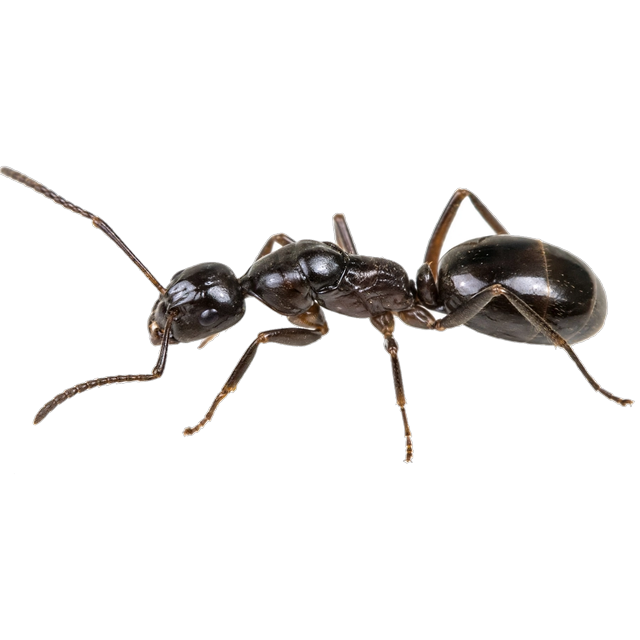
 Odorous house ant
Tapinoma sessile (Say, 1836)
Odorous house ant
Crush one and it smells like rotten coconut, the native ant that moves indoors every spring.
- Order
- Hymenoptera
- Family
- Formicidae
- Group
- Ants
- Ontario status
- Native, established provincewide
Why it matters
A persistent food contaminator and one of the most common spring invaders in Ontario homes. Does not sting, bite, or damage structures, but it is relentless.
Origin
Native to North America, it lived in forests long before houses, nesting under logs and stones.
Behavior
Forages day and night in strong trails, especially after rain. Colonies merge and split with the seasons, huge in summer, fragmented in winter.
Living conditions
Nests in wall voids, under floors, in insulation, and outdoors under mulch and stones. Moves indoors in spring seeking sweets and moisture; colonies relocate often.
Signs of presence
- Small dark ants in trails, especially in kitchens and bathrooms in spring
- Rotten-coconut smell when ants are crushed
- Ants appearing after rain
Weaknesses
- Colonies relocate frequently, so nests are findable by following trails
- Strongly attracted to sweets, easy to monitor with sweet baits
- Outdoor nests under mulch and stones are accessible
Myths and facts
Myth The coconut smell means the house has a gas leak or rot.
Reality The smell is the ant's own defensive chemistry (methyl ketones), it is the identification test, not a house problem.
Research notes
Morphology
Workers 2.4-3.25 mm, dark brown to black. Thorax uneven in profile (no spines); single flattened, inconspicuous petiole node. 12-segmented antennae, no club. Gaster with slit-like anal opening (dolichoderine character).
Diagnostics
Confirm by rotten-coconut odor when crushed + uneven thorax + single flat node. The odor test is diagnostic in the field.
Easily confused with
- Pavement ant, Tetramorium caespitum Pavement ant has two waist segments, grooved head sculpturing and no odor; odorous house ant has one flat node and the coconut smell.
- Little black ant, Monomorium minimum Little black ant has two waist segments and no odor; odorous house ant has one node and the diagnostic smell.
Life cycle
- Adult
- Workers live several months; queens live multiple years.
- Egg
- Eggs hatch in ~2-3 weeks at warm temperatures.
- Egg to adult
- ~34-40 days at warm temperatures
- Generations per year
- Continuous brood in season; colonies overwinter and rebound
- Nymph or larva
- Legless larvae; naked pupae.
Development
Complete metamorphosis: egg → larva → pupa → adult.
Reproduction
Multiple queens (polygynous), multiple interconnected nests (polydomous); colonies bud. Supercolony-scale networks (100,000+ workers) documented.
Distribution
- Global
- North America
- Native range
- North America
- Ontario
- Native; established provincewide, common in structures
Ecology
Highly adaptable native tramp; nests opportunistically indoors and out, relocating with moisture and food. Tends honeydew-producing insects outdoors. Foraging peaks after rain.
Resistance
Limited published data.
IPM implications
Colonies relocate readily, so monitoring must be repeated, a nest mapped in May may have moved by July. Trail-following to nest sites is the primary technique; sweet-based monitoring exploits its strong sugar preference. Because colonies bud and merge seasonally, single-nest thinking fails; treat the network. Outdoor harborage (mulch against foundations) is the preventable reservoir.
Chemical ecology
Defensive methyl ketones produce the diagnostic rotten-coconut odor; dolichoderine anal secretions used in defense and trail marking.
Genetics and DNA
No reference genome published as of 2026.
Taxonomy
Order Hymenoptera, family Formicidae, subfamily Dolichoderinae. Described by Say, 1836. Native North American tramp species.
Open questions
Drivers of seasonal colony fusion/fission cycles; supercolony genetics in urban Ontario.
References
- Hölldobler, B. & Wilson, E.O. 1990, The Ants, Harvard University Press
- Mallis Handbook of Pest Control