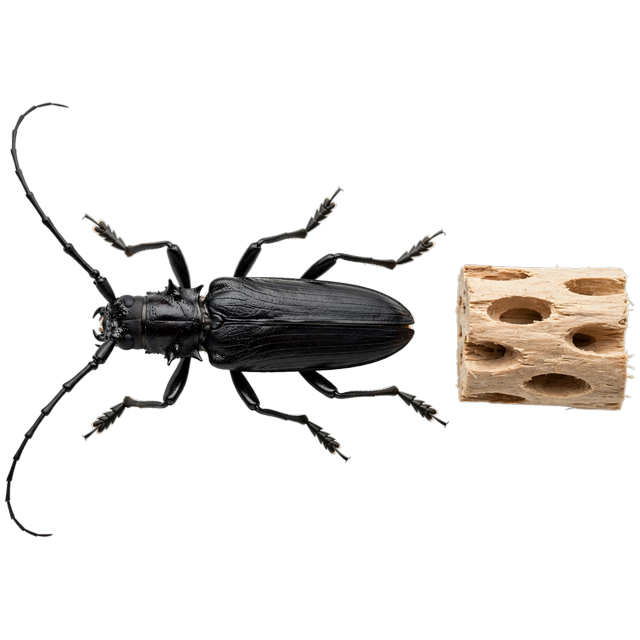
 Old house borer
Hylotrupes bajulus (Linnaeus, 1758)
Old house borer
A longhorn beetle whose larvae can chew inside your roof beams for a decade, then emerge leaving oval holes the size of a fingertip.
- Order
- Coleoptera
- Family
- Cerambycidae
- Group
- Fabric & structural beetles
- Ontario status
- Established, in Ontario pine/spruce structural lumber, especially older homes and cottages; reinfests seasoned softwood
Why it matters
The most structurally significant wood-boring beetle in Ontario, it attacks the actual framing, not just flooring, and reinfests seasoned wood that other borers abandon.
Origin
Europe originally; spread worldwide in pine lumber, bajulus means 'carrier,' for the way it travels in timber.
Behavior
Larvae tunnel for years, 2 to 10, silently. Adults emerge in summer through oval holes, mate, and lay eggs back into the same timbers. You may hear faint chewing or ticking in quiet attics.
Living conditions
Seasoned softwood: pine, spruce, fir framing, roof timbers, and joists. Uniquely among wood borers, it reinfests the same seasoned wood generation after generation.
Signs of presence
- Oval emergence holes 6-10 mm in softwood beams or joists
- Tightly packed, fibrous frass in galleries (not loose powder)
- Faint rasping or ticking sounds in timbers on quiet summer nights
- Large black beetles (10-20 mm) with long antennae indoors in summer
Weaknesses
- Only attacks softwoods (pine, spruce, fir), hardwoods are safe
- The multi-year larval stage gives a long detection window
- Emergence holes are large and obvious once adults exit
Myths and facts
Myth It only attacks old houses, hence the name.
Reality The name refers to seasoned (old, dried) wood, not old buildings, it infests new pine lumber too, and the damage shows years later.
Research notes
Morphology
Adult 10-20 mm, flattened, black to dark brown, with long antennae (shorter than body in females, longer in males). Two shiny raised spots on the pronotum. Larva white, up to ~30 mm, with enlarged thoracic segments. Exit holes oval, 6-10 mm. Frass tightly packed, fibrous, with a rippled gallery surface.
Diagnostics
Oval 6-10 mm holes + packed fibrous frass + softwood = old house borer. The combination of reinfestation habit and softwood host is diagnostic.
Easily confused with
- Powderpost beetle, Lyctus spp. Powderpost: 1-2 mm round holes, flour-fine frass, hardwood only. Old house borer: 6-10 mm oval holes, packed frass, softwood only.
Life cycle
- Adult
- Emerge in summer; live 2-3 weeks; mate and oviposit on the same timbers
- Egg
- Laid in cracks of softwood; hatch in ~2 weeks
- Egg to adult
- Typically 3-5 years; up to 10 in poor wood
- Generations per year
- Far less than one, overlapping cohorts in the same timber
- Nymph or larva
- Larvae tunnel 2-10 years, among the longest larval stages of any structural pest
Development
Complete metamorphosis; exceptionally prolonged larval stage.
Reproduction
Females lay ~200 eggs in wood cracks; reinfestation of the same member compounds damage across generations.
Distribution
- Global
- Cosmopolitan in softwood lumber trade
- Native range
- Europe
- Ontario
- Established; structural pine/spruce, especially cottages and older homes
Ecology
The only major cerambycid that reinfests seasoned structural softwood, most longhorns need dying trees. Larval development rate tracks wood protein and moisture.
Resistance
Unknown, no documented resistance.
IPM implications
Inspection must be structural: probe and listen, the damage is inside load-bearing members. Because generations overlap in the same timber, a single treatment year rarely ends it; management is measured in years, and severely damaged members are replaced. Prevention is in the lumber yard: kiln-dried, inspected stock.
Chemical ecology
Male-produced aggregation pheromones documented in cerambycids generally; host monoterpenes guide oviposition.
Genetics and DNA
No reference genome published as of 2026.
Taxonomy
Order Coleoptera, family Cerambycidae (longhorn beetles). Monotypic genus Hylotrupes; bajulus = 'porter/carrier.'
Open questions
What triggers the extreme plasticity of larval duration (2 vs. 10 years); acoustic detection thresholds for early infestation.
References
- Ebeling, W. (1978). Urban Entomology. University of California, Riverside.
- Hickin, N.E. (1963). The Insect Factor in Wood Decay. Hutchinson.